The global luxury furniture market is approaching a critical horizon. As we move toward 2026, the demand for "Dark Wabi Sabi" aesthetics and the material renaissance of dark tropical hardwoods is skyrocketing, specifically for Mahogany. However, this aesthetic resurgence is colliding with a rigid new reality: the "Green Wall" of global regulation. For B2B buyers and importers, the days of sourcing timber based solely on price and design are over. A new era of "provenance" has arrived, where the story of where a chair comes from is just as important as how it looks.
Key Takeaways
- The Deadline: The EU Deforestation Regulation (EUDR) mandates that all timber entering the EU must be "deforestation-free" and geolocated by late 2025/2026.
- The Solution: Indonesia’s SVLK system is being upgraded to include geolocation and sustainability data, offering a streamlined "Green Lane" for compliance.
- The Asset: SVLK-certified Mahogany is becoming an "investment-grade" material, protecting buyers from legal risks and supply chain disruptions.
- The Opportunity: Designers and retailers can use this compliance to tell a premium story of provenance, justifying higher price points for ethical luxury.
What is the EUDR? Definition and Requirements
The European Union Deforestation Regulation (EUDR) is a mandatory legislative framework that prohibits the placement of products on the EU market unless they are verifiable as "deforestation-free," legal, and traceable. Scheduled for full implementation in late 2025/2026, it represents the most significant regulatory shift in the timber industry in decades.
Crucially, this regulation demands three things:
- Deforestation-Free: The wood must not come from land deforested after December 31, 2020.
- Legality: The wood must be harvested in accordance with the relevant legislation of the country of production.
- Geolocation: Operators must provide precise geolocation coordinates (latitude/longitude) for the specific plot of land where the timber was harvested.
Table: From EUTR to EUDR – The Compliance Shift
| Feature | EUTR (Old Standard) | EUDR (New Standard) | SVLK (Indonesia's Solution) |
| Primary Focus | Legality (Did you have a permit?) | Sustainability (Is the forest still standing?) | Legality + Sustainability |
| Deforestation Rule | Allowed if legal locally. | Strictly Prohibited (post-2020). | Prohibited (New SVLK adds deforestation-free criteria). |
| Traceability | The country/Region level is often sufficient. | Plot-Level Geolocation (GPS coordinates required). | SIPUHH System Integration (captures GPS data). |
| Scope | Timber only. | Timber, Rubber, Cattle, Cocoa, Coffee, Soy, Palm Oil. | Covers all timber & wood products. |
| Due Diligence | "Green Lane" for FLEGT licenses. | No automatic "Green Lane" yet (Simplified Due Diligence negotiated). | Negotiating "Low Risk" status for SVLK. |
EUTR vs. EUDR: Understanding the Change
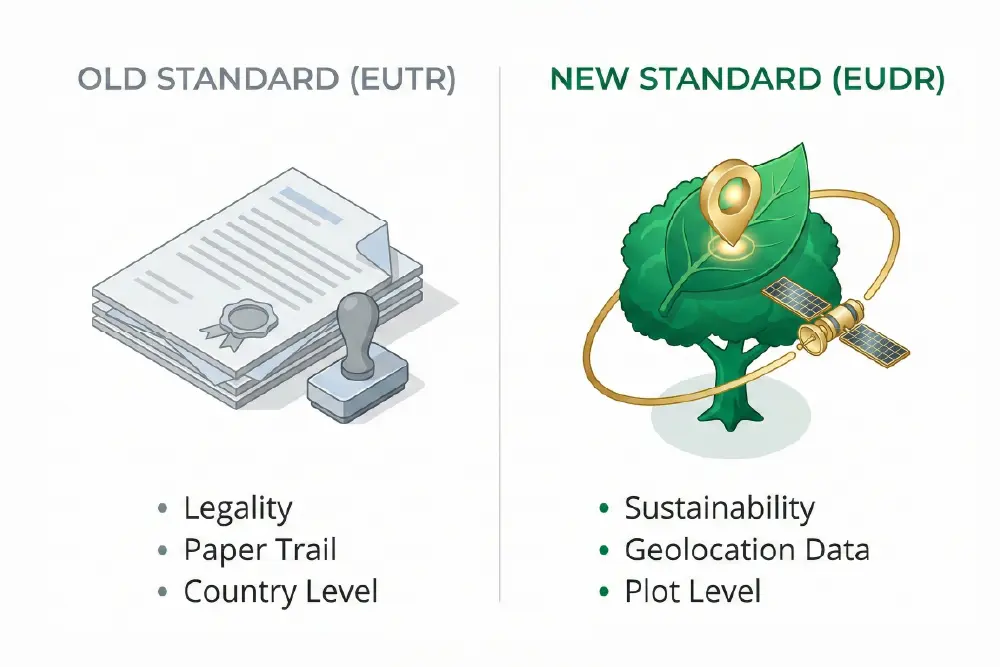
Before the EUDR, the standard was the EUTR (European Union Timber Regulation). Implemented in 2013, the EUTR focused primarily on legality. Its main goal was to stop illegal logging, harvesting timber against the laws of the country of origin. If you had a license proving you had a permit to cut, you were generally safe. It did not, however, explicitly ban deforestation if that deforestation was technically "legal" under local laws.
Why the Shift? Closing the Deforestation Loophole
The EU recognized a critical loophole in the EUTR: it was possible to legally deforest land. You could obtain a permit to clear a rainforest for a plantation, making the timber "legal" but environmentally destructive.
The EUDR was introduced to close this gap. It is a direct response to the climate crisis and biodiversity loss, shifting the standard from "Legal Timber" to "Sustainable Timber." It forces the industry to prove not just that they could cut the tree, but that the cutting didn't permanently damage the forest ecosystem.
Compliance Pain Points for Mahogany Importers
For importers of tropical hardwoods like Mahogany, the EUDR has created immediate friction:
- Administrative Burden: Collecting GPS coordinates for thousands of individual logs is a logistical nightmare for unorganized supply chains.
- Cost Spikes: The cost of verification is driving up prices, creating a bifurcation in the market between "compliant" and "non-compliant" wood.
- Supply Chain Risk: Many suppliers in Southeast Asia and South America lack the technology to provide this data, leaving importers at risk of having shipments seized at EU borders.
Why Indonesia’s SVLK is the Answer
In this chaotic landscape, Indonesia offers a solution that few other nations possess. Indonesia’s national timber system, SVLK, acts as a government-backed infrastructure that absorbs much of this compliance burden. Instead of an importer having to map every tree themselves, they can rely on an Indonesian furniture supplier backed by a national system that is already integrating these requirements.
If you are ready to secure your supply chain, we have outlined the specific steps in our article on Navigating SVLK Certification for Furniture Imports.
What is SVLK? Legality and Sustainability
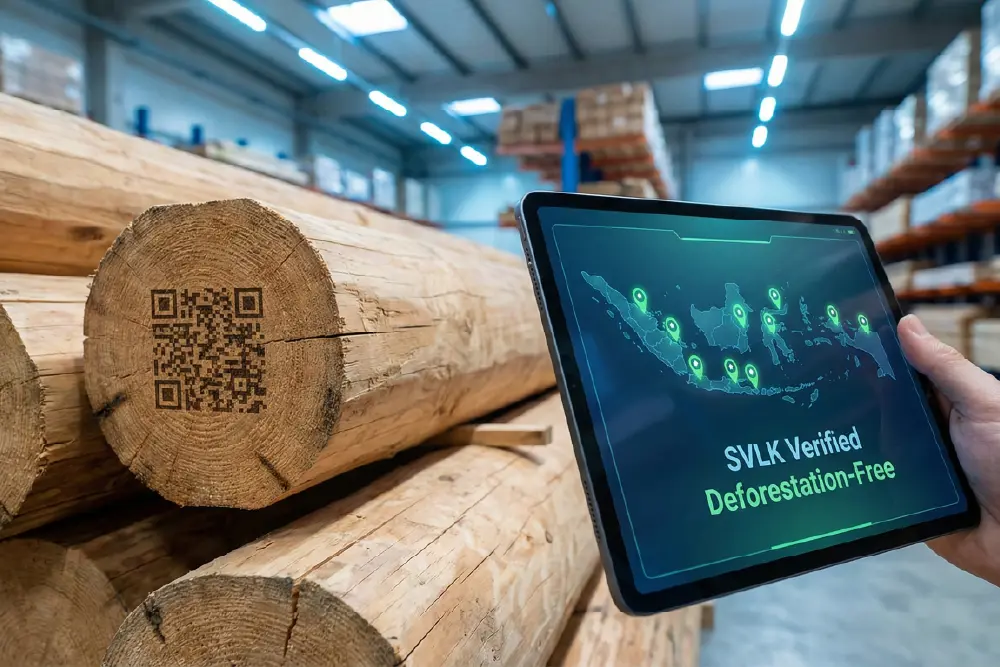
SVLK (Sistem Verifikasi Legalitas dan Kelestarian) is Indonesia’s mandatory, state-run certification system that verifies the legality and sustainability of timber products throughout the entire supply chain. Originally standing for Sistem Verifikasi Legalitas Kayu (Timber Legality Verification System), it was Indonesia's answer to illegal logging.
Recently, anticipating global shifts, the Indonesian government effectively rebranded it to include Kelestarian (Sustainability). It is a mandatory, multi-stakeholder scheme that audits every step of the supply chain to ensure timber is both legal and sustainably managed.
Facilitating Compliance: The “Green Lane” Advantage
While the EUDR technically applies to everyone, SVLK offers a unique advantage. Indonesia is the only country in the world that achieved FLEGT (Forest Law Enforcement, Governance and Trade) licensing status with the EU. Under the old rules, FLEGT-licensed timber was automatically accepted.
Currently, Indonesia is negotiating for SVLK to act as a "Green Lane" under the new EUDR. Because the new SVLK standards align so closely with EUDR requirements, buyers of SVLK-certified wood are positioned to face significantly simplified due diligence. While other countries are scrambling to build systems from scratch, Indonesia’s SVLK provides a mature, trusted framework that regulators already recognize.
For a more technical breakdown of how these licenses function for international shipments, explore our resource on Legal Wood and FLEGT Timber from Indonesia.
SVLK’s Evolution Toward EUDR Approval
Indonesia hasn't stood still. To ensure SVLK meets the specific demands of the EUDR, the Ministry of Environment and Forestry has rolled out critical upgrades:
- Geolocation Integration: National timber tracking systems (like SIPUHH) are being updated to include geolocation coordinates for harvest plots, directly satisfying the EUDR’s toughest requirement.
- Sustainability Criteria: New audit standards explicitly check for "deforestation-free" status post-2020.
- Traceability: Enhanced digital tracking ensures that high-value woods like Mahogany can be traced back to their point of origin.
The Opportunity: Strategic Advantages for Designers & Retailers
The arrival of the EUDR and the evolution of SVLK create a unique "first-mover" advantage for different players in the B2B ecosystem. It transforms compliance from a headache into a powerful marketing and operational tool.
1. For Interior Designers: The Renaissance of Dark Woods
The "Dark Wabi Sabi" trend requires moody, authentic materials like Mahogany and Walnut. However, for years, designers have hesitated to specify tropical hardwoods due to fears of "cancellation" or environmental guilt.
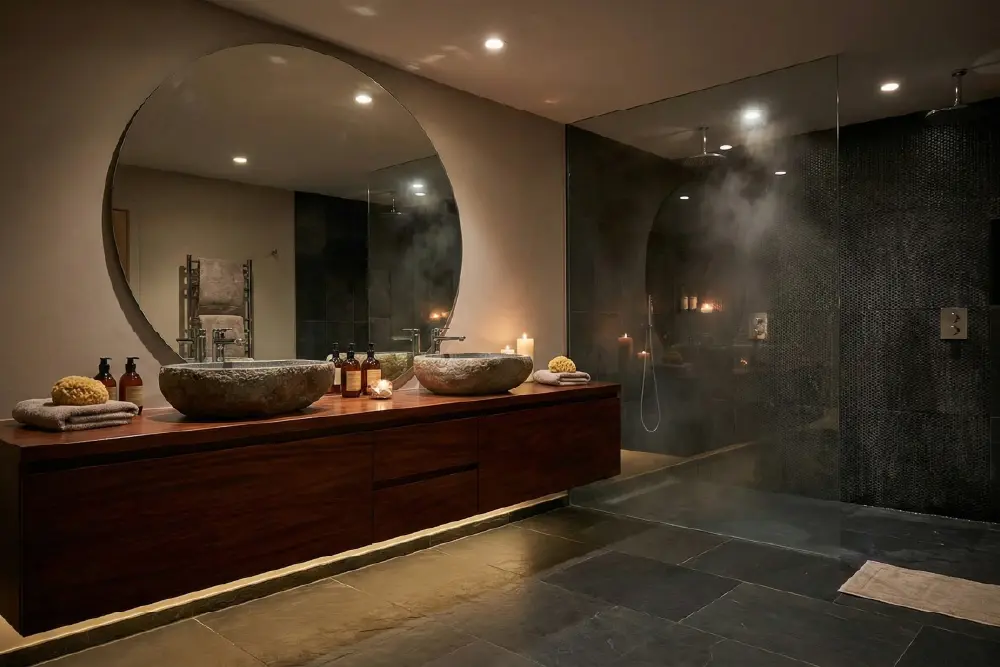
- Design Freedom: SVLK-verified Mahogany allows designers to return to these rich, historical materials with a clean conscience. You can specify the deep, luxurious textures of Swietenia macrophylla—perfect for creating the 'Shadowed Sanctuaries' and grounded, monastic interiors that define the 2026 hospitality landscape—knowing the supply chain is ethically bulletproof.
- Project Security: Specifying non-compliant wood risks project delays if materials are seized at customs. SVLK acts as an insurance policy for your mood boards, ensuring that what you specify actually arrives on site.
To see practical examples of how to apply this timeless material in modern luxury spaces, read our in-depth guide on Mastering Mahogany in Interior Design.
2. For High-End Retailers: Selling “Investment Grade” Furniture
In the luxury market, provenance is power. Just as consumers demand to know the origin of a diamond or a bottle of wine, high-net-worth individuals are increasingly asking about the origin of their furniture.
- The Digital Product Passport (DPP): Retailers can use SVLK data to create "Digital Passports" for their furniture. Imagine a showroom where a client scans a QR code on a mahogany dining table and sees a map of the sustainable Indonesian forest where the wood grew. This elevates the product from a commodity to a curated experience.
- Justifying the Premium: Compliance costs money, but it also creates scarcity. Retailers can frame EUDR-compliant stock as a limited "Tier 1" asset, justifying higher price points compared to risky, unverified alternatives.
3. For Hotel Developers & Procurement Officers: Risk-Free Assets
For large-scale hospitality projects, risk mitigation is everything.
- The "Green Lane" for Logistics: With strict opening deadlines, no hotel developer can afford to have containers stuck in Rotterdam or Hamburg due to failed due diligence. Sourcing SVLK-certified goods smooths the import process, protecting the project timeline. Furthermore, working with manufacturers who maintain 100% in-house production (like MPP Furniture) eliminates the "data gaps" common in fragmented supply chains, ensuring every coordinate is accurate and audit-ready.
- Automated ESG Compliance: Most major hotel groups now have rigid Environmental, Social, and Governance (ESG) targets. Purchasing SVLK-verified furniture provides audit-ready data that automatically satisfies these corporate sustainability goals without extra paperwork.
Conclusion
The EUDR is not a blockade; it is a filter. It filters out the opaque, the illegal, and the unsustainable. For the luxury furniture industry, Indonesia’s SVLK system serves as the ultimate pass-key. By bridging the gap between strict European regulations and the rich, tropical allure of Mahogany, SVLK allows businesses to turn compliance into a competitive advantage. In the 2026 horizon, the most luxurious furniture will not just be beautiful, it will be traceable.
Let’s Build the Future Together
The shift toward 2026 brings new challenges, but also exciting opportunities to create something truly lasting. At MPP Furniture, we believe that the best way to face these changes is by growing together.
For over 20 years, we have focused on being more than just a typical Indonesian furniture manufacturer. We strive to be a supportive partner, ensuring that every piece of furniture is crafted with care and integrity right here in our own factory. Our commitment to SVLK compliance isn't just about meeting regulations; it is about giving you the peace of mind to focus on what you do best: designing and curating beautiful spaces.
We are always here to help navigate these new standards with you. Whether you have questions about sourcing or simply want to discuss your next project, we invite you to start a conversation with us.
Planning your next best-selling collection?
Request catalog, pricing info, MOQ, and custom options today — we’ll respond quickly.
Frequently Asked Questions (FAQ)
1. Is Indonesia's SVLK recognized by the EUDR?
The EUDR does not yet automatically recognize foreign certifications as full substitutes for due diligence. SVLK remains the most advanced national system for compliance. Negotiations currently aim for SVLK-certified timber to reach "Low Risk" classification, which simplifies the due diligence process for importers.
2. Does SVLK require geolocation coordinates?
Yes. Updated standards integrate with Indonesia’s SIPUHH system to capture precise geolocation coordinates of harvest plots. This update satisfies the specific EUDR requirement for plot-level traceability.
3. Can I still import Mahogany into the EU after 2025?
Yes, provided the wood remains compliant. Importers must prove the Mahogany (Swietenia macrophylla) is legal and deforestation-free. sourcing SVLK-certified wood from Indonesia provides a verified data trail for EU customs.

Versatile Digital Marketing & Creative Specialist with a strong foundation in graphic design, product photography, and comprehensive brand strategy. Proven ability to bridge the gap between physical products and digital presence, translating complex concepts into high-converting marketing assets. Adept at leveraging SEO, web analytics, and engaging visual content to drive business growth and elevate brand identity in competitive markets.
0 Comments