When you visit the Indonesian furniture manufacturers, the first thing most buyers look at is product samples. But what actually determines whether an Indonesian furniture factory can deliver export-quality furniture consistently isn’t just the craftsmanship; it’s the machinery behind the production.
Whether you’re sourcing teak furniture from Indonesia, building furniture collections from Indonesian mahogany wood, exploring sungkai wood furniture collections, or working with mindi wood furniture, understanding the machinery behind production helps you evaluate a manufacturer’s true capability.
This guide walks you through the mandatory machinery every buyer should inspect during a factory visit. The right machines directly influence lead time, product accuracy, defect rates, and your long-term margins.
Why Machinery Matters More Than You Think
Real-World Insight: What Actually Happens When Machinery Is Missing
From firsthand experience working with furniture production, the absence of machinery doesn’t just slow down operations; it creates a chain reaction that affects everything from lead time to structural integrity.
In many cases, long lead times happen not because a factory is busy, but because it lacks the essential machines needed to process wood efficiently. Without proper machinery, artisans spend extra time correcting uneven surfaces, adjusting misaligned joinery, or fixing components that should have been precise from the beginning.
Even worse, factories without a kiln-dry chamber often produce items with unstable moisture content. Wood is a living material; when it isn’t dried to safe levels, it tends to crack, warp, or cause glue joints to fail. This is one of the most common reasons for structural issues in exported wooden furniture.
A recent example illustrates this clearly: a buyer visited after facing repeated product failures from their previous Indonesian furniture supplier. The issue turned out to be simple; their former supplier was actually a small workshop with no machinery and no kiln-dry capability. Because of this, cracking and construction failures became unavoidable.
Machinery is not about replacing craftsmanship; it’s about giving artisans the precision foundation they need to work efficiently. When machines handle accuracy, artisans can focus on the final refinement, meaning assembly requires only minor adjustments.
Worth reading: Why in-house Indonesian furniture manufacturers give you advantages
How Machinery Affects Your Actual Business Outcomes
Many buyers underestimate how machinery impacts their daily operations. A factory may handcraft beautiful samples, but without proper machines, scaling production leads to inconsistent dimensions, unstable joinery, and delays.
Here’s how machinery shapes your business results:
- Lead time stability: Factories with complete machinery avoid production bottlenecks.
- Dimensional accuracy: CNC routers, jointers, and planers ensure every piece matches your specifications.
- Lower defect rates: Proper sanding, kiln-dry chamber, and accurate cutting prevent cracking, wobbling, and finishing issues.
- Repeatability: When reordering the same SKU, machinery ensures your pieces remain consistent across batches.
We have explained this in detail in our guide on key technical factors when sourcing Indonesian furniture manufacturers.
The Real Difference Between Workshops and Professional Export Manufacturers
Indonesia has thousands of small workshops that rely mainly on hand tools. They can produce samples, but often struggle with:
- Uneven surfaces and misaligned joinery
- High moisture content in wood, leading to cracks or mold
- Longer production timelines
- Poor finishing consistency
Export-ready Indonesian furniture manufacturers, on the other hand, balance handcrafted skill with modern machinery. This combination is essential for producing stable teak furniture, smooth sungkai wood finishes, and structurally reliable mahogany wood pieces.
Mandatory Machinery Checklist for Indonesian Furniture Manufacturers
Below is the essential machinery that buyers must inspect during a factory visit, along with the reasons why it matters. The following explanations now incorporate practical insights from real-world production experiences, including common issues that arise when machinery is incomplete.
1. Kiln Dry Chamber
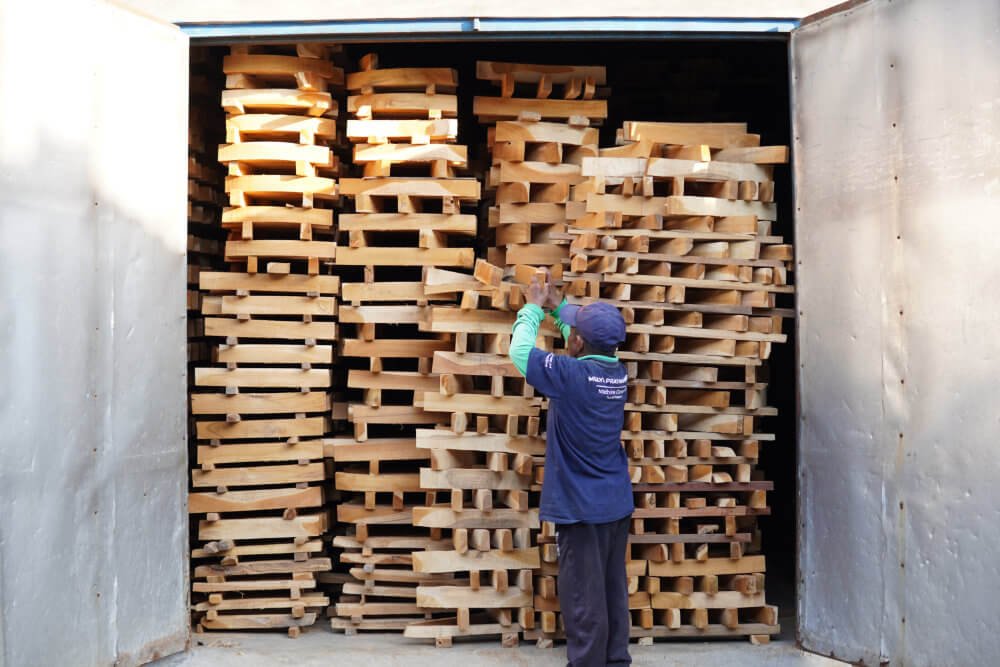
Controlling wood moisture content is the foundation of stable furniture.
- Target MC for export: 8 to 12%
- Why it matters: Wood that is not dried correctly will crack, warp, or grow mold during shipment. When moisture is unstable, glue joints often fail because the wood continues to expand or contract after assembly.
From real production experience, wood is a living material. If it is not dried to a safe level, it will "move" again and cause cracking. This is one of the most common reasons for construction failure in both teak furniture and Indonesian mahogany wood products.
Factories that skip proper kiln-drying procedures often have inconsistency from one batch to the next, because moisture levels differ per shipment. This directly affects sizing, joinery stability, and finishing absorption.
Red flags:
- No Kiln Dry machine on-site
- Factory outsources drying without documented MC checks
2. CNC or NC Router
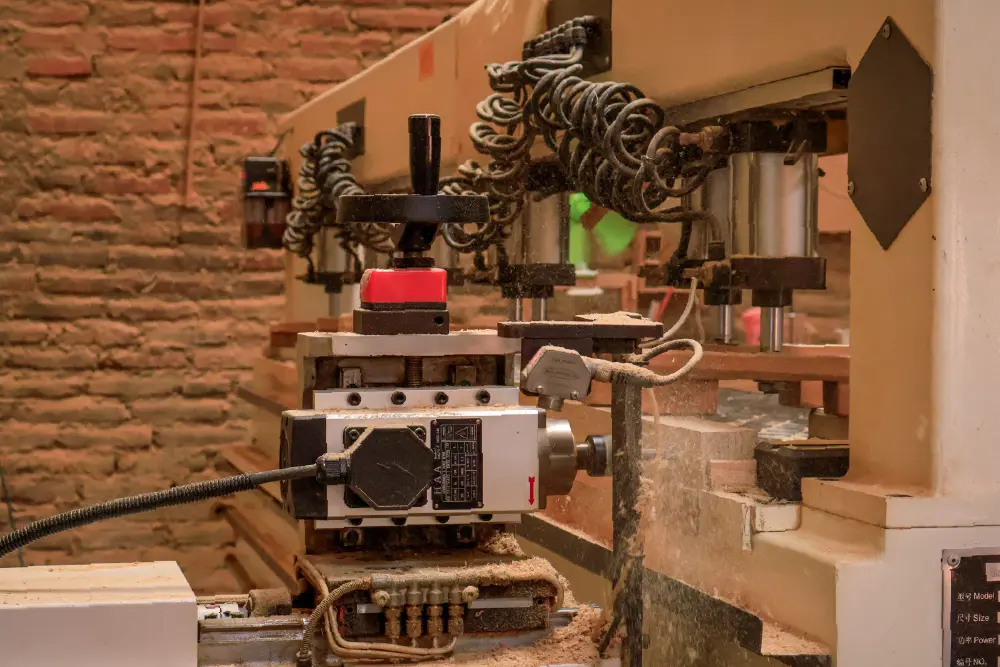
This machine ensures precision for complex cuts, curves, and repeated components.
- Essential for OEM projects and custom shapes
- Ensures uniform mortise positions, backrest curvature, and panel shapes
From practical operations, NC routers help speed up production significantly. Because the cuts are precise, artisans only need minor adjustments during assembly. This shortens lead time and reduces the risk of misalignment, especially during large batch production.
In factories without CNC, dimensional differences between batches are common. A buyer may receive a perfect first sample but find variations in the next shipment because manual cutting relies heavily on operator skill.
Why buyers should care: Your SKU accuracy depends on the stability and calibration of this machine.
3. Panel Saw
Panel saws produce straight, clean cuts for table tops, shelves, doors, and cabinet components.
- Reduces manual cutting errors
- Provides smooth edges that make assembly faster and more accurate
Without this machine, factories often rely on handheld saws that lead to small deviations in size. These small deviations accumulate during assembly and cause gapping, uneven joints, or misalignment between panels.
Red flags: Factories that rely only on handheld circular saws often struggle with consistent sizing, especially across large batches.
4. Spindle Machine
The spindle machine is used to shape legs and rounded parts.
- Important for sungkai wood furniture and mindi wood furniture, especially for Scandinavian-style profiles
- Ensures uniformity across all batches
Factories without a spindle machine depend heavily on manual shaping, which makes it difficult to achieve consistent size and curvature across 100 to 1000 units.
What good looks like: Spindle machines with multiple heads, allowing uniform production without depending heavily on manual shaping.
5. Tenon and Mortise Machine
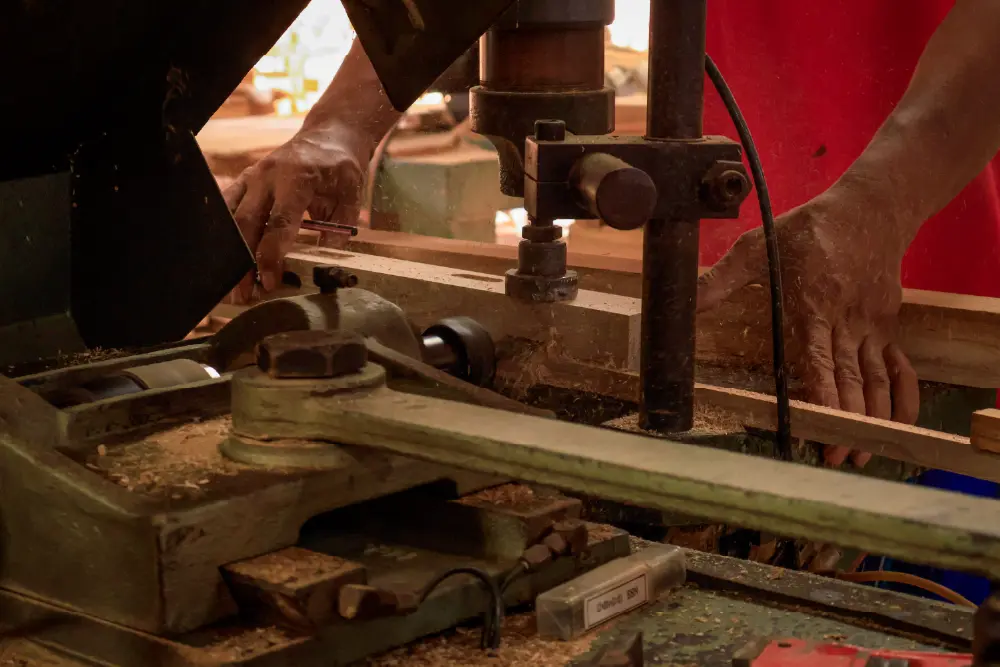
Strong joinery depends on accurate and repeatable cuts.
- Produces reliable joints for chairs, stools, and tables
- Reduces wobbling, misalignment, and structural failures
In production environments that lack this machine, joinery often varies from piece to piece. This leads to chairs that wobble, joints that loosen over time, or structural weak points that fail during use.
Impact on business: Better joints mean fewer replacements, stronger customer satisfaction, and fewer warranty claims.
6. Planer and Jointer
Planers and jointers ensure correct thickness, flatness, and alignment.
- Essential for all woods, including teak, sungkai, mahogany, and mindi wood
- Creates uniform surfaces for tabletops, panels, and structural components
Factories relying heavily on manual sanding to correct thickness inconsistencies usually have variations across batches. Even a difference of 1 to 2 millimeters can affect assembly and cause fitting issues.
Red flags: Factories relying solely on manual sanding to correct thickness inconsistencies typically struggle with accuracy.
7. Wide Belt Sander
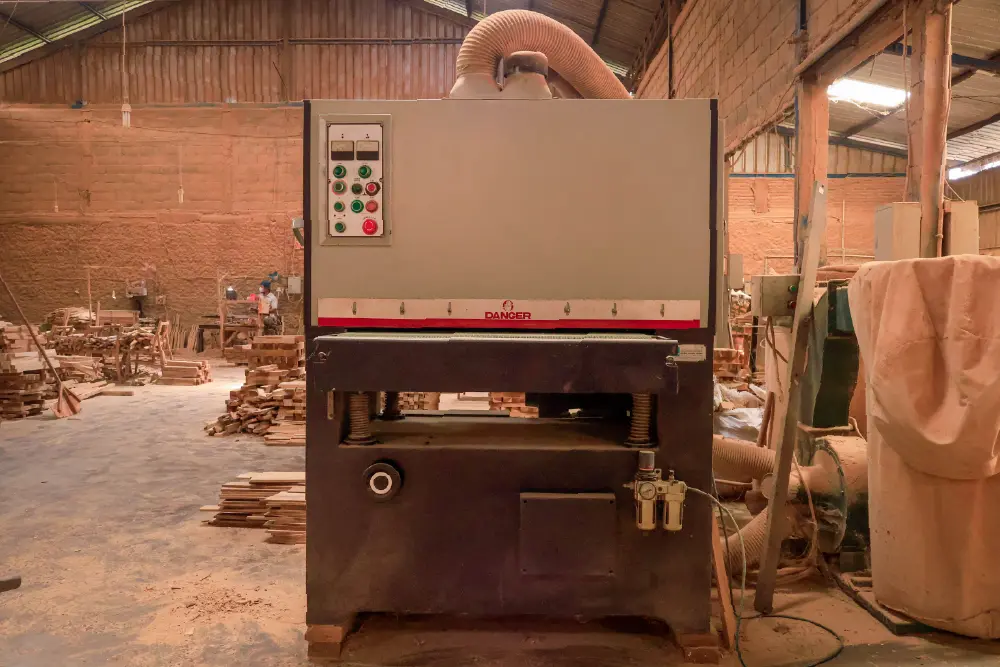
One of the most overlooked machines by buyers.
- Creates industrial-level smoothness
- Eliminates swirl marks, waves, and uneven sanding
In practical operations, MPP uses a wide belt sander for top tables to increase efficiency, while chairs still require manual sanding for fine detailing. This combination allows the factory to move faster without sacrificing craftsmanship.
Factories without a wide belt sander typically take longer to reach smooth surfaces, and the final result often shows inconsistent texture, especially when producing light colored woods like sungkai.
Why it matters: Consistent surface quality leads to better finishing results, reduced rework, and improved overall product appearance.
8. Finishing and Spray Booth Equipment
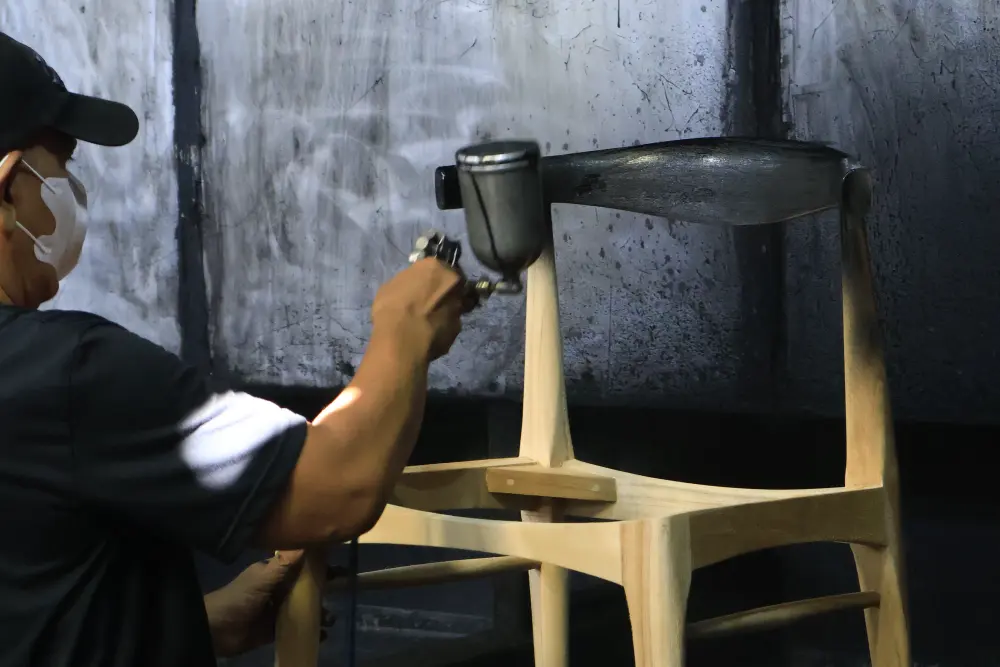
Finishing determines the final look and feel of your collection.
- A dust-free booth ensures clean and even coatings
- Proper airflow prevents paint contamination and surface defects
Factories that finish in open-air spaces struggle to control dust, humidity, and airflow. This results in uneven color, rough texture, or small particles trapped in the coating.
Red flags: Finishing performed in open-air spaces, which increases dust contamination and finishing inconsistency.
Why Handcrafted Skill Alone Isn’t Enough
Indonesia is known for talented craftsmen, but relying solely on hand tools limits scalability and accuracy.
What Handcrafting Does Well
- Detail work
- Rattan weaving
- Artistic shaping
What Machinery Ensures
- Consistency across 100–1,000 units
- Accurate dimensions for container loading
- Repeatable quality for long-term collections
A world-class Indonesian furniture supplier must combine both.
At MPP Furniture, artisans shape details by hand while precision machines ensure structural accuracy. This balance allows us to export consistently across the US, Spain, Australia, New Zealand, South Africa, UAE, Saudi Arabia, Chile, Argentina, and Canada.
What Good Looks Like: Factory Visit Checklist
Use this checklist during your next factory visit.
Production Floor Indicators
- KilnD machine operating with documented moisture reports
- CNC router and spindle machines with active production
- Clean panel saw output with no burn marks
- Belt sander achieves smooth, even surfaces
Quality Control Indicators
- Multiple QC stages: material, assembly, finishing
- Moisture content checks per batch
- Proper warehouse storage and ventilation
Green Flags
- Full in-house production
- Organized workflow and safety practices
- Clear production documentation
Red Flags
- Overreliance on hand tools
- No KD chamber
- Outsourced components without QC oversight
- Dusty or poorly lit finishing area
For a full, comprehensive understanding, read this checklist when visiting Indonesian furniture suppliers
Why Choose MPP Furniture
Without making this article overly promotional, here’s how MPP aligns with the machinery and standards you’ve just learned.
Expertly Handcrafted
Our team uses traditional craftsmanship supported by modern machinery. Each piece of Indonesian teak furniture, sungkai wood furniture, mindi wood, or mahogany furniture is shaped with care and engineered for consistency.
Attention to Detail
From thickness accuracy to finishing clarity, every step follows precise standards supported by reliable equipment.
Reliable Manufacturer
MPP operates with full in-house production, free custom development, flexible MOQ, and 99% client satisfaction. Our complaint ratio sits at only 0.56%, reflecting our commitment to consistency.
For buyers seeking a long-term Indonesian furniture supplier, machinery is not a bonus; it’s the foundation of reliability.
Two decades of manufacturing expertise in wood and natural materials for global B2B projects.
Long-term relationships with retailers and importers who rely on consistent quality and service.
Extremely low complaint and defect rate, supported by strict in-house quality control at every stage.
Predictable lead times, stable production, and consistent specifications across repeat orders.
Conclusion
Understanding the machinery inside an Indonesian furniture manufacturer helps you make informed decisions, avoid costly delays, and choose suppliers capable of supporting your brand long-term. When combined with handcrafted skill and strict QC, the right machines ensure dependable lead times, precise production, and stable product quality.
If you’re evaluating suppliers or planning a factory visit, use this guide as your reference. And if you want to see how a fully equipped Indonesian manufacturer operates, MPP Furniture welcomes virtual or on-site visits.
Your next best-seller might be here
Request a quotation and custom options tailored to your needs today via WhatsApp or email.
FAQs
1. Why is kiln drying important when sourcing Indonesian furniture?
Kiln drying prevents cracking; warping; and mold during shipment by reducing moisture content to export-safe levels (8-12%).
2. What machinery separates workshops from real manufacturers?
CNC routers; KD chambers; panel saws; wide belt sanders; and finishing booths indicate scalable; export-ready production.
3. Can handcrafted factories produce export-quality furniture?
They can produce samples; but without proper machinery; they often struggle with dimensional accuracy and lead time.
4. What wood types benefit most from proper machinery?
Teak; sungkai; mindi; and Indonesian mahogany wood all require accurate machining and controlled drying for stable products.
5. How does machinery affect long-term supplier reliability?
Complete machinery reduces defects; speeds up production; ensures repeatable quality; and lowers operational risks for buyers.

Hi, I’m Salman, founder of MPP Furniture, an Indonesian furniture manufacturer serving global retailers and project-based clients.
I began my career in my family’s export-oriented furniture company, gaining hands-on experience in production, construction, finishing, material performance, and product development. With a clear understanding of how international buyers evaluate furniture quality and reliability, I founded MPP Furniture to deliver export-ready products with consistent standards.
Here, I share insights from the perspective of a furniture manufacturer working directly with production teams on the factory floor, focusing on manufacturing and supplier evaluation.
Connect on LinkedIn
0 Comments