We have all seen the shift. Walk into any high-end hotel lobby in Dubai or a trendy restaurant in New York, and you will notice the hard edges are gone. They have been replaced by fluid shapes, rounded sofas, and sweeping wooden arches.
This "Neotenic" design style is dominating the hospitality and commercial sectors. For retailers and interior designers, this trend represents a massive opportunity to sell pieces that feel modern and welcoming. But for a procurement buyer or business owner, curved furniture represents a risk.
Unlike straight-line furniture, which relies on standard joinery, curved pieces fight against the wood's natural grain. If not engineered correctly, a beautiful bentwood chair will warp, crack, or lose its shape within months.
As an Indonesian furniture manufacturer specializing in curved furniture manufacturing, we don't just look at the aesthetics of a curve; we look at the physics holding it together. This guide takes you behind the scenes of the manufacturing floor to understand how we turn rigid timber into fluid, durable art.
The Shift to Neotenic Design: Why the World Wants Curves
Before we talk about how we build them, it is important to understand why your clients are asking for them. The demand for soft contract furniture isn't just a passing fad; it is a response to how people use spaces today. As highlighted in WATG's Hospitality Interior Design Trends 2024, the industry is moving toward organic forms that offer comfort and visual softness.
Flow and Efficiency in Floor Plans
Architects love curved furniture because it breaks the rigid grid of a room. In a crowded hotel lounge, a kidney-shaped sofa allows for better traffic flow than a boxy sectional. It softens the room and guides guests naturally through the space.
The Perception of High Value
There is a subconscious understanding among buyers that curves are hard to make. A boxy table can be cut and screwed together quickly. A curved table requiring steam bending or bent lamination implies craftsmanship. It signals luxury.
Moreover, studies in emotional architecture suggest that humans biologically perceive curved lines as safer and more relaxing than sharp angles. Offering these complex shapes elevates your brand’s perception from a commodity seller to a purveyor of high-design goods, making the investment in high-quality curved furniture manufacturing essential for modern projects.
Curved Furniture Manufacturing Process: 3 Ways to Bend Wood
In curved furniture manufacturing, creating a curve requires force, heat, and precision. We use three primary methods, depending on the design's radius and the required structural integrity.
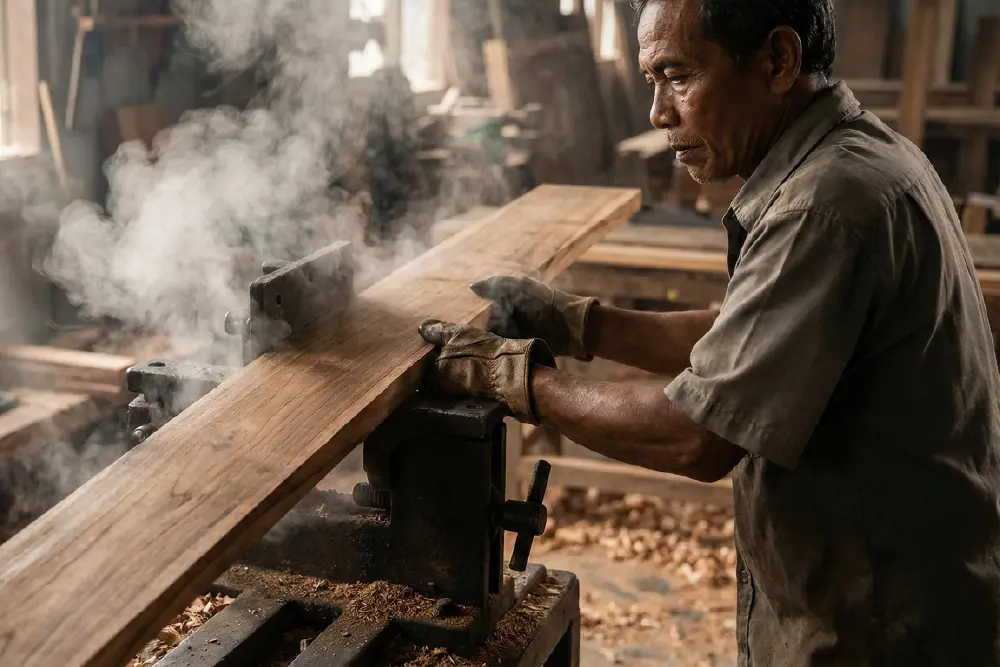
1. Solid Wood Bending (Steam & Heat)
This is the most traditional method and arguably the most respectful of the material. It fits perfectly with our philosophy of excellence in curved furniture manufacturing.
- The Process: We place air-dried solid wood into a steam chamber. The steam softens the lignin (the natural glue) in the wood fibers, a critical step in the science of steam bending. Once pliable, the wood is clamped rapidly into a metal or wooden form.
- The Result: A continuous grain structure that flows around the curve. This creates an incredibly strong piece because we haven't cut through the grain fibers; we have simply redirected them.
- Best For: Chair backs, legs, and structural components where visible grain is essential.
Learn more about why Sungkai wood is the designer's perfect choice for steam-bent furniture.
2. Bent Lamination (Veneers & Molds)
When a design calls for a dramatic sweep or a shape that solid wood cannot achieve without breaking, we turn to bent lamination, a core technique in complex curved furniture manufacturing.
- The Process: We glue together thin layers of wood veneer. While the glue is wet, these layers are pressed into a two-part mold under immense pressure.
- The Engineering: This makes the wood extremely stable. Because the grain direction of each layer can be alternated or aligned for specific strength, laminated curves are less likely to warp than solid wood.
- Best For: Lounge chair shells, architectural panels, and complex Neotenic design elements.
3. CNC Machining & Composite Curving
Sometimes, the curve is purely decorative, or the shape is too complex for bending. This is where modern technology meets traditional skill to modernize curved furniture manufacturing.
- The Process: We use 5-axis CNC machining to cut curves directly from a solid block or a glued-up panel. For upholstered items, we might use molded plywood or FRP (Fiber-Reinforced Plastic) internal shells.
- The Precision: CNC ensures that every curve is identical to the millimeter. This Attention to Detail is critical for B2B projects where you might order 500 chairs for a hotel; they all need to look exactly the same.
Explore the advanced machinery of Indonesian furniture manufacturers that we use to ensure precision.
Engineering Structural Integrity: What Happens Inside the Wood?
Making the wood curve is the easy part. Keeping it curved and strong is where the engineering comes in. Successful curved furniture manufacturing demands that we account for the journey the furniture will take, from our tropical climate to perhaps a dry winter in Canada.
Managing Tension and Compression
When you bend a piece of wood, the outside fibers stretch (tension) and the inside fibers squash (compression). If you bend it too far, the outside snaps or the inside wrinkles.
We manage this by calculating the "minimum bend radius" for each wood species. Teak and Rattan are forgiving, while brittle woods require different treatment. We ensure the ratio of thickness to radius is safe, guaranteeing the furniture won't fail under the weight of a hotel guest.
Read more about maximizing the durability of indoor teak furniture performance.
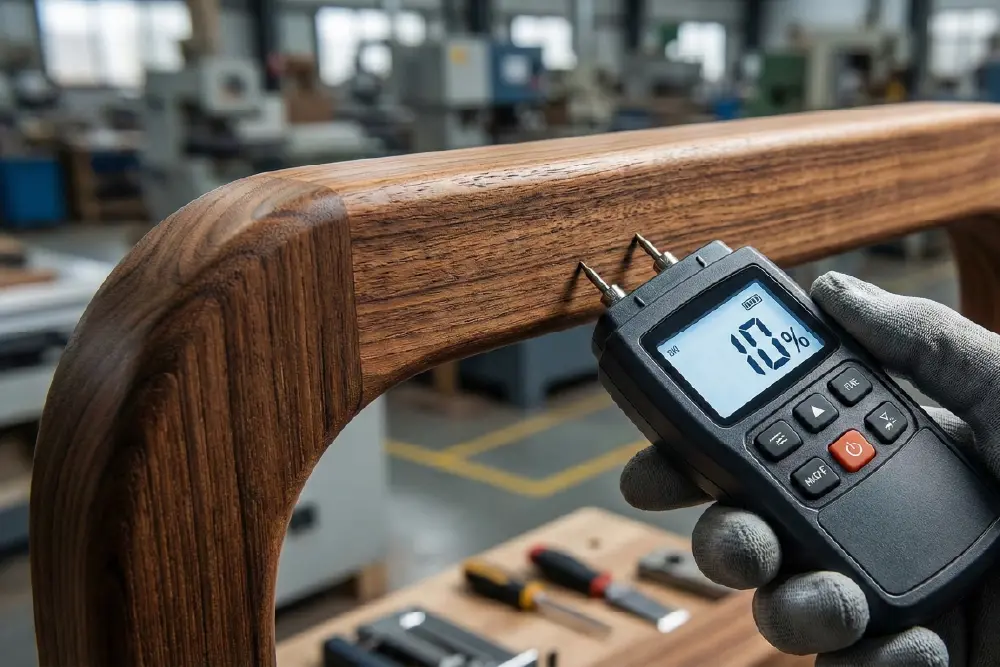
Controlling Moisture Content (MC)
This is the single most critical factor for export-quality curved furniture manufacturing.
- If the wood is too wet when bent, it will shrink and crack later.
- If it's too dry, it will snap during the bending process.
We strictly control the Moisture Content (MC) at every stage, aligning with international wood moisture content standards. This rigorous process is part of why we are a Reliable Indonesian Furniture Supplier, boasting a minimal complaint ratio of just 0.56% across global shipments.
Avoid costly mistakes by understanding common wood defects in teak furniture for export.
The Challenge: Strength vs. “Springback”
Every piece of bent wood wants to return to its original straight shape. This is called "springback," and it is a consistent challenge in curved furniture manufacturing.
If we bend a chair back to a 90-degree angle, it might spring back to 93 degrees once released from the mold. An inexperienced factory will force it back into place with screws, creating internal stress that eventually causes the joint to explode.
How we handle springback in curved furniture manufacturing:
- Over-Bending: We calculate the springback factor and over-bend the wood slightly so it relaxes into the exact correct shape.
- Proper Drying Time: We leave the wood in the molds until it is completely cool and set. We don't rush.
- Complex Joinery: We use reinforced joinery methods, such as floating tenons or dowels, designed to handle the multi-directional forces found in curved furniture.
Finishing and Upholstery: The Final Engineering Challenge
The engineering of curved furniture manufacturing doesn't stop at the wood frame. In fact, the most common quality failures in hospitality furniture design happen at the finishing stage.
Why? Standard materials are designed for flat surfaces, not organic shapes.

1. The Upholstery Conflict: The Grid vs. The Curve
Most commercial fabrics are woven in a straight grid (warp and weft). When you attempt to wrap a rigid grid over a curved surface, two things happen:
- The Inside Curve (Compression): The fabric has too much material, leading to bunching, pleating, and unsightly wrinkles.
- The Outside Curve (Tension): The fabric stretches, potentially distorting the pattern or stressing the seams until they tear.
To solve this, our upholstery division treats furniture like high-fashion tailoring.
- Bias Cutting: We cut fabric at a 45-degree angle to the grain. This allows the weave to stretch diagonally ("drape"), hugging the curve without wrinkling.
- Molded Foam: Instead of forcing flat foam to bend, we often use pre-molded high-resiliency foam that matches the frame's curvature perfectly, ensuring the fabric sits tight for years.
2. The Finishing Challenge: Sanding the Un-Sandable
Flat furniture is easy; it runs through automated wide-belt sanders. Curved furniture is not. A machine cannot feel the nuance of a steam-bent leg.
We rely on skilled manual craftsmanship for curved furniture manufacturing.
- Consistent Tactility: Our craftsmen use pneumatic drum sanders and hand blocks to ensure the curve remains smooth without flattening the shape.
- Stain Absorption: Curved wood exposes different grain orientations (end grain vs. face grain). These absorb stains differently. Our finishers adjust their application techniques to ensure the color is uniform from the top of the arch to the base.
This Attention to Detail ensures that the final product looks crisp and high-end, avoiding the "sloppy" look often found in mass-produced curved items.
Conclusion: Why Partner with a Reliable Indonesian Furniture Supplier?
In this guide, we have explored the complex journey of curved furniture manufacturing, moving far beyond simple aesthetics. We started by understanding the Neotenic design shift—a movement driving the demand for softer, safer, and more organic forms in global hospitality projects.
We then unpacked the technical realities behind these shapes. Whether it is the traditional art of steam bending to preserve grain continuity, the stability of bent lamination for complex curves, or the precision of 5-axis CNC machining, each method serves a specific structural purpose.
Most importantly, we discussed the invisible engineering that defines quality:
- Moisture Content Control: The critical defense against warping and cracking.
- Springback Management: The mathematical precision required to keep a curve true.
- Structural Integrity: Balancing tension and compression to ensure longevity.
For retailers and hospitality buyers, understanding these processes is the key to risk mitigation. Beautiful furniture is only valuable if it survives the rigors of commercial use. By partnering with an Indonesian furniture manufacturer who prioritizes engineering alongside design, you ensure that your investment is as durable as it is striking.
Ready to develop your curved furniture collection? MPP Furniture offers free product development and consultation to ensure your designs are feasible and profitable.
Your next best-seller might be here
Request a quotation and custom options tailored to your needs today via WhatsApp or email.
Frequently Asked Questions
Is steam-bent wood stronger than cut curves?
Steam bending keeps the wood's long-grain fibers intact along the entire curve. Cutting a curve from a board involves slicing across the grain, which creates inherent weak points. For high-stress areas like chair legs, steam bending represents a superior structural choice.
Why is curved furniture more expensive to manufacture?
This manufacturing process requires specialized labor and time-intensive methods like steam bending or bent lamination. Unlike flat furniture that supports mass-cutting, curves often require custom molds, manual sanding, and complex joinery to manage structural tension.
How do you check the quality of bent wood furniture?
Inspect the inside curve for compression wrinkles, which indicate insufficient steaming. Check the outside curve for cracks that suggest overstretching. High-quality pieces feature smooth, continuous surfaces and use reinforced joints like floating tenons or dowels.
What is the best wood for steam-bending furniture?
Air-dried hardwoods such as Oak, Ash, Beech, and Sungkai provide the long, straight grain fibers necessary for bending without snapping. Kiln-dried wood often becomes too brittle for extreme bends. Species are selected based on their plasticity when heated to ensure a flawless result.

Versatile Digital Marketing & Creative Specialist with a strong foundation in graphic design, product photography, and comprehensive brand strategy. Proven ability to bridge the gap between physical products and digital presence, translating complex concepts into high-converting marketing assets. Adept at leveraging SEO, web analytics, and engaging visual content to drive business growth and elevate brand identity in competitive markets.
0 Comments