For years, furniture sourcing decisions came down to one thing: unit cost. Find the cheapest manufacturer, place the order, and watch your margins grow. Simple math.
That playbook doesn't work anymore.
When the Trump administration imposed heavy tariffs on Chinese exports, many buyers had to rethink their supply chains. Especially in furniture. Vietnam had been the go-to source for years because of cheap labor, fast turnaround, and high volume.
But with tariffs adding cost and complexity, buyers started looking elsewhere. More buyers came knocking. More orders flowed in.
And suddenly, Indonesian manufacturers were being taken seriously. Not as a backup option, but as a long-term partner.
The New Math of Furniture Sourcing
Many businesses still source furniture based primarily on unit cost. They compare quotes from three manufacturers, pick the lowest number, and consider the job done. This approach worked when trade policy was stable and predictable.
But the calculation has fundamentally changed. Tariff exposure, trade policy shifts, and landed cost variations can now swing your total costs by 20-30%, depending on where you source.
A manufacturer offering furniture at $100 per unit with 25% tariffs costs you more than one charging $115 with 0% tariffs. Yet many buyers still optimize for the wrong number.
The Trump administration imposed 10% tariffs on all Chinese goods starting February 4, 2025, with rates potentially rising to 60% as part of bilateral trade negotiations.
For businesses sourcing large volumes of furniture, these policy changes can wipe out profit margins overnight. What looked like a cost advantage on paper becomes a liability when tariffs hit.
Vietnam became the alternative when China faced tariff pressure because of production, established supply chains, and familiar processes.
But as Vietnam's costs rise and its own tariff exposure increases, the equation is changing again.
Indonesia is emerging not as the cheapest manufacturing base, but as the tariff-smart one. Lower tariff exposure to major markets, stable trade relationships, and manufacturing infrastructure that's matured over decades.
For commercial furniture buyers planning hotel chains, restaurant groups, retail store rollouts, or office fit-outs, this positioning protects margins in ways unit cost comparisons never will.
Why Tariff Exposure Has Become a Key Risk in Commercial Furniture Sourcing
Tariff risk used to be background noise. A line item in landed cost calculations that rarely changed enough to matter. That changed dramatically over the past few years.
The Trump administration imposed 10% tariffs on all Chinese goods starting February 4, 2025, with potential increases to 60% depending on trade negotiations.
For context, furniture is one of the largest categories affected by these policies. When tariffs jump from 0% to 10% or potentially 60%, your entire cost structure breaks.
Here's what tariff exposure actually means for commercial furniture buyers:
1. Project Budgets Become Unstable
You quote a hotel project based on current landed costs. Six months later, when production completes, tariffs have increased.
Your margin evaporates, or you're forced to renegotiate with clients who've already signed contracts.
2. Long-term Contracts Become Risky
Multi-year agreements for retail chain expansions or franchise furniture packages depend on predictable costs.
Tariff volatility makes these contracts nearly impossible to price accurately.
3. Inventory Decisions Get Complicated
Do you stockpile furniture before tariff increases hit? That ties up capital and warehouse space.
Do you wait and hope policies stabilize? That gambles with your availability and costs.
The larger your furniture volumes, the more these risks compound. A boutique hotel buying 50 pieces can absorb some cost volatility. A hotel chain buying 5,000 pieces across multiple properties cannot.
Beyond direct tariff costs, there's the added complexity of compliance. Different product categories face different rates. Classification disputes with customs can delay shipments or trigger penalties.
Manufacturers in high-tariff countries might pressure you to engage in questionable workarounds that expose you to legal risk.
Smart commercial buyers are asking a new question, "Which sourcing origins give me the most tariff stability and lowest long-term risk?"
That question leads many to Indonesia.
Indonesia’s Tariff Position in the Global Furniture Trade
Indonesia occupies a unique position in the global furniture trade that many buyers still underestimate.
For US imports, Indonesian furniture faces significantly lower tariff rates compared to Chinese products.
While Chinese furniture now carries 10% baseline tariffs with potential for much higher rates, Indonesian imports maintain more favorable treatment under standard trade relationships.
It's about trade relationship stability.
Indonesia maintains generally positive trade relations with major furniture import markets, including the US, Europe, Australia, and the Middle East. The country isn't embroiled in trade tensions that lead to sudden policy shifts.
For European markets, Indonesia benefits from preferential trade arrangements that reduce or eliminate tariffs on many furniture categories.
For businesses supplying hotels, restaurants, or retail chains across Europe, this creates cost advantages.
The Middle East and Australia represent growing commercial furniture markets where Indonesian manufacturers have established track records. Tariff treatment remains favorable, and logistics infrastructure connecting these markets is well developed.
Beyond tariff rates themselves, Indonesia's export infrastructure handles documentation and compliance smoothly.
Manufacturers accustomed to serving international commercial clients understand customs requirements, product classification, and the documentation needed to clear goods efficiently.
For commercial buyers, this tariff positioning translates to more predictable landed costs and less exposure to sudden policy changes that can destroy project economics. You're not betting your margins on trade negotiations between major powers.
Indonesia’s Manufacturing Capability Supports Tariff-Smart Sourcing
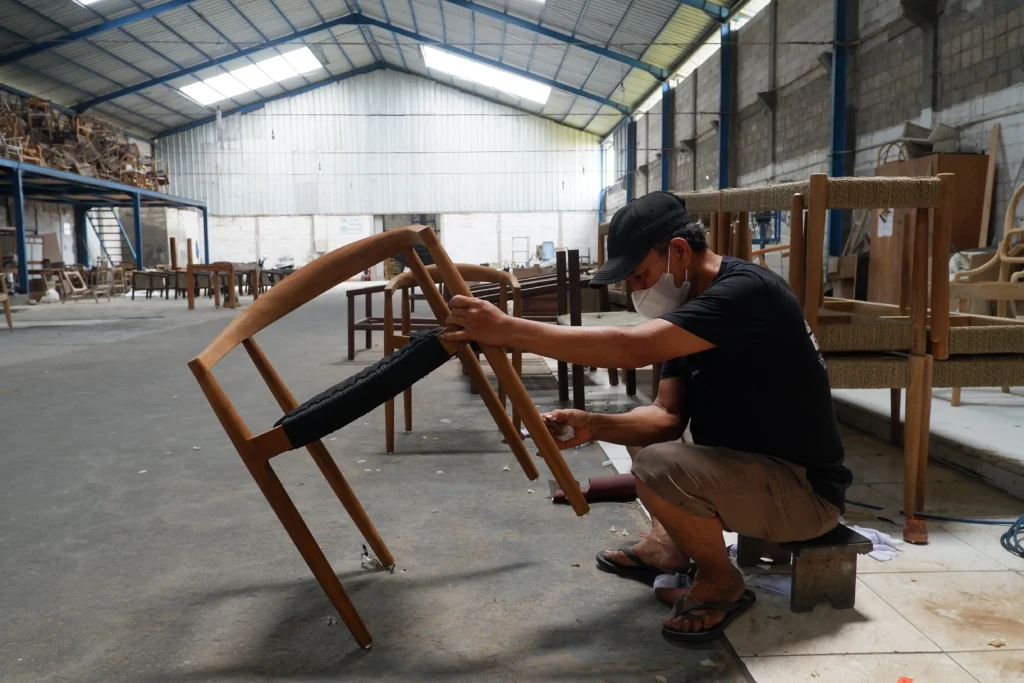
Favorable tariff treatment means nothing if manufacturing capabilities can't deliver what commercial projects require. This is where Indonesia had to prove itself when buyers began to take it seriously.
Of course, it came with pressure. Indonesian manufacturers had to scale. They had to modernize. They had to prove they could deliver the volume and the quality that buyers had previously received from Vietnam or China.
But the infrastructure was already in place, built over decades to serve international markets. What changed was the intensity and volume of demand as buyers diversified away from concentrated risk.
Indonesian furniture manufacturers serving commercial segments are established operations built around hotels, restaurant groups, retail chains, and commercial developers who need furniture that performs reliably at scale.
This shows up in several ways:
1. Custom Commercial Specs
Commercial furniture faces different requirements than residential pieces. Higher durability standards, specific material certifications, flame-retardant treatments for hospitality applications, and consistent replication across large volumes.
Indonesian manufacturers serving this segment understand these requirements because they've been meeting them for international clients for decades.
2. Large Volume Projects
A 200-room hotel needs furniture delivered on coordinated schedules. Different furniture types must arrive at specific times to match construction sequencing.
Indonesian manufacturers operating at a commercial scale have the production capacity and logistics coordination to handle these complex rollouts.
3. B2B Compliance
Commercial furniture projects involve detailed documentation, quality inspections, warranty terms, and after-sales support that residential furniture rarely requires.
Experienced Indonesian manufacturers have systems in place to meet these B2B requirements.
The manufacturing ecosystem in Indonesia includes integrated operations that control their supply chains from timber sourcing to final finishing. This integration reduces the variability that plagues furniture projects.
When manufacturers control their kiln drying, joinery production, finishing lines, and quality systems internally, they can deliver the consistency commercial projects demand.
For commercial buyers evaluating Indonesian manufacturers, production capabilities matter as much as tariff advantages.
The combination of favorable trade positioning and proven manufacturing infrastructure is what makes Indonesia strategically valuable.
If you're assessing potential manufacturing partners, our guide on Indonesian furniture manufacturers and 3 key factors breaks down what to evaluate beyond just pricing and tariff rates.
Indonesia as a Strategic, Tariff-Smart Partner for Furniture Sourcing
The question facing commercial furniture buyers isn't whether to source from Indonesia. It's a question of whether to continue sourcing from origins with increasing tariff exposure while Indonesian options exist.
Strategic sourcing means optimizing for long-term cost stability and supply chain resilience, not just current unit prices. Indonesia delivers both through favorable trade positioning and manufacturing maturity that serve commercial-grade requirements.
For businesses planning multi-year furniture programs across hotel portfolios, restaurant chains, retail expansions, or office developments, tariff-smart sourcing protects project economics from policy volatility.
At MPP Furniture, we've built our operations around serving commercial and retail buyers who need this combination.
Our 16,000 m² facility integrates complete production capabilities, and with over 20 years of serving international clients, we understand furniture that performs reliably in demanding commercial environments.
Whether you need custom furniture for specific projects or an ongoing supply for multi-location rollouts, we approach each one through the lens of long-term cost efficiency.
Explore our furniture collections to see what we produce for hospitality, retail, food service, and office environments.
For insights on managing timelines, check out lead time matters in Indonesian furniture.
👉 Want to evaluate your options? Schedule a free consultation to review your specific sourcing needs for furniture.
Email Us: sales@mppfurniture.com
WhatsApp: +62 821-4630-5858
Planning your next best-selling collection?
Request catalog, pricing info, MOQ, and custom options today — we’ll respond quickly.
FAQ: Custom Furniture Sourcing
1. What are the primary benefits of sourcing custom furniture from Indonesia?
Sourcing custom furniture from Indonesia allows retailers to achieve unique designs at a lower cost compared to domestic production. Manufacturers offer integrated services, including material selection, design development, and specialized finishing, allowing for high levels of customization at competitive price points.
2. How does the custom furniture development process work?
The process typically starts with a design concept or technical drawing. Manufacturers then develop prototypes to ensure functionality, dimensions, and aesthetics meet specifications. Once approved, the factory transitions to full production with rigorous quality control at every stage.
3. Is custom furniture more expensive than standard collections?
While custom furniture involves an initial investment in prototyping, it provides better long-term value. Customization allows retailers to differentiate their brand, avoid direct competition, and create products optimized for their target market, ultimately leading to higher margins.
4. How can retailers ensure quality when ordering custom pieces?
Retailers should prioritize manufacturers with in-house production control, including their own kiln-drying facilities and finishing departments. Requesting regular updates, clear technical specifications, and photo/video inspection of samples before production is key to ensuring quality.
5. What is the typical lead time for custom furniture projects?
Lead times are generally longer due to design validation and prototype development. Retailers should expect a minimum of 12–16 weeks for custom development and initial production, plus ocean freight time, depending on the complexity of the design.

A passionate writer with 2+ years of experience in SEO who turns complex ideas into informative & helpful content. I share the challenges & important considerations when preparing a global furniture project, hoping to help MPP Furniture’s readers make more informed business decisions.
0 Comments