Sourcing furniture from Indonesia changes how you manage inventory. Production happens thousands of miles away. Container ships take weeks.
Minimum order quantities tie up capital. Lead times stretch months instead of days.
According to Mordor Intelligence, furniture products are often bulky and expensive to store, and predicting demand can be difficult, leading to overstocking and high warehousing costs, or to stockouts due to under-ordering.
When you add overseas manufacturing to this equation, inventory management becomes a strategic operational challenge affecting cash flow, warehouse capacity, and your ability to respond to market shifts.
The retailers who succeed with Indonesian sourcing aren't the ones with the biggest warehouses. They're the ones who plan inventory systematically from the start.
Why Overseas Sourcing Requires Different Inventory Thinking
Long production and shipping lead times change inventory planning. When your supplier is local, you can reorder quickly if something sells faster than expected.
When your supplier is in Indonesia, that flexibility disappears.
Production takes 8-12 weeks for standard furniture, longer for custom pieces. Ocean shipping adds 4-6 weeks. Customs clearance adds another week or two.
By the time you realize you need more inventory, you're 3-4 months away from receiving it.
A higher inventory commitment than local sourcing is unavoidable. You must forecast demand months in advance and commit capital to inventory before you know if those forecasts are accurate. This risk amplifies for retailers managing multiple locations or seasonal product lines.
The impact on cash flow and store operations is direct. Money invested in inventory sitting in containers or warehouses is money not available for marketing, expansion, or responding to opportunities. Empty floor space due to a container arriving late means lost sales that can't be recovered.
Key Inventory Challenges Retailers Face When Buying from Indonesian Manufacturers
1. Minimum Order Quantities (MOQ)
Indonesian manufacturers set MOQs to ensure production efficiency. A typical MOQ might be 50-100 pieces per SKU, and sometimes a full container load is required for the best pricing.
For retailers, this creates immediate challenges. You must invest significant capital upfront. You need warehouse space to store inventory that might take months to sell.
And you're betting that your demand forecast for each SKU is accurate enough to justify the volume commitment.
According to IndexBox, many companies are building up inventory, ordering more than they need so they have stock to counter service delays.
La-Z-Boy, for example, spent $83 million on protective inventory builds to manage supply chain challenges.
It's a strategic investment to maintain business continuity when lead times are unpredictable. But it requires capital that most small retailers don't have readily available.
2. Production Scheduling and Delays
Indonesian manufacturers juggle multiple clients and orders. Your production slot depends on their capacity, material availability, and competing priorities.
Delays happen for many reasons. Raw material shortages delay the start of production. Equipment breakdowns interrupt manufacturing. Quality issues require rework. Port congestion extends shipping times.
According to Studioother, La-Z-Boy struggled with a large backlog of orders due to longer lead times, with customized products that used to be delivered in 4 to 6 weeks now taking 4 to 7 months.
If this happens to a major US manufacturer with the resources to manage its supply chain, smaller retailers face even greater vulnerability.
3. Demand Uncertainty and Seasonal Trends
Furniture retail displays seasonal patterns. Sales spike during holiday periods, home-buying seasons, and promotional events. They drop during slower months.
When sourcing locally, you can adjust orders to match these patterns. When sourcing from Indonesia with 3-4 month lead times, you must predict demand accurately months before the selling season begins.
Get the forecast wrong in either direction, and you pay. Overestimate demand and you're stuck with inventory eating warehouse space and cash flow.
Underestimate, and you miss sales during peak periods when margins are highest.
Understanding Lead Times and Production Cycles in Indonesian Furniture Manufacturing
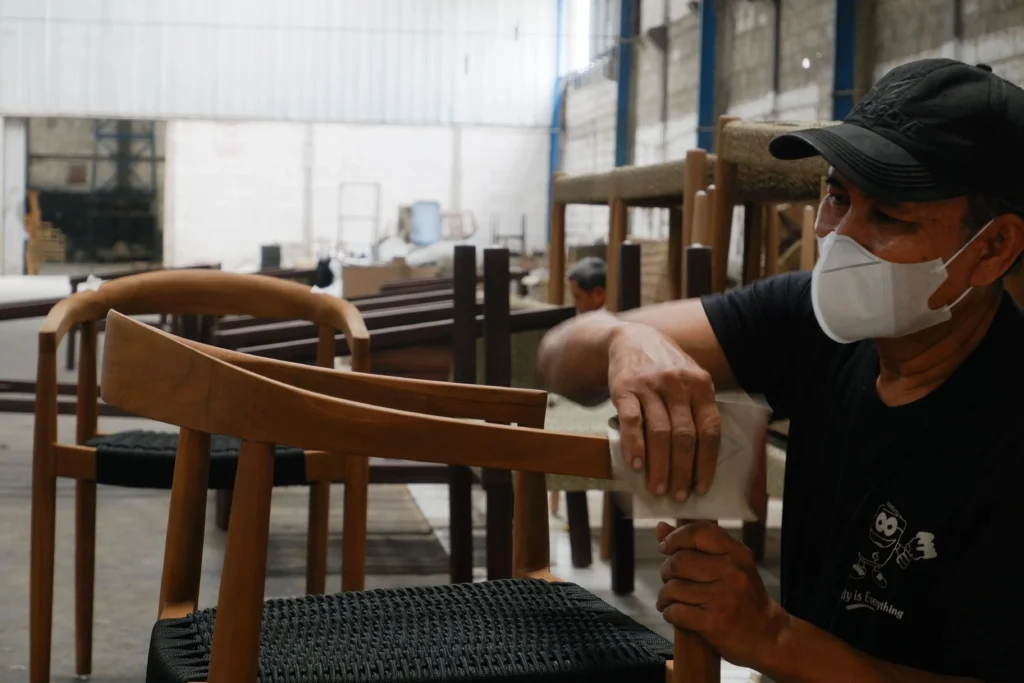
Production cycles in Indonesian furniture manufacturing follow predictable stages. Understanding these stages helps you plan inventory more accurately.
- Material procurement: 1-2 weeks for standard materials. Longer for specialty woods or custom hardware.
- Production: 6-10 weeks for standard furniture. 10-14 weeks for custom pieces requiring design development, samples, or complex finishing.
- Quality control and finishing: 1-2 weeks. Cannot be rushed without compromising quality.
- Container loading and export documentation: 1 week. Requires coordination among the manufacturer, freight forwarder, and customs officials.
- Ocean freight: 3-5 weeks to the US West Coast, 5-7 weeks to the East Coast, 4-6 weeks to Europe, 2-4 weeks to Australia.
- Customs clearance: 1-2 weeks in the destination country. Delays occur due to documentation issues or random inspections.
The total timeline from order placement to warehouse delivery is 12-20 weeks, depending on the destination and product complexity. This assumes everything proceeds smoothly. Real-world delays often extend these timelines by weeks or months.
For a deeper understanding of how lead times affect furniture sourcing, see our article on lead time matters in Indonesian furniture.
Inventory Planning Strategies for Retail Furniture
1. Safety Stock Calculations
Calculate the buffer inventory you need based on lead-time variability and demand volatility.
For example, La-Z-Boy reduced its distribution footprint from 15 large centers to three centralized hubs while expecting a 30% reduction in warehouse square footage and 20% drop in inventory mileage.
This consolidation only works with accurate safety stock planning.
2. ABC Inventory Classification
The items are high-value, fast-moving products requiring careful monitoring. B items have moderate value and turnover. C items are low-value but might represent a significant SKU count.
Focus inventory investment and attention on A items. These drive revenue and profit.
Manage B items systematically but with less intensity.
C items should be minimized or eliminated if they tie up warehouse space without contributing meaningfully to profit.
3. Reorder Point Planning
It determines when to place orders with Indonesian suppliers. Calculate reorder points based on lead time, average daily sales, and desired safety stock.
This ensures you order early enough that new inventory arrives before existing stock depletes.
For furniture sourcing in Indonesia specifically, check our guide on how to buy furniture from Indonesian suppliers.
Aligning Order Quantity and MOQ with Retail Inventory Capacity
1. Warehouse Capacity Constraints
Calculate available space before committing to orders. Factor in furniture's bulk. A container of chairs occupies far more warehouse space than a container of smaller retail products.
According to Research And Markets reports, unsold furniture inventory sits at 2.06 months, setting an unfortunate record for the industry, with furniture sales dropping 2.9 percent while stockpiles rose.
Excess inventory due to miscalculated warehouse capacity results in expensive external storage or forced discounting to clear space.
2. Cash Flow Impact Assessment
MOQs might make economic sense from a unit-cost perspective, but they strain working capital to the breaking point.
Calculate total landed cost including product, shipping, duties, and warehousing. Compare this against the projected sales timeline and margin.
If the inventory takes 6 months to sell and ties up capital you need for other purposes, the lower unit cost might not justify the overall financial impact.
3. SKU Rationalization
Instead of ordering small quantities across many SKUs, concentrate investment in proven sellers. This might mean higher MOQ per SKU but fewer total SKUs, creating more manageable inventory levels.
For insights on how sourcing decisions affect warehouse operations, see sourcing furniture impact on warehouse management.
Logistics, Shipping Schedules, and Their Impact on Inventory Flow
Container shipping schedules determine when inventory actually arrives. Unlike air freight, ocean shipping operates on fixed sailing schedules that can't be accelerated.
- Shipping frequency varies by route. Major routes from Indonesia to the US West Coast might have weekly sailings. Less common routes might be every 2-3 weeks. Missing a sailing adds weeks to your lead time.
- Port congestion creates unpredictable delays. A 20-day transit would be around 65 days, then 35, and then back to 80 days, according to FTI Consulting's analysis of furniture supply chains. This unpredictability makes inventory planning extremely difficult.
- Container availability and costs fluctuate based on global shipping demand. During peak seasons or supply chain disruptions, container costs can triple or quadruple. Some routes might have no containers available at any price.
Plan inventory orders around shipping realities, not ideal timelines. Build buffer time into all projections.
Coordinate multiple product orders to fill containers efficiently, reducing per-unit shipping costs while managing warehouse capacity.
How Indonesian Furniture Manufacturers Can Support Better Inventory Management
The right manufacturing partner actively helps you manage inventory challenges rather than just fulfilling orders.
- Flexible production scheduling allows adjusting order timelines within reason. Manufacturers with good planning systems can sometimes accommodate rush orders or delays without major disruption.
- Modular order structures let you order in phases rather than all at once. Initial production of core items, followed by replenishment orders for fast sellers and smaller quantities of test items.
- Inventory holding services, where manufacturers store finished goods and ship in stages, can reduce warehouse pressure on your end. Not all manufacturers offer this, but those serving international retail clients often can accommodate staggered shipping.
- Clear production visibility through regular updates prevents surprises. When manufacturers communicate proactively about production status, material delays, or shipping schedules, you can adjust your plans accordingly.
At MPP Furniture, we've built inventory support systems specifically for retail clients managing long supply chains. Our 16,000 m² facility can accommodate staggered production and storage, giving retailers flexibility in how they receive and deploy inventory.
Our experience serving retailers across multiple continents taught us that inventory management support is part of manufacturing service.
It's not enough to make good furniture. We need to deliver it in ways that support your operational and financial realities.
Explore our furniture collections to see the range of products we manufacture, with inventory management flexibility built into our work with retail clients.
👉 Planning your first overseas order? Schedule a free consultation to review inventory planning strategies for your specific retail situation.
Email Us: sales@mppfurniture.com
WhatsApp: +62 821-4630-5858
Planning your next best-selling collection?
Request catalog, pricing info, MOQ, and custom options today — we’ll respond quickly.
FAQ: Managing Furniture Retail Inventory
1. Why does sourcing furniture from Indonesia require a different inventory approach?
Unlike local sourcing where replenishment is fast, overseas sourcing involves long lead times (12–20 weeks) for production and ocean freight. This makes it impossible to quickly react to sudden spikes in demand, necessitating more accurate forecasting and a proactive inventory strategy to prevent stockouts.
2. What are the biggest inventory challenges when working with Indonesian manufacturers?
Key challenges include managing Minimum Order Quantities (MOQs), navigating unpredictable production schedules, and accurately forecasting seasonal demand months in advance. These factors can tie up significant capital, require more warehouse space, and increase the risk of overstocking or understocking.
3. How can retailers calculate the right amount of "safety stock"?
Safety stock should be calculated based on your demand volatility and lead-time variability. By analyzing historical sales data and current shipping transit times, you can determine the buffer stock needed to cover potential delays during the 3–4 month period between placing an order and receiving the goods.
4. What is "ABC Inventory Classification," and how does it help?
ABC classification categorizes inventory by value and turnover: 'A' items are high-value/fast-moving, 'B' items are moderate, and 'C' items are low-value. By focusing your capital and storage efforts on 'A' items, you maximize profitability and avoid wasting warehouse space on low-contributing products.
5. How can manufacturers help retailers manage inventory more effectively?
Supportive manufacturers offer flexible production scheduling, modular ordering structures (such as phased delivery), and clear production visibility. Some partners may even provide temporary holding services, allowing you to stagger shipments and reduce pressure on your own warehouse capacity.

A passionate writer with 2+ years of experience in SEO who turns complex ideas into informative & helpful content. I share the challenges & important considerations when preparing a global furniture project, hoping to help MPP Furniture’s readers make more informed business decisions.


0 Comments