
Indonesian teak patio furniture is not just about selecting beautiful outdoor pieces. It is a strategic sourcing decision that directly affects your retail margin, return rate, and long-term brand reputation.
The global outdoor furniture market continues to expand, driven by rising consumer interest in enhancing outdoor living spaces, as highlighted by Ken Research.
However, as demand increases, quality and production consistency become the real differentiators.
This article outlines the key aspects retailers must validate before committing to bulk orders, based on practical insights from Indonesian outdoor furniture manufacturer’s experience, MPP Furniture.
Why Buying Indonesian Teak Patio Furniture Is a Strategic Business Decision
Outdoor patio furniture is not a short-cycle category. Once products reach the market, they are exposed to weather, usage stress, and long-term environmental changes that indoor furniture never faces.
For furniture buyers, a single sourcing mistake does not only result in product issues. It can lead to return claims, margin erosion, delayed replenishment, and long-term brand perception risks.
This is why buying Indonesian teak patio furniture should be treated as a structured evaluation process. Beyond aesthetics, buyers must assess material qualification, supplier readiness, construction integrity, and production consistency before confirming bulk orders.
What to Validate Beyond Appearance When Sourcing Patio Furniture from Indonesia
Teak patio furniture often looks premium at first glance. However, visual appeal alone does not guarantee long-term outdoor performance.
For furniture buyers, validating the teak wood grade, confirming outdoor-grade cushion and fabric specifications, and ensuring the finishing system is designed for exterior exposure are critical steps to reduce brand risk and protect long-term customer satisfaction.
1. Indonesian Teak Wood Grade and Sapwood Control
Not all teak boards offer the same structural strength. Buyers should ask how suppliers control sapwood proportion, grading standards, and consistency in material selection across production batches.
Based on our experience in manufacturing Indonesian teak furniture for outdoor use, teak with dense, mature heartwood and minimal sapwood content performs more consistently under weather stress and is less prone to cracking.
Excessive white sapwood areas may reduce structural durability when exposed to long-term moisture and temperature changes.
Surface color alone cannot indicate quality. Understanding how a supplier manages teak grading and selection helps prevent early cracking, uneven weathering, and long-term structural issues.
2. Cushion and Fabric Specification for Outdoor Use
Seating performance is critical in outdoor patio furniture. Cushions that trap water or retain excessive moisture can significantly reduce product durability and compromise customer experience over time.
Furniture buyers should confirm whether the fabric used is water-repellent, moisture-resistant, and designed to withstand prolonged UV exposure.
It is advisable to request technical specifications, including performance ratings and estimated lifespan under outdoor conditions.
In practice, outdoor-grade cushion systems must meet clear technical standards. We use certified fabrics such as Sunproof, with documented UV resistance and water-repellency performance, helping ensure long-term durability and buying confidence.
3. Outdoor Finishing System and Expected Performance
Finishing serves as the first layer of protection against UV exposure, humidity, rain, and prolonged sun exposure.
Buyers should understand whether the finishing system is specifically designed for outdoor exposure and how it performs over time.
We have received QC’s buyer reports where finishing peeled and faded prematurely because indoor-grade coatings were mistakenly applied to outdoor collections. These failures typically become visible only after the products are exposed to real weather conditions in the market.
A reliable outdoor furniture supplier should be able to explain expected weathering behavior, maintenance requirements, and finishing consistency across production batches.
For fully outdoor exposure under direct sunlight, our finishing standard maintains stable color performance for at least 1 year without noticeable fading.
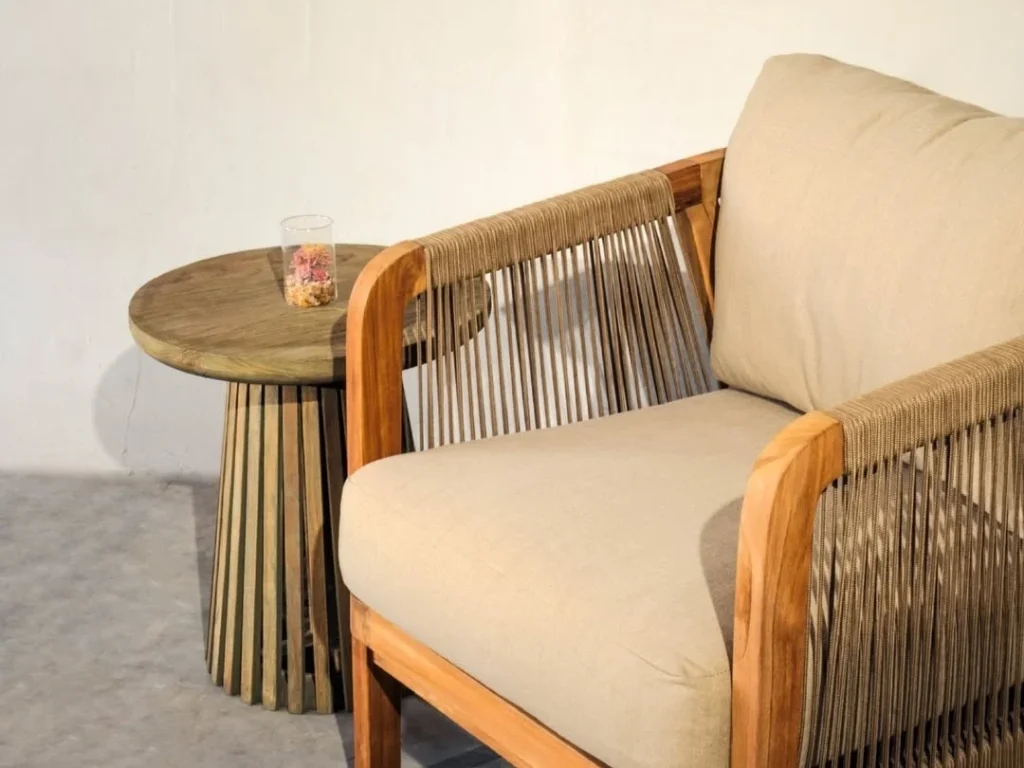
4. Weaving as Decorative Element, Not Structural Core
In patio furniture, weaving often serves as a visual enhancement rather than a primary structural support.
Buyers should clarify whether weaving components are specified for outdoor use and how they interact with the frame and cushion system.
Misaligned specifications between structure and decorative elements can compromise product stability over time.
Supplier Readiness: Can They Deliver Beyond the Sample?
Many suppliers can produce an impressive sample, but the real question is whether the same quality can be maintained consistently at scale.
Supplier readiness determines whether quality standards can be sustained across multiple production batches.
Before confirming bulk orders, furniture buyers should evaluate production capacity & capability, construction standards, and export experience to ensure long-term reliability
1. Factory Facilities and Production Capacity
Buyers should understand whether production is handled in-house or fragmented across multiple subcontractors.
In-house production control over kiln drying, machining, assembly, and finishing allows better monitoring of moisture levels, construction precision, and finishing consistency.
When production is fragmented, maintaining consistent standards becomes significantly more difficult.
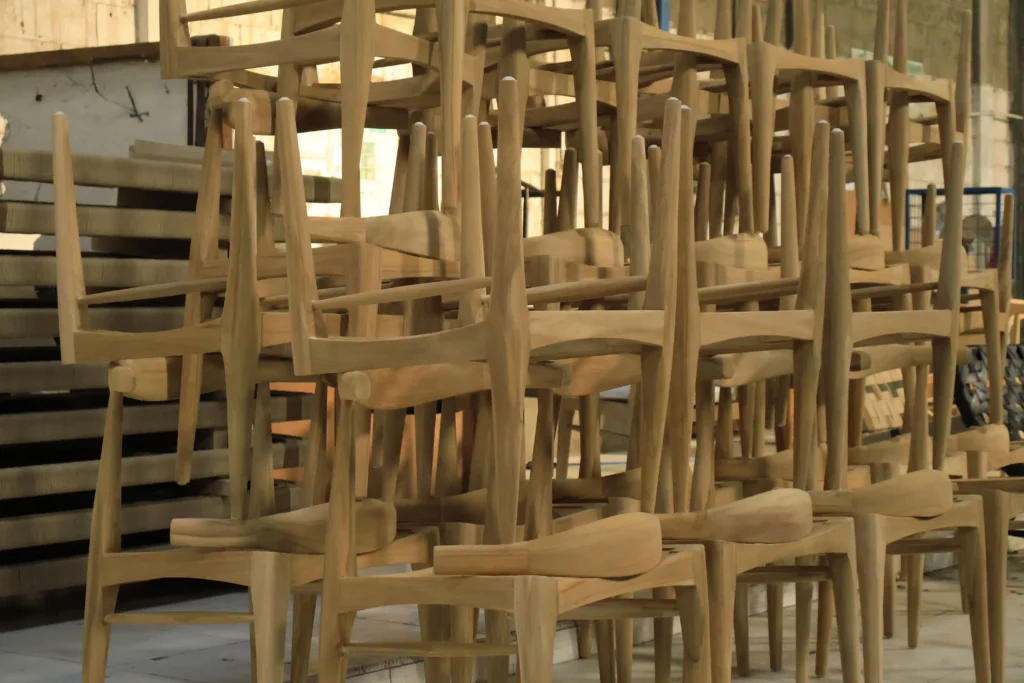
For example, if chair production is divided among different subcontractors, variations may occur in wood sourcing, construction tolerances, joinery methods, and finishing techniques. Even small inconsistencies at this stage can result in visible quality differences once products reach the market.
Consistency at scale requires controlled systems, not just good craftsmanship.
2. Construction Standards Used
Outdoor patio furniture requires stable joinery and precise structural tolerances to withstand prolonged outdoor use.
Furniture buyers should clarify what construction methods are applied.
For seating products, mortise and tenon joinery provides stronger structural integrity. For table assemblies, tongue-and-groove connections help stabilize panels under humidity changes. Moisture content should ideally be controlled below 12% for optimal outdoor performance.
Supporting machinery also plays an important role. Equipment such as mortise and tenon machines ensures repeatable precision that manual methods alone may not consistently achieve at a production scale.
3. Experience in International Markets
Export experience is critical because each market has different regulatory and performance requirements.
For example, shipments to the United States may require legal labeling for cushion materials. If a supplier lacks familiarity with these requirements, compliance issues may arise after purchase confirmation.
Comprehensive export experience also signals operational maturity.
Suppliers that consistently serve established retailers or large commercial buyers are typically required to meet higher quality, documentation, and production standards. This track record can serve as an additional indicator of reliability.
Sampling and Construction Testing Before Mass Production
Sample approval is often treated as the final validation step. In reality, it should mark the beginning of a deeper evaluation. A visually approved sample does not automatically guarantee structural reliability or production consistency once orders scale.
For furniture buyers, sampling should go beyond visual assessment. Construction stability, joinery strength, component alignment, and finishing adhesion must be evaluated before bulk production begins.
In our production process, sample testing is mandatory before bulk manufacturing. We conduct impact testing to validate joint durability and apply ISTA packaging standards to minimize transit damage during export shipment. It also allows us to evaluate construction performance.
For buyers, structured testing provides additional confidence that the product is safe, durable, and ready for market distribution. Early validation at this stage helps prevent costly defects related to construction methods, finishing application, or component specification once production scales.
Production Control and Batch Consistency for Scalable Collections
Approving a strong sample is only one part of the equation. Mass production is a different process entirely, where consistency must be maintained across dozens or hundreds of units, not just a single prototype.
Without controlled production systems, even minor variations in material selection, joinery tolerance, or finishing application can create noticeable inconsistencies across batches. Differences in teak grading, moisture content, construction alignment, or finishing thickness may result in uneven appearance, structural variation, and ultimately customer complaints.
Effective production control requires standardized procedures at every stage, from kiln drying and machining to assembly and finishing. Clear quality checkpoints, controlled moisture levels, and repeatable construction methods help ensure that each batch meets the same structural and visual standards as the approved sample.
For scalable collections, consistency is not the result of craftsmanship alone. It is the outcome of controlled systems designed to deliver the same quality across every shipment.
Supplier’s MOQ and Your Collection Planning
Minimum order quantity is not only a pricing consideration. It directly affects collection structure, inventory planning, and cash flow allocation.
Furniture buyers should evaluate whether a supplier’s MOQ aligns with their merchandising strategy and seasonal demand cycle. At the same time, planning your patio collection helps ensure design consistency, material standardization, and smoother repeat orders.
Working with an Indonesian furniture manufacturer that offers flexible MOQ options can support better inventory control and more strategic business growth.
At MPP Furniture, we support our buyers with a flexible MOQ for new patio furniture market testing and consistency across batches for scalable collections. In 2024, our defect rate is only 0,54% across thousands of furniture pieces we sent.
Evaluate Before You Commit: Red Flags and Qualification Checklist
Before confirming bulk orders, furniture buyers should move beyond pricing and visual presentation. Certain warning signs often indicate potential production and consistency risks.
1. Unclear material grading
If a supplier cannot clearly explain teak selection standards, sapwood control, or moisture content management, consistency during mass production becomes uncertain.
At MPP Furniture, we prioritize dense, mature heartwood with minimal sapwood content because it delivers more stable performance under weather exposure and significantly reduces the risk of surface cracking.
2. Lack of Technical Specifications
Suppliers should be able to provide clear information about cushion fabric performance, finishing systems, packaging standards, and regulatory compliance for export markets.
We use certified fabrics such as Sunproof, with documented UV resistance and water-repellency performance, helping ensure long-term durability and buying confidence.
To prevent finishing failure, we work closely with the Propan team for a better outdoor finishing system and to minimize risk.
3. Fragmented production without centralized control
Fragmented production may lead to variations in construction, finishing, and component quality. In contrast, in-house control over kiln drying, machining, assembly, and finishing allows better consistency. Clear quality checkpoints and documented standards indicate readiness for scalable collections.
At MPP, production is managed through controlled in-house systems and machinery with defined grading standards, construction tolerances, and outdoor-specific material specifications.
This structured approach helps ensure that approved samples can be reproduced consistently across repeat orders and seasonal programs.
Final thoughts: Buy with confidence, not just an assumption
Buying Indonesian teak patio furniture should never be reduced to a design or pricing decision. It is a structured sourcing process that directly influences product durability, retail margin, and long-term brand credibility.
From material validation and supplier readiness to sampling tests and production control, each stage plays a critical role in ensuring consistency at scale. Small oversights during sourcing can become costly issues once products reach the market.
By working with Indonesian outdoor furniture manufacturers that operate with controlled systems and transparent standards, furniture buyers can build scalable patio collections with greater confidence and reduced long-term risk.
Ready to Validate Your Next Indonesian Teak Patio Collection?
Discuss your teak grading, outdoor specifications, and production requirements with our team before confirming your next bulk order.
FAQ: Indonesian Teak Patio Furniture Checklist
1. What teak grade should I choose for outdoor patio furniture?
For full outdoor exposure, Grade A teak with dense heartwood and minimal sapwood is generally the most stable and resistant to cracking. Grade C, which contains higher sapwood content, is typically not recommended for long-term outdoor use. Buyers should confirm how grading consistency is maintained across batches.
2. Should Indonesian teak patio furniture be kiln-dried?
Yes. Proper kiln drying helps control moisture content, ideally around or below 12 percent for outdoor performance. Controlled moisture levels reduce the risk of cracking, joint movement, and structural instability after shipment.
3. What construction method is best for teak patio furniture?
Mortise-and-tenon joinery is widely regarded as one of the most stable construction methods for outdoor seating. It provides stronger structural integrity compared to simple screw-based assembly, especially under heavy and prolonged outdoor use.
4. How can I verify sustainability and legal sourcing?
Buyers should check whether the supplier holds certifications such as FSC or SVLK, which indicate legal and responsibly sourced wood. Proper documentation is especially important for export compliance and large retail distribution.
5. What are common mistakes when sourcing Indonesian teak patio furniture?
Common issues include unclear teak grading, inconsistent moisture control, use of indoor-grade finishing for outdoor products, fragmented production without centralized control, and lack of technical specifications for cushion or hardware materials.

Hi, I’m Salman, founder of MPP Furniture, an Indonesian furniture manufacturer serving global retailers and project-based clients.
I began my career in my family’s export-oriented furniture company, gaining hands-on experience in production, construction, finishing, material performance, and product development. With a clear understanding of how international buyers evaluate furniture quality and reliability, I founded MPP Furniture to deliver export-ready products with consistent standards.
Here, I share insights from the perspective of a furniture manufacturer working directly with production teams on the factory floor, focusing on manufacturing and supplier evaluation.
Connect on LinkedIn


0 Comments