
Importing furniture from Indonesia can be highly profitable for retailers. Many brands increase margins by sourcing directly from Indonesian furniture manufacturers.
However, without understanding the critical factors, buyers often face late shipments, inconsistent finishing, hidden logistics costs, and customs complications.
By understanding the critical B2B sourcing factors before placing a bulk order, those risks can be prevented from becoming expensive problems.
Why Importing Furniture from Indonesia Is Not Just About Price
Many buyers focus on the FOB price. They compare quotations from several Indonesian furniture suppliers and choose the lowest number.
But importing furniture from Indonesia is not just a single purchase. It is entering a coordinated export system that includes production planning, quality control, documentation compliance, international logistics, and tax structure.
For example, 5% cheaper unit price becomes irrelevant if finishing fails, moisture is uncontrolled, documentation is inaccurate, or packaging is weak.
This is why buyers must evaluate Indonesian furniture manufacturers not only by price, but by export readiness, quality control systems, and process transparency.
The goal is not to find the cheapest supplier but to find the supplier with the lowest overall risk exposure.
Understanding the Import Process for Indonesian Furniture

Importing furniture from Indonesia follows a structured process. Understanding each stage helps buyers reduce risk before placing a bulk order.
Here is a simplified overview based on our experience serving retailers worldwide:
1. Find the Right Supplier
Choosing the right Indonesian furniture supplier is the most critical decision, because it determines production reliability, documentation accuracy, and long-term consistency.
If you are still evaluating suppliers, this guide might help you choose the right Indonesian furniture manufacturer:
2. Request Catalog, Pricing, and Tailored Product Development
Buyers should request full catalogs, detailed pricing structures, and explore product development options tailored to their business model and target market.
You can review the three key factors when sourcing from Indonesian furniture manufacturers
3. Negotiate MOQ, Payment Terms, and Incoterms
Before confirming production, clarify minimum order quantities, payment terms, and Incoterms such as EXW, FOB, or CIF to prevent misunderstandings that may affect total landed cost.
4. Visit Indonesian Furniture Suppliers (If Possible)
Factory visits allow buyers to verify production capacity, quality standards, and whether the supplier truly operates in-house manufacturing.
When visiting, you should also evaluate whether the factory has the essential machinery required for export-grade production
5. Place the Order with Clear Specifications
All details, including dimensions, finishing standards, packaging method, and lead time, must be clearly written in the proforma invoice before production begins.
6. Conduct Quality Control
Quality control can be handled by a third-party inspection agency or through structured reporting from the supplier during production and before container loading.
Further reading: Understand the importance of third-party inspection in furniture sourcing
7. Prepare Shipping and Export Documentation
Ensure commercial invoice, packing list, bill of lading, certificate of origin, and wood legality documents are prepared correctly to avoid customs delays.
8. Customs Clearance and Local Delivery
Once the shipment arrives, import duties, tax payments, and local logistics coordination must be handled efficiently before goods can be distributed.
Logistics planning is also a critical factor. Understanding sourcing logistics before placing a bulk order helps buyers prevent timeline delays and unexpected cost increases.
The Critical Factors You Must Know Before Importing Furniture from Indonesia

On paper, the process looks manageable. In reality, failures occur when critical factors are overlooked before production begins.
Below are the factors that separate a smooth container delivery from an expensive sourcing mistake.
1. Supplier Selection: The First Critical Decision
Not all Indonesian furniture suppliers operate the same way. Some companies are direct furniture manufacturers with full in-house production. Others are trading companies coordinating multiple workshops.
Direct manufacturers typically offer better production control, faster issue resolution, more consistent finishing, and clearer accountability.
However, a reliable export-grade manufacturer must also have adequate machinery and proper kiln-drying systems to maintain moisture content below 12%. Without this, products may crack or warp during transit.
Trading companies provide flexibility and broader product variation, sometimes with lower MOQs. But production control can become fragmented, and communication may pass through multiple layers.
If you are importing Indonesian indoor furniture or Indonesian outdoor furniture in bulk, production consistency is non-negotiable. Once the container leaves the port, mistakes cannot be corrected.
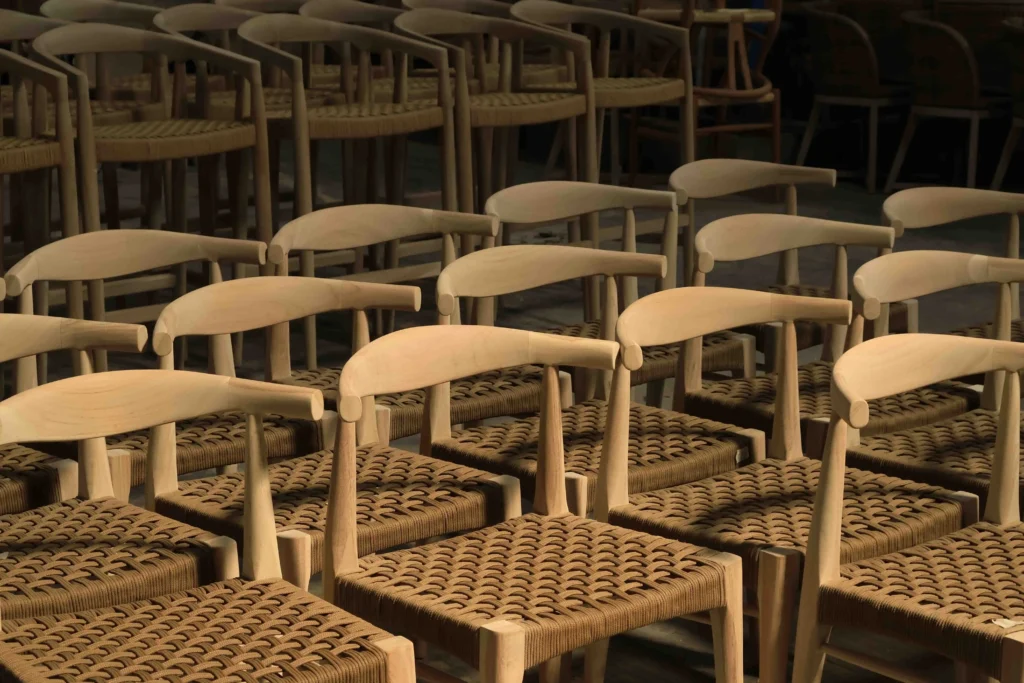
At MPP Furniture, we operate fully in-house across a 16,000 sqm facility, from raw timber to final packaging. This allows tighter control over moisture, finishing, and packing standards.
One of our Australian buyers values this structure because we combine full production control with flexible MOQs, allowing shipment consolidation with other suppliers. From our experience, this helps buyers test markets, manage cash flow, and scale without overcommitting inventory.
Choosing a manufacturer that combines production control with flexible MOQ discussion often provides better long-term sourcing stability.
2. Production & Technical Risk: Moisture, Construction, and Packaging
From our experience, these three production factors determine whether the shipment arrives safely.
Firstly, in practice, wood must be properly kiln-dried before production. The moisture content should generally be below 12%. If the moisture level is too high, the product may crack during transit, warp after arrival, or develop joint gaps within a few weeks of use.
Secondly, construction and finishing systems must be stable. Proper joinery, curing time, and sealing protect durability and prevent surface defects.
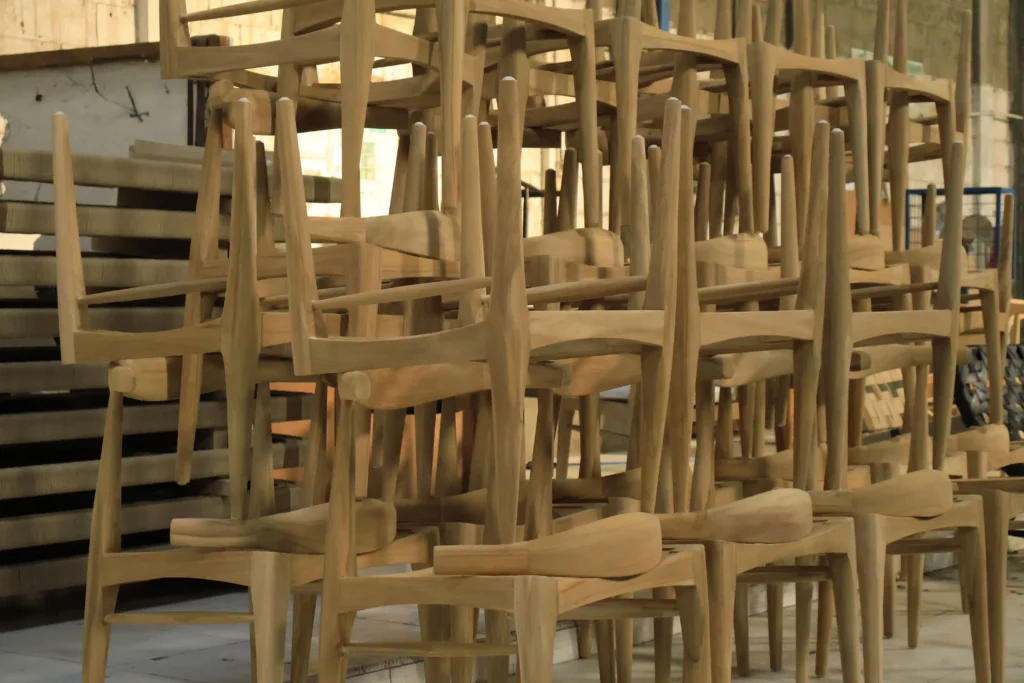
Thirdly, packaging determines whether the furniture arrives in the same condition it left the factory. During shipping, containers are exposed to movement, stacking pressure, and humidity shifts.
3. Documentation & Compliance Risk
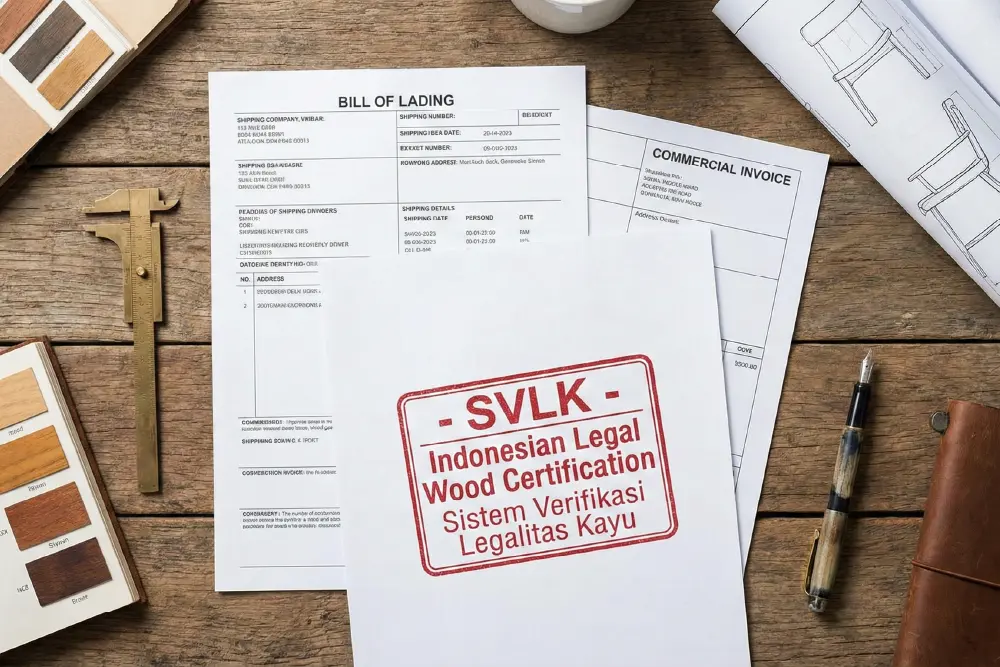
Importing furniture from Indonesia requires accurate and complete export documentation. Documentation errors are one of the most common causes of shipment delays.
Standard export documents typically include:
- Commercial Invoice
- Packing List
- Bill of Lading
- Certificate of Origin
- SVLK document for wood legality verification
Missing or inaccurate documentation can result in:
- Port delays
- Additional customs inspections
- Extra inspection fees
- Customs penalties
- Container release delays
Based on discussions with our forwarder partners, we have seen cases where the HS code was incorrectly identified at the supplier level.
The container had already arrived at the destination when customs flagged the classification mismatch. The result was delayed clearance, demurrage, and additional penalties paid by the buyer.
In some markets, even a minor mismatch in consignee details or declared wood species can trigger manual customs inspection.
Export experience is not about how many containers a factory produces, but it is about how clean and consistent their documentation process is.
4. Logistics & Port Risk
When importing furniture from Indonesia, buyers must consider not only the shipping cost, but also the shipping efficiency and risk of ownership.
Key logistics factors include:
- FCL versus LCL efficiency
- Container loading optimization
- Insurance coverage
- Port congestion season
- Destination customs clearance timeline
In peak seasons, container booking space may need to be secured 7 to 10 days earlier than normal departure schedules. Without early planning, shipments may miss vessel cut-off dates.
Delays at destination ports may also result in demurrage and detention charges. Depending on the port, these charges can range from $80 to $200 per container per day.
Poor container loading planning can reduce space efficiency by up to 15–20%. This increases the cost per unit because you are effectively shipping unused space.
5. Landed Cost Structure You Must Calculate
Before placing a bulk order, buyers must calculate the real landed cost, not just the product price. A simplified landed cost structure includes:
Product Cost
- Inland Handling
- Ocean Freight
- Insurance
- Import Duty
- VAT or GST equals Real Landed Cost
A 5% miscalculation in landed cost can reduce retail margin by 12–18%, depending on your markup structure.
For example, if your product cost is $20,000 and freight plus insurance is $5,000, tax will be calculated on $25,000, not $20,000.
Importing furniture is not only about cost calculation. It is also about cash flow timing between deposit payment, balance payment, shipping duration, and retail turnover cycle.
Common Mistakes Buyers Make When Importing Indonesian Furniture
Most important failures are not dramatic. They happen because small operational details are ignored.
Many buyers focus only on price and overlook production control and export readiness. Others skip technical verification, such as moisture content, finishing system, or packaging standards.
Some underestimate logistics timing, assuming production lead time equals delivery time. Port congestion and customs clearance can easily extend schedules.
Another common mistake is miscalculating landed cost by comparing only product price without factoring in duty, VAT, and inland charges.
Importing furniture is not just about purchasing. It is supply chain and margin management.
How MPP Supports Buyers Importing Furniture from Indonesia
At MPP Furniture, with over 20 years of experience, we apply quality control at every production stage, not only before shipment. This reduces technical risk before the container leaves the factory.
Our team also supports buyers with documentation preparation and logistics coordination, because export readiness is as important as manufacturing capability.
For growing retailers and e-commerce brands, we provide flexibility in MOQ discussions and allow shipment consolidation where possible. This helps buyers test products, manage cash flow, and scale sustainably.
Our goal is not just to ship containers, but to reduce sourcing risk before problems happen.
Conclusion
Importing furniture from Indonesia can be highly profitable. The country offers strong craftsmanship, competitive pricing, and scalable production capacity.
However, success does not come from finding the lowest price. It comes from understanding supplier structure, documentation accuracy, logistics planning, landed cost calculation, and technical production stability.
If you are planning to import furniture from Indonesia, approach the process strategically. Ask the right questions, verify the right systems, and work with partners who understand export complexity.
Ready to Import Furniture from Indonesia with Lower Risk?
If you are planning your next bulk order from Indonesia, start with a discussion before production begins.
Frequently Asked Questions About Importing Furniture from Indonesia
1. Is importing furniture from Indonesia profitable for retailers?
Yes, if sourcing is structured properly. Profitability depends on production stability, accurate documentation, and correct landed cost calculations.
2. What is the biggest risk when importing furniture from Indonesia?
The biggest risk is underestimating production control and export compliance before shipment.
3. How long does it take to import furniture from Indonesia?
Production typically takes 45–60 days, but the total timeline depends on container booking, port congestion, and customs clearance.
4. Should I choose a trading company or a direct manufacturer?
Direct manufacturers usually offer better production control, while trading companies may offer more flexibility. The right choice depends on your sourcing priorities.
5. What is the import duty from Indonesia to the USA?
Import duty depends on the HS code classification of the furniture. Rates vary by product type and may change based on trade policy. Buyers should confirm the correct HS code and current tariff rate before shipment.

Hi, I’m Salman, founder of MPP Furniture, an Indonesian furniture manufacturer serving global retailers and project-based clients.
I began my career in my family’s export-oriented furniture company, gaining hands-on experience in production, construction, finishing, material performance, and product development. With a clear understanding of how international buyers evaluate furniture quality and reliability, I founded MPP Furniture to deliver export-ready products with consistent standards.
Here, I share insights from the perspective of a furniture manufacturer working directly with production teams on the factory floor, focusing on manufacturing and supplier evaluation.
Connect on LinkedIn

0 Comments