
Most furniture sourcing conversations start the same way. You discuss design, materials, finishing, and pricing. Everything aligns perfectly. Then you mention your preferred order quantity.
That's when you hear about MOQ, which stands for Minimum Order Quantity.
It sounds like a simple number. But MOQ affects everything from your cash flow to your warehouse space to how fast you can respond to market changes.
Producing larger quantities of a product lowers per-unit cost, allowing suppliers to take advantage of economies of scale.
What MOQ Really Means in Furniture Production
MOQ is the minimum quantity a supplier requires a buyer to purchase in a single order.
For commercial furniture, this typically means 50-100 pieces per SKU for standard items, though sometimes full container loads are required for optimal pricing.
Why manufacturers set MOQ requirements comes down to basic economics.
Every production run involves fixed costs, such as machine setup, material procurement, quality control systems, and administrative overhead. These costs exist whether the manufacturer produces 20 units or 200.
According to Txtur Living, if a mold costs $1,000 and each unit costs $2 in materials, ordering 1 piece would cost $1,002 total, while ordering 1,000 pieces would cost $3,000, making each piece just $3. The fixed cost gets distributed across volume.
Local manufacturers might accept smaller orders because shipping costs are lower and communication is easier.
Instead, Indonesian manufacturers typically set higher MOQs because they're optimizing for container-load efficiency and international logistics costs.
Why MOQ Matters More Than Retailers Realize
MOQ determines your capital commitment before you sell a single piece.
If the MOQ is 100 units at $150 per unit, you're investing $15,000 in upfront costs, including shipping, before generating any revenue.
For retailers managing multiple SKUs, this capital requirement scales quickly.
For example, Ashley Furniture offers a distinct advantage with a minimum order quantity (MOQ) of 1, enabling retailers to offer larger selections without incurring hefty carrying costs. This flexibility comes at a price premium.
Most Indonesian manufacturers can't offer an MOQ of 1 while maintaining the cost advantages that make overseas sourcing attractive.
How MOQ Shapes Ordering Behavior
MOQ forces longer-term thinking. You can't order based on this week's sales.
You must forecast demand months ahead and commit inventory capital based on those forecasts.
This changes risk profiles. Local sourcing with low MOQ lets you test products with minimal commitment. Instead, overseas sourcing with high MOQ requires confidence in your market understanding before placing orders.
Long-Term Implications for Retail Operations
MOQ affects warehouse requirements, cash flow cycles, and operational flexibility. Higher MOQs mean more warehouse space is needed, longer cash conversion cycles, and a reduced ability to pivot quickly when trends shift.
As cited by Zigpoll, from 2019 to 2023, warehouse inventory increased by 50%, from 0.6 months to 0.9 months.
This inventory buildup partially reflects MOQ pressures as retailers balance supply security against capital efficiency.
The Financial Impact of MOQ on Furniture Retailers
1. Upfront Capital Requirements
Calculate total capital needed:
(MOQ × Unit Cost) + Shipping + Duties + Insurance.
For a single SKU with a 100-unit MOQ at $200 per unit, including 20% shipping and duties, you're investing $24,000 before that product generates any return.
Multiply this across 10 SKUs, and you need $240,000 in working capital just for initial inventory.
Many retailers underestimate this requirement when first sourcing overseas.
2. Carrying Costs Over Time
Inventory sitting in warehouses costs money. Storage fees, insurance, potential obsolescence, and opportunity cost of tied capital add up.
Industry standard carrying costs run 20-30% annually. On $240,000 in inventory, that's $48,000-$72,000 in holding costs per year if inventory doesn't turn quickly.
3. Risk of Overstocking vs Understocking
High MOQ creates asymmetric risk. Overestimate demand and you're stuck with inventory eating warehouse space and cash flow.
Instead, underestimate and you miss sales during peak seasons when margins are highest, but you can't reorder quickly enough to capture the opportunity.
This risk amplifies for trendy or seasonal furniture where demand for windows is narrow.
MOQ and Its Effect on Inventory Management
1. Planning Inventory Levels
MOQ sets floor inventory levels regardless of demand forecasts. If the optimal order quantity based on sales velocity is 60 units but the MOQ is 100, you're carrying 40 units of excess inventory from day one.
2. Warehouse Space Allocation
Volume-based MOQ measured in cubic meters suits bulky items like furniture, ensuring efficient use of packaging and shipping space. But this efficiency for manufacturers creates space challenges for retailers.
Calculate warehouse space needed before committing to MOQ. Furniture's bulk means space constraints hit faster than with smaller retail products.
3. Cash Flow Cycles
MOQ extends cash conversion cycles. Pay manufacturers upfront or with deposits, receive goods months later, store inventory for weeks or months before sales, and collect payment from customers.
This cycle can stretch 4-6 months from cash out to cash in.
Retailers operating on thin margins or limited capital reserves struggle with these extended cycles.
How MOQ Influences Furniture Pricing and Profit Margins
1. Unit Cost Economics
Higher order volumes reduce per-unit costs through economies of scale. As IndexBox notes, at a retail price of $12 per unit, you need to sell at least 417 units to profit. At $20 per unit, you only need 251 units.
This relationship between pricing, volume, and MOQ determines whether specific products make economic sense for your retail model.
2. Tiered Pricing Structures
Many Indonesian manufacturers offer tiered MOQ with corresponding price breaks:
- 50-99 units: $200 per unit
- 100-299 units: $180 per unit
- 300+ units: $160 per unit
The price difference between tiers can be 10-20%. For retailers able to commit higher volumes, this significantly improves margin potential.
3. Competitive Positioning
MOQ affects your competitive positioning. Retailers who can meet higher MOQs access better unit costs, more aggressive retail pricing, or higher margins.
Those limited to lower volumes pay higher unit costs, squeezing margins.
MOQ, Lead Time, and Production Efficiency
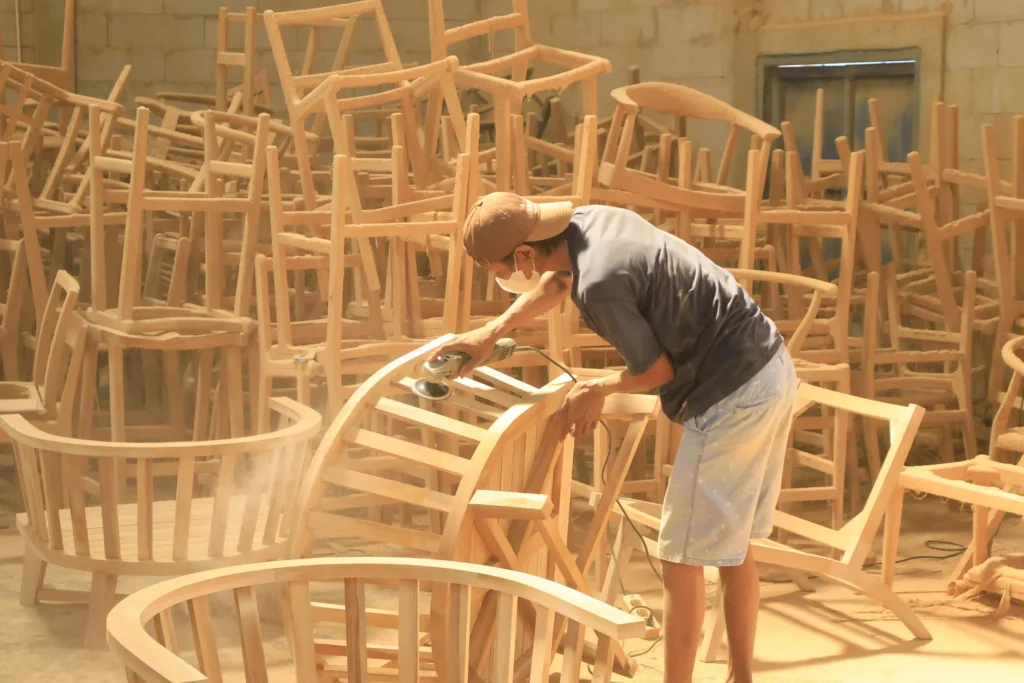
MOQ and lead time connect directly through production scheduling.
1. Production Batching
Manufacturers batch production runs for efficiency. Meeting or exceeding MOQ means your order fits standard production schedules.
Orders below the MOQ are either rejected or incur premium charges and longer wait times while manufacturers accumulate enough volume to justify production.
2. Priority in Production Queues
Larger orders get priority scheduling. When capacity is constrained, manufacturers allocate slots to orders that meet or exceed the MOQ before considering smaller orders.
This affects lead times. Standard 10-12 week production might extend to 16-20 weeks for orders below the MOQ while you wait for production capacity.
3. Container Optimization
MOQ often aligns with container load efficiency. A 40-foot container holds approximately:
- 200-250 dining chairs
- 100-120 dining tables
- 80-100 sofas or larger pieces
Indonesian manufacturers set MOQs considering these logistics realities. Orders that efficiently fill containers reduce per-unit shipping costs and simplify logistics.
How Retailers Can Manage MOQ When Working with Indonesian Furniture Manufacturers
1. Aligning Order Quantities with Sales Forecasts
Don't guess. Use historical sales data and seasonal patterns to guide buying and adjust order quantities early, before trends change.
Build demand models that account for seasonality, promotional effects, and market trends. Test assumptions against actual sales regularly.
2. Combining SKUs or Collections
Rather than ordering minimum quantities across many single SKUs, consider concentrating investment in proven sellers. This strategy:
- Reduces total SKU count
- Increases volume per SKU
- Improves negotiating leverage
- Simplifies inventory management
Many retailers successfully operate with focused collections of 20-30 core SKUs rather than spreading capital across 50+ marginal performers.
Negotiation and Phased Production Strategies
Not all MOQ is fixed. Negotiation approaches include:
- Multi-SKU flexibility: Some manufacturers allow mixing SKUs to meet the total MOQ. Order 30 units each of 3-4 designs to reach 100-unit minimum.
- Phased delivery: Produce full MOQ but ship in phases. The manufacturer stores finished goods and releases inventory as needed.
- Partnership development: Manufacturers are more flexible with MOQ for established clients with proven order history. Your first order faces a strict MOQ. Your fifth order might include accommodation for testing new designs at lower volumes.
For detailed guidance on working with Indonesian suppliers, see our article on how to buy furniture from Indonesian suppliers.
Turning MOQ into a Strategic Advantage with the Right Indonesian Furniture Manufacturer
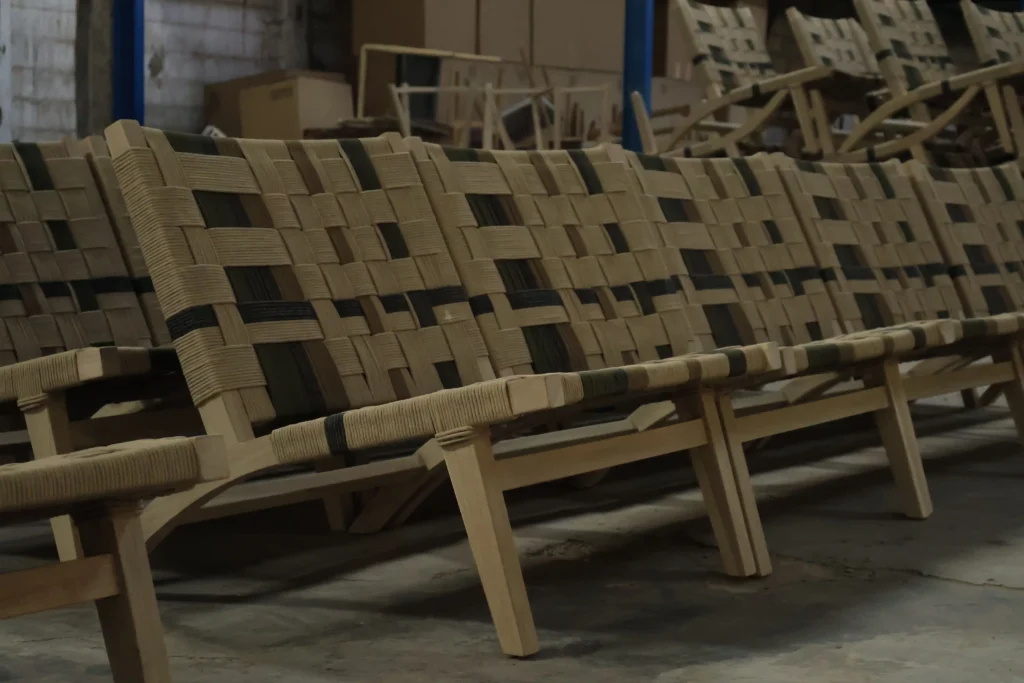
MOQ should never be treated as a fixed obstacle or a simple pricing lever. But it’s a structural decision that influences cash flow, inventory turnover, production stability, and the potential for long-term partnerships.
The right manufacturing partner doesn't just enforce MOQ. They help you structure it strategically based on validation, container planning, and reorder strategy.
At MPP Furniture, we treat the first-time orders differently from repeat orders. The first shipment should function as a structured market test. Volume must balance production efficiency with demand validation.
We don't push buyers into large commitments upfront. Instead, we focus on three principles:
Separate first order MOQ from repeat order MOQ. Your first order should test market response without straining cash flow. Once demand is validated, scaling volume becomes more efficient for both sides. Unit costs improve, batching becomes smoother, and container planning gets optimized.
Structure MOQ per collection instead of per SKU. Rather than committing high volume to a single SKU, we work with retailers to structure MOQs based on collection groupings or controlled variation within a single model.
For example, one of our US buyers tested a single chair model in three different weaving variations. Instead of 60 pieces in one color, they ordered 20-20-20.
This allowed them to validate customer preferences without overcommitting to a single finish. Because the core frame remained the same, our production batching stayed efficient.
This structured variation minimizes buyer risk while keeping our operations efficient.
Align MOQ with container mix strategy. MOQ planning should integrate with container configuration from the beginning.
A mixed container strategy allows multiple SKUs to share space efficiently while maintaining structured quantity per item.
Because we operate with full in-house production across our 16,000 m² facility, we manage MOQ flexibility without sacrificing quality.
We control kiln drying, machining, joinery, finishing, and quality inspection at every stage. This integration allows us to adjust batching without losing consistency.
Explore our furniture collections to see the range we produce, with flexible MOQs tailored to retail realities. For insights into how cost factors beyond MOQ affect total landed costs, check out the cost of custom furniture.
Planning your first order? Schedule a free consultation to review MOQ strategies for your specific retail situation and capital constraints.
Email Us: sales@mppfurniture.com
WhatsApp: +62 821-4630-5858
Planning your next best-selling collection?
Request catalog, pricing info, MOQ, and custom options today — we’ll respond quickly.

A passionate writer with 2+ years of experience in SEO who turns complex ideas into informative & helpful content. I share the challenges & important considerations when preparing a global furniture project, hoping to help MPP Furniture’s readers make more informed business decisions.


0 Comments