
Global demand is unstable, furniture retail cycles are slower, and cash flow discipline matters more than ever.
Yet many first orders fail not because of quality issues, but because of one decision made too early: MOQ commitment.
Minimum Order Quantity is not just a factory rule; it is a risk management decision.
If structured poorly, it can strain cash flow, overload your warehouse, and weaken your market testing phase. If structured correctly, it becomes a strategic tool.
This article explains how to approach MOQ intelligently when buying furniture from an Indonesian furniture supplier.
MOQ as a Risk Management Decision in Global Market Uncertainty
Recent global conditions are unpredictable; trade tensions and geopolitical conflicts are actively reshaping global supply chains and complicating demand forecasting in international trade (Global Trade Magazine).
Currency and shipping costs are also volatile; recent reports from trade agencies highlight how geopolitical tensions and shifting trade policies are contributing to unpredictable freight and logistics costs (Reuters).
In stable markets, high volume can reduce the cost per unit. But in uncertain markets, high volume increases risk per unit.
If demand slows down, your warehouse becomes your biggest cost center. Overstock ties up capital and increases operational pressure.
You can explore how inventory structure impacts operations in our article on the impact of sourcing furniture for warehouse management.
MOQ should answer one question: How much risk can your business realistically absorb?
For first-time orders, especially when entering new collections like Indonesian teak furniture, mindi wood furniture, or mahogany furniture, volume should follow validation, not just an assumption.
A well-structured MOQ reduces financial exposure. It allows you to test multiple SKUs, observe customer response, and manage working capital more carefully. It gives room to adjust before scaling.
You can also reinforce general supply chain and inventory risk with this academic review: Inventory management strategies are key to dealing with supply chain disruptions and demand uncertainty
Why MOQ Is a Critical Decision When Sourcing Furniture Direct from Indonesian Manufacturers

When buyers hear MOQ, many assume it is simply a factory’s production rule. In reality, MOQ sits at the intersection of production efficiency, cost structure, and buyer commitment.
MOQ affects three core areas of your business:
- Cashflow: Higher MOQ locks a larger portion of your working capital into inventory before revenue is generated, directly affecting liquidity and reinvestment capacity.
- Inventory turnover: Excessive volume slows stock rotation, increases holding costs, and reduces operational flexibility when demand shifts.
- Market validation: Committing to large quantities before testing demand increases the risk of misreading customer preference and overstocking underperforming SKUs.
A high MOQ locks capital into stock before you know whether the product will sell. A low MOQ, on the other hand, can signal unstable production systems if the supplier is not ready for flexibility.
This is why MOQ often becomes the hidden reason behind first-order failure in B2B furniture sourcing.
When buyers search for an Indonesian furniture supplier, they often focus on price, material, and lead time. But MOQ is just as important because it directly impacts your financial exposure
However, volume discussion should be part of early supplier negotiation, as explained in our breakdown of negotiation aspects with furniture suppliers.
Common MOQ Mistakes B2B Furniture Buyers Make
Many first-time sourcing problems are not caused by poor craftsmanship or delayed shipment. They are caused by misaligned volume decisions.
Accepting High MOQ Without Market Validation
Some buyers agree to high MOQ because the unit price looks attractive. Lower cost per unit feels like a better deal. But a lower cost per unit does not guarantee higher profit.
When volume is committed before market validation, three risks appear:
- Slow sell-through: Products may not rotate as quickly as expected.
- Forced discounting: Overstock pushes retailers to reduce prices, hurting margin and brand positioning.
- Capital stagnation: Cash tied in unsold inventory limits the ability to introduce new collections.
High MOQ should only follow proven demand. For first orders, volume should confirm data, not replace it.
Choosing Low MOQ Without Evaluating Factory Commitment
On the other side, some buyers chase the lowest possible MOQ without understanding the Indonesian furniture factory structure.
Extremely low volume can create different risks:
- Lower production priority in busy seasons.
- Inconsistent finishing when items are produced outside normal batching schedules.
- Higher hidden cost through price adjustment per unit.
Low MOQ is not automatically strategic. It must be supported by a manufacturer with controlled production systems and clear planning.
The real mistake is not high MOQ or low MOQ. The real mistake is choosing volume without understanding how it affects both your cash flow and the factory’s production logic.
Why Flexible MOQ Matters for Furniture Retailers

Flexible MOQ is not about lowering standards. It is about aligning volume with real market signals.
For retailers and importers, flexibility creates room to learn before scaling. It protects working capital while still allowing access to new designs and collections from Indonesian furniture manufacturers.
Testing the Market Before Scaling
Every new collection is a hypothesis. You test price acceptance, design preference, and material response. A flexible MOQ allows you to introduce several SKUs in smaller quantities instead of committing to one product in large quantities.
This approach improves data quality. Instead of guessing which product will perform, you observe real sell-through patterns and reorder based on evidence.
Supplier Evaluation Signal
MOQ flexibility can also indicate how structured a factory is. A manufacturer with in-house production control, material planning, and finishing coordination can adjust batching without losing consistency.
If a supplier cannot explain how they manage production when MOQ changes, flexibility may come at the cost of quality or lead time stability.
Problem Mitigation in First Orders
First orders carry the highest uncertainty. Flexible MOQ reduces exposure during this phase. It allows you to balance container mix, modify finish, improve packaging, and adjust design.
Instead of treating MOQ as a fixed barrier, strategic buyers treat it as a negotiation point aligned with long-term reorder plans.
Flexibility, when structured properly, does not weaken a partnership. It strengthens it because both sides share realistic expectations from the beginning.
Understanding MOQ from the Furniture Factory Perspective
To structure MOQ intelligently, buyers also need to understand how Indonesian furniture factories operate.
Wood furniture manufacturing is not only about assembling pieces. It involves timber selection, moisture control, machining setup, sanding stages, finishing preparation, and quality inspection. Each stage requires grouping similar items to maintain consistency.
Production Line Efficiency
Based on our production experience, teak, mindi, and mahogany furniture require different treatment processes before entering kiln drying. Moisture levels, grain direction, and cutting sequence must be aligned.
When production is fragmented into very small quantities, batching becomes inefficient, and quality control becomes harder to stabilize. Inconsistent preparation increases the risk of color variation, structural movement, or finishing inconsistency.
Material Procurement
Material procurement also influences MOQ. In our factory, raw timber is purchased and processed in volume to maintain grain consistency and structural stability across a collection.
Hardware components, weaving materials, and packaging elements are sourced in planned quantities as well. Extremely low volume disrupts this planning and increases cost per unit because suppliers cannot optimize purchasing cycles.
Container Optimization
Indonesian furniture exports are commonly structured under FOB (Free On Board) pricing. Under FOB terms, accuracy in volume calculation, SKU breakdown, and container configuration directly affects cost transparency and shipment execution.
When too many SKUs are packed in small and fragmented quantities, several operational risks emerge: documentation mismatch, loading inefficiency that increases cost per cubic meter, and FOB miscalculation that affects margin planning.
Logistics structure and shipping terms play a major role here, which we discuss further in Why Logistics Is Important for Sourcing Indonesian Furniture.
Smart MOQ Strategies for B2B Furniture Buyers
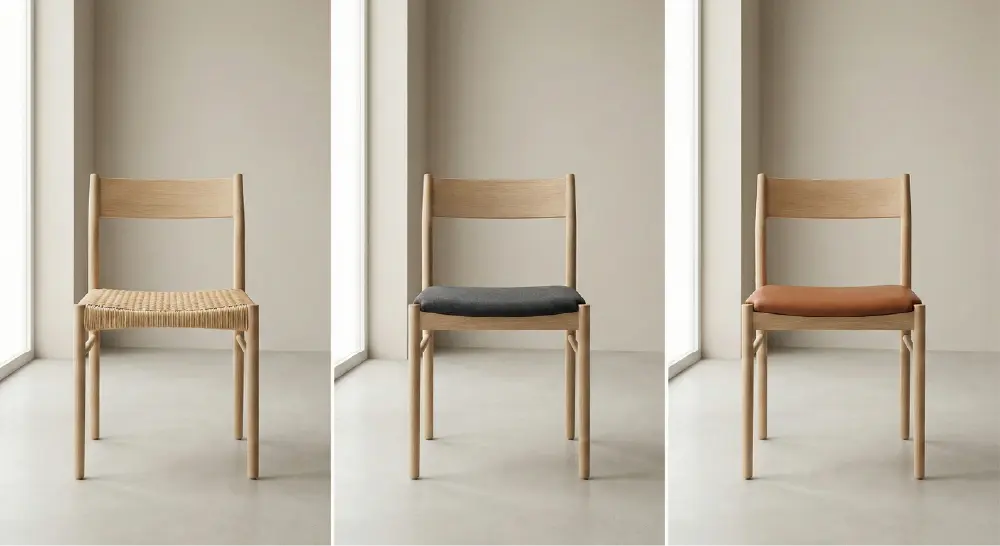
Once you understand MOQ from both financial and production perspectives, the next step is structuring it strategically.
Smart buyers do not ask, “What is your MOQ?” They ask, “How should MOQ be structured for first order and long-term scaling?”
Separate First Order MOQ from Repeat Order MOQ
The first order should focus on validation, not optimization. Volume should be sufficient to test sell-through rate, packaging durability, and customer response, but not so high that it pressures cash flow.
This separation reduces risk in early stages and increases efficiency in later stages.
Structure MOQ Per Collection Instead of Per SKU
Instead of committing high volume to a single SKU, buyers can structure MOQ based on collection grouping or controlled variation within one model.
For example, one of our buyers in the US tested a single chair model in three different weaving or color variations. Technically, it was one core design, but it was divided into three SKUs for market testing. Instead of 60 pcs in one color, they tested in 20-20-20.
This approach allowed the buyer to validate customer preference without overcommitting to one finish. At the same time, because the core frame structure remained the same, our production batching stayed efficient.
This kind of structured variation minimizes buyer risk while keeping Indonesian furniture manufacturers operationally efficient.
Align MOQ with Container Mix Strategy
MOQ planning should align with the container configuration from the beginning. Instead of treating container loading as a final step, integrate it into volume planning.
A mixed container strategy allows multiple SKUs to share space efficiently while maintaining structured quantity per item. This reduces landed cost volatility and avoids last-minute loading adjustments.
How MPP Furniture Approaches MOQ for Long-Term Partnership
At MPP Furniture, MOQ is not designed to push buyers into large commitments. It is structured to build sustainable repeat orders.
Because we operate with full in-house production, we can align MOQ with real production planning rather than rigid volume targets. Our approach focuses on three principles:
- First order as the validation stage. The first shipment should function as a structured market test. Volume must balance production efficiency with demand validation, not maximize quantity.
- Production control before flexibility.
With 100% in-house production, we manage MOQ flexibility without sacrificing quality. Our system monitors moisture content below 12%, machining precision, finishing consistency, and packing standards at every stage. - Long-term scaling.
When demand is validated, scaling volume becomes more efficient for both sides. Unit cost improves, batching becomes smoother, and container planning becomes more optimized. In 2024, our defect rate ratio was 0.56%.
For us, the objective is simple: reduce first-order risk, stabilize production, and create a foundation for long-term cooperation.
Conclusion: MOQ Is a Strategy, Not Just a Number
Minimum Order Quantity should never be treated as a fixed obstacle or a simple pricing lever. It is a structural decision that influences cash flow, inventory turnover, production stability, and long-term partnership potential.
High MOQ without validation increases exposure. Extremely low MOQ without production control increases instability. The right approach sits between these extremes.
For B2B furniture buyers, especially when sourcing from Indonesian furniture manufacturers, the smarter question is not “What is your MOQ?” but “How should we structure MOQ based on validation, container planning, and reorder strategy?”
When MOQ is aligned with risk management, production logic, and market data, it becomes a growth tool rather than a pressure point.
Are you evaluating Indonesian furniture suppliers and want to structure your order realistically?
Start with a discussion about volume strategy before committing to numbers.

Hi, I’m Salman, founder of MPP Furniture, an Indonesian furniture manufacturer serving global retailers and project-based clients.
I began my career in my family’s export-oriented furniture company, gaining hands-on experience in production, construction, finishing, material performance, and product development. With a clear understanding of how international buyers evaluate furniture quality and reliability, I founded MPP Furniture to deliver export-ready products with consistent standards.
Here, I share insights from the perspective of a furniture manufacturer working directly with production teams on the factory floor, focusing on manufacturing and supplier evaluation.
Connect on LinkedIn




0 Comments