
Walk into a typical big-box furniture store today, and you are greeted by technical perfection. Flawless veneers, uniform colors, and surfaces so smooth they feel sterile. Yet, despite this technical precision, consumers are increasingly bored. In a market flooded with disposable homogeneity, the "perfect" product often feels soulless.
This shift in consumer sentiment has given rise to a powerful economic driver: the "Authenticity Premium."
This article explores why patina is not just a finish, but a high-value asset that justifies premium pricing and protects retailer margins. This is the tangible value, often a 30% to 50% price increase that buyers place on an object for displaying signs of history, life, and use. For the B2B buyer and store owner, understanding patina in furniture is no longer just an aesthetic choice; it is a strategic necessity. It is the moat that separates high-margin, brand-building inventory from the commoditized product in the "race to the bottom."
What is Patina in Furniture?
To the uninitiated, patina looks like wear. To the expert, it is a layer of protection and character that signals value. Patina is defined as the acquired change of a material’s surface due to evolving chemical compounds or physical usage.
Unlike damage, which weakens an object, true patina often stabilizes it. It is the physical signature of an object’s history, a chemical transformation that separates a "used" chair from an "heirloom" piece.
Natural vs. Applied Patina: The Difference
Patina is not a single event; it is a timeline. For retailers sourcing inventory, distinguishing between natural and applied processes is critical.
The Natural Process (Autocatalytic)
This is the "real deal," resulting from decades of undisturbed interaction with the environment. It is driven by factors like oxygen, UV light, humidity, and even the oils from human skin. While highly valued in the antique market, it is slow, unpredictable, and impossible to scale for mass retail.
The Applied Process (Craftsmanship)
In the modern furniture industry, retailers cannot wait 50 years for a table to develop character. This leads to "Applied Patina" or distressing. This is an art form where skilled craftspeople use specialized chemical catalysts (like acidic solutions for metals) or mechanical techniques (chisels, layering) to replicate the look of age.
For the volume retailer, Applied Patina is the strategic sweet spot. It allows you to offer the "heritage look" consumers crave, but with the structural integrity and availability of a brand-new product.
Patina Guide: Wood, Metal, and Leather
Not all aging is created equal. To sell distressed furniture effectively, you must articulate the narrative behind the finish.
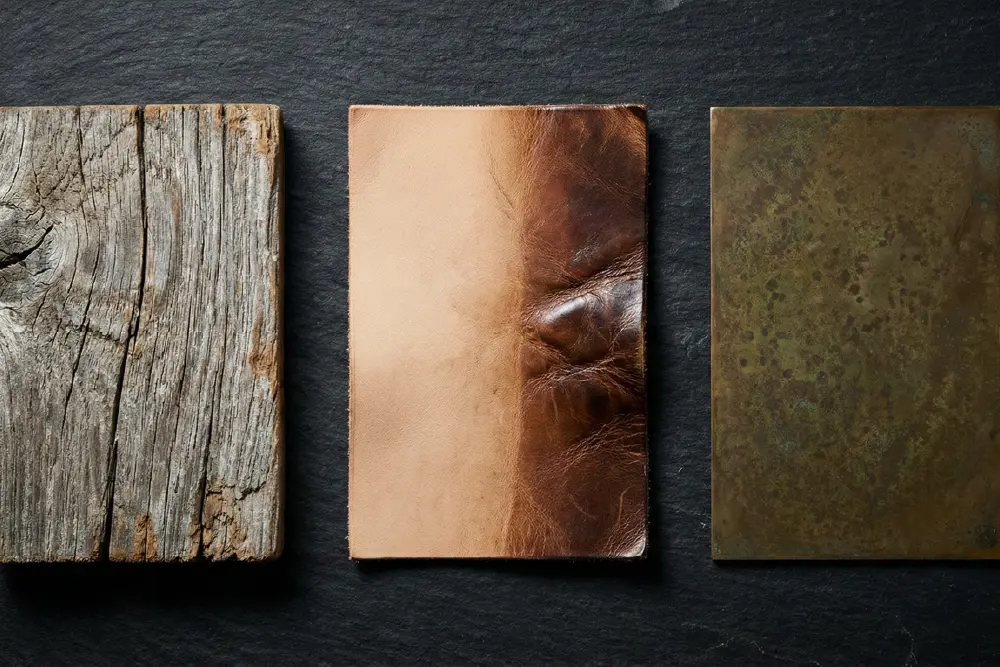
Wood: The Photochemical Shift
Wood doesn't just fade; it evolves through photochemical reactions driven by UV radiation, breaking down lignin.
- The Look: Over time, raw woods shift toward warm honey tones or, in the case of teak and oak, a distinguished silver-grey.
- Retail Angle: Educate customers that the silvering of an outdoor chair isn't "rot", it's a protective layer of oxidized cells that actually shields the wood beneath.
It is crucial to distinguish this natural process from quality issues; learn more about common wood defects in teak furniture export.
Metal: Noble Rust vs. Verdigris
This is where the science gets critical for quality control.
- The Science: Copper and bronze oxidize to form carbonates and sulfates.
- The Look: The transition from shiny red/gold to rich browns and eventually the iconic green "Verdigris."
- Retail Angle: Distinguish between "Noble Rust" (a stable, protective layer) and active corrosion. Noble rust stops the metal from degrading further; it is a value-add. Active rust destroys the asset.
Leather: The Self-Healing Asset
Vegetable-tanned leather (like Vachetta) is unique because it interacts with the user's biology.
- The Science: It absorbs environmental moisture and skin oils over years of use.
- The Look: It darkens, softens, and develops a "sheen" that acts as a natural sealant.
- Retail Angle: Sell the "evolution." A leather sofa shouldn't look the same in year 5 as it did in year 1. If it does, it's likely plastic-coated. Real luxury gets better with use.
For a deeper understanding of material quality, discover 3 reasons why woven leather furniture is superior.
The Value of Patina: Consumer Psychology
Moving beyond the material science, the true driver of the Authenticity Premium lies in consumer psychology. Why do customers pay more for "imperfection"?
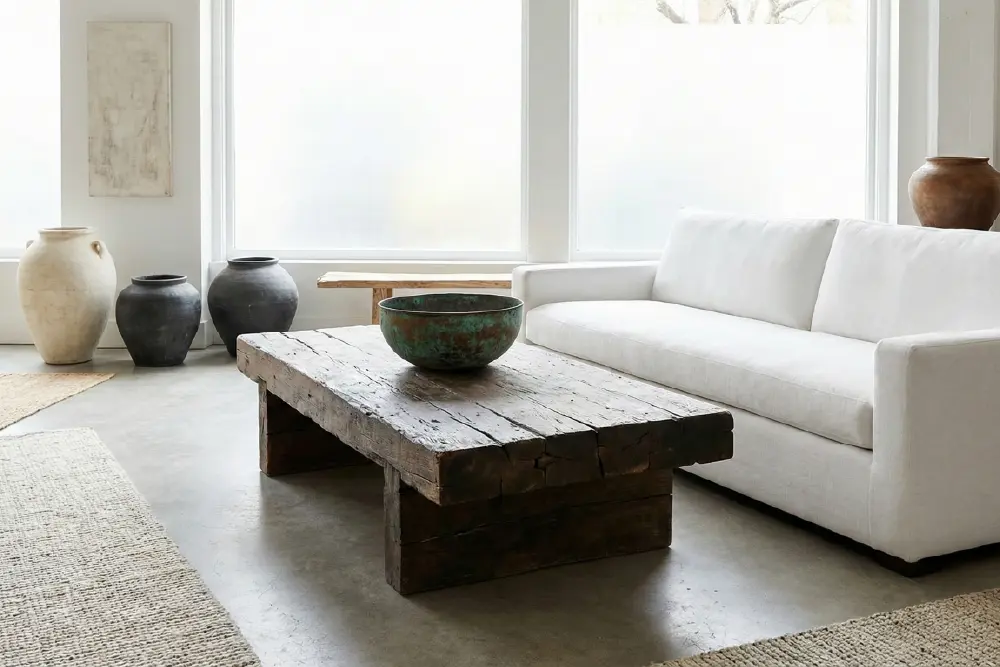
The “Wabi-Sabi” Effect
Rooted in Japanese aesthetics, Wabi-Sabi values the imperfect, impermanent, and incomplete. In a high-stress, digital world, customers find a subconscious peace in natural textures that show the passage of time.
To see where this trend is heading next, explore the concept of Dark Wabi-Sabi in luxury hospitality style for 2026.
The “Age-Value” Paradox
There is a counterintuitive logic at play: Consumers assume that if an object looks old, it must be built well. If it has survived this long (or looks like it has), it implies a "survival of the fittest" build quality that modern disposable furniture lacks. Patina is social proof of durability.
What It Means for Retailers
If you are competing on price, you are competing with algorithms. If you compete on character, you are competing in a blue ocean.
- Margin Protection: It is easy for a customer to price-match a generic white laminate desk. It is nearly impossible to price-match a hand-distressed mahogany sideboard. The uniqueness of the finish breaks the direct comparison, protecting your margins.
- Differentiation: Patina tells a story. "New" furniture sells utility; "Patinated" furniture sells a narrative.
See specifically how weathered wood finishes add value for retailers in today's competitive landscape.
How Retailers Can Take Advantage
Visual Merchandising (The Mix)
Don't just sell "old-looking" stuff. The most powerful aesthetic right now is the "Curated Mix", placing a distressed, rustic console table next to a sleek, modern sofa. The contrast makes both pop.
For sourcing ideas, look at retailers specializing in this textured aesthetic, such as those offering Indonesian woven leather dining chairs.
Education as a Sales Tool
Train your staff to explain the why. When a customer asks about a color variation in wood, the answer shouldn't be "Oh, that's just how it comes." It should be, "That is the natural heartwood showing through; it’s proof that this is solid timber, not veneer."
The Challenge: Scalability vs. Soul
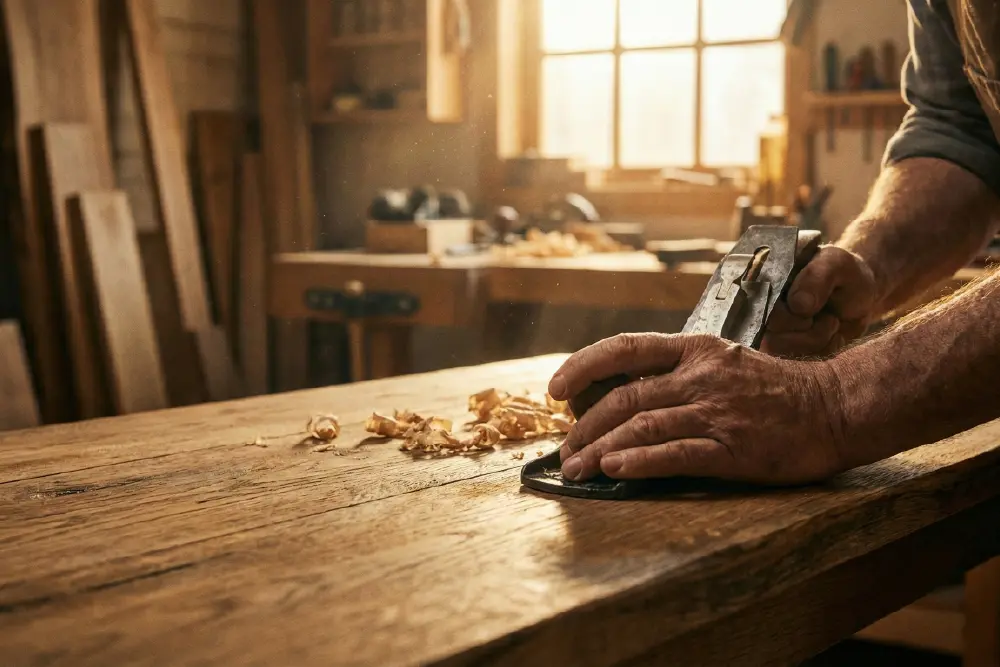
The challenge is clear: Natural patina is unpredictable.
If you are a retailer with 50 locations, you cannot rely on sourcing genuine antiques. You need 500 dining tables that look like they come from a 19th-century French farmhouse, but you need them to be identical in dimensions, structurally sound, and available next month.
Furthermore, bad "distressing" is obvious. We've all seen "farmhouse" tables with generic, repeating scratch patterns that look like they came off a conveyor belt. That doesn't add value; it destroys it.
You need a partner who can scale artistry.
The Solution: MPP Furniture
This is where a manufacturing partner like MPP Furniture bridges the gap.
MPP operates with a philosophy of "Controlled Authenticity." They don't just manufacture furniture; they engineer character.
- In-House Mastery: Unlike many manufacturers who subcontract finishing, MPP keeps 100% of production in-house. From the raw log to the final hand-applied finish, every step is controlled. This is how they achieve the "Authenticity Premium" at scale.
- The 0.56% Standard: In the world of distressed and hand-finished furniture, inconsistency is the enemy. MPP boasts a major defect/complaint rate of just 0.56% per year. That is a staggering statistic for an Indonesian furniture supplier producing complex, organic finishes. It means you get the soul of an artisan product with the reliability of an industrial one.
- Grow Together: Their core value isn't just shipping containers; it's "Continuous Improvement." With 20+ years of experience and full SVLK certification, they ensure that your "heritage" line arrives on time, sustainable, and ready for the modern showroom.
Conclusion
Patina is more than just a finish choice; it is a rejection of the disposable.
The key takeaway is clear: Patina is a high-value asset that justifies premium pricing and protects retailer margins. For the modern retailer, the opportunity lies in sourcing products that carry this emotional weight. Products that don't just fill a space, but anchor it. By understanding the science of surface evolution and partnering with Indonesian furniture manufacturers like MPP, who can replicate it with precision, you don't just sell furniture. You sell the one thing money usually can't buy: Time.
Your next best-seller might be here
Request a quotation and custom options tailored to your needs today via WhatsApp or email.
Frequently Asked Questions
What is the difference between patina and damage?
Patina represents a protective and aesthetic surface change—such as oxidation on copper or seasoning on leather—that stabilizes the material. In contrast, damage like rot or deep cracks compromises structural integrity and lowers value. While patina tells a story, damage effectively ends it.
Does patina increase the value of furniture?
Yes. The "Authenticity Premium" phenomenon suggests that furniture with high-quality patina can command prices 30% to 50% higher than pristine equivalents. This occurs because patina provides "social proof" of durability, craftsmanship, and heritage, distinguishing the item from mass-produced disposable goods.
What is "Noble Rust" in metal furniture?
Noble rust describes a stable, protective layer of oxidation that forms on metals like bronze and copper. Unlike "active corrosion" that eats away the metal, this layer seals the surface from further degradation and preserves the asset while providing a desirable vintage aesthetic.
Why does teak furniture turn silver-grey?
Teak undergoes a photochemical process where UV radiation breaks down surface lignin. This natural, protective evolution signifies that the furniture consists of genuine, solid timber rather than veneer or synthetic composites.
Is distressed (applied patina) furniture durable?
Yes, provided it comes from reputable manufacturers. Applied patina utilizes artistic techniques like glazing or hand-scraping to replicate age on the surface. These items offer the aesthetic of an antique while retaining the structural integrity and longevity of a brand-new product.

I am a self-taught graphic designer with a deep passion for exploring the creative world through various tools and techniques. I have honed my skills in Adobe Illustrator, Photoshop, and Lightroom, while continuously expanding my knowledge by diving into After Effects and Premiere. Photography has become an integral part of my life, and I actively engage with it to capture moments and experiment with visual storytelling.
My fascination with color theory, histograms, and innovative design approaches drives my work, as I am always seeking new ways to push the boundaries of my creativity. From photography models and motion graphics to textures, collage, and surrealism, I am captivated by the endless possibilities in design and constantly strive to challenge myself with fresh and exciting ideas.
0 Comments