
In the B2B world of wooden furniture, few issues are more costly than unexpected material failure. For retailers, importers, and project managers, nothing is more frustrating than receiving a shipment of beautiful Solid Wood Furniture only to see it cup or warp over time. This frustrating issue is often blamed on the manufacturing process and quickly escalates into costly warranty claims. While quality control certainly matters, the true root cause of many stability issues is a predictable physics problem: the misapplication of a log's cut. This technical oversight is a major, avoidable Wood Movement Risk.
This guide is for you, the decision-maker and procurement manager. Our goal is to equip you with the knowledge needed to upgrade your Commercial Wood Specification documents. By understanding the physics of Plain Sawn versus Quarter Sawn lumber, you can mandate the correct material for high-risk components, effectively guaranteeing Dimensional Stability and preventing costly claims in your finished products.
Wood Science Explained: Understanding Tangential vs. Radial Wood Movement
To control wood, you must first understand the fundamental way it behaves. Wood is a natural, hygroscopic material, meaning it constantly absorbs and releases moisture, causing it to change size. This movement is not random; it follows predictable patterns relative to the tree’s growth rings. As wood is an anisotropic material, its dimensions change differently in three primary directions.
The Anatomy of a Log: Annual Rings, Tangential (Parallel), and Radial (Perpendicular) Directions.
Imagine a cross-section of a tree trunk. The log is structured around the annual growth rings. We define movement in three ways:
- Longitudinal: Along the length of the grain (usually negligible).
- Tangential: Parallel to the growth rings (the direction around the tree).
- Radial: Perpendicular to the growth rings (the direction from the center out).
The Critical Difference: Tangential Shrinkage (Greatest Movement) vs. Radial Shrinkage (Least Movement).
Here is the technical reality: wood shrinks and swells at different rates depending on the direction of the grain.
- Tangential Shrinkage is the greatest movement, typically two to three times greater than radial movement. The U.S. Forest Products Laboratory confirms that Tangential Shrinkage is the greatest movement, exceeding radial movement significantly.
- Radial Shrinkage is the smallest movement, running from the center (pith) to the bark.
The Consequence: This Differential Movement Causes Cupping and Warping.
Because the tangential and radial movements are so different, differential stress is created when a board releases moisture. If a board is cut in a way that exposes a large section to high tangential movement, it will shrink much more on that face, forcing the board to warp or cup. This is the simple physical cause of almost all component instability, the essence of Wood Movement. The relationship between these values is expressed as the T/R ratio, which serves as a reliable measure of a wood's inherent dimensional stability.
Sourcing Stability: Plain Sawn vs. Quarter Sawn for Wood Movement Risk Control
The way a log is cut determines the grain pattern seen on the board's face and, more importantly, its long-term stability. For Furniture Warranty Mitigation, the choice between the two main cuts is the most impactful decision you can make in your material specification.
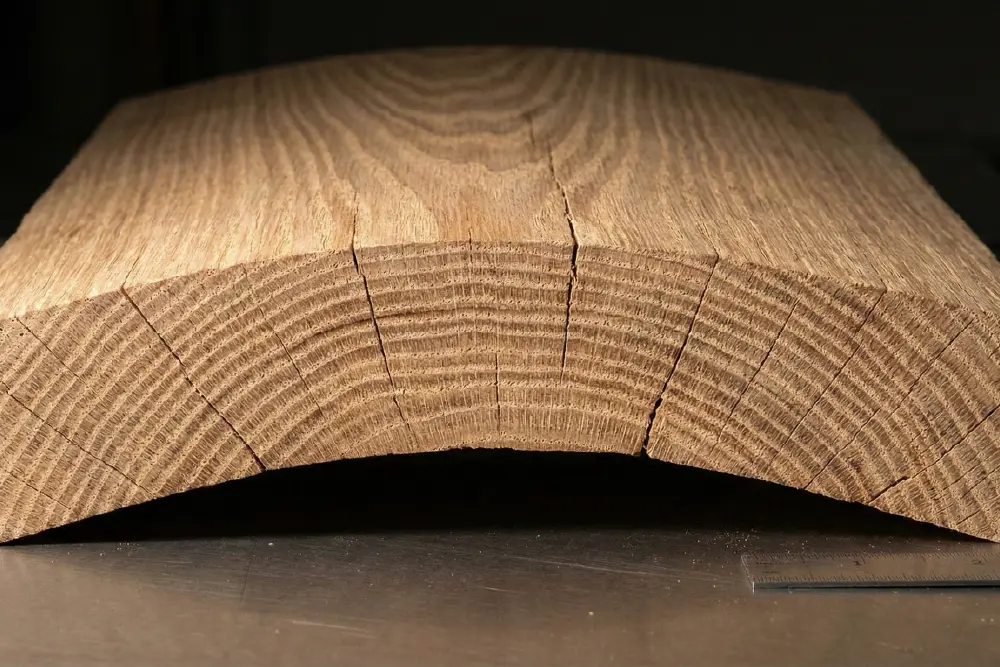
Plain Sawn: High Wood Movement Risk and Cost-Effectiveness.
Plain Sawn (or flat-sawn) is the most common and fastest way to cut a log.
- Grain Appearance: It features the familiar, arching “cathedral” pattern on the board face.
- Stability Profile: Because the growth rings run parallel to the width of the board, the board's face is largely experiencing Tangential Shrinkage. This exposes it to the maximum amount of Wood Movement Risk.
- Best Use: This material is perfectly acceptable for frame components, stretchers, legs, and posts where the component is narrow and dimensional stability is primarily managed by the surrounding joinery. It is also the most cost-effective option, which is important for budget considerations.
To see how our Indonesian Furniture Manufacturer ensures precision and consistency in processing all cuts, explore our guide on full in-house production and advanced machinery.
Quarter Sawn: Superior Dimensional Stability and Lower Risk.
Quarter Sawn lumber is cut by first dividing the log into quarters and then sawing perpendicular to the growth rings.
- Grain Appearance: It features distinct, straight, parallel stripes or lines running the length of the board. In some species, it also produces beautiful medullary rays (figure).
- Stability Profile: The growth rings run close to perpendicular (80 to 90 degrees) to the board’s face. This means the board is experiencing Radial Shrinkage across its width, the direction of least movement. This dramatically increases the Dimensional Stability of the finished piece. Studies confirm that Quartersawn boards cup less during drying and in use.
- Best Use: This is the standard for high-performance surfaces where stability is non-negotiable, such as fine cabinetry, flooring, and wide panels like tabletops.
Cost vs. Risk Analysis for Furniture Warranty Mitigation.
The reality of B2B procurement means balancing quality with budget. Quarter Sawn lumber is often 20% to 50% more expensive because the process is slower and yields less usable material from the log.
However, consider the cost of failure. The slight savings gained by using Plain Sawn wood for a high-risk component like a large dining table top will be wiped out tenfold by a single warranty claim. For this reason, Commercial Wood Specification must be an analysis of Cost vs. Risk, not just Cost. By partnering with an Indonesian Furniture Manufacturer that can source and process both cuts with precision, you can apply the right material where it truly matters. We are experts in optimizing this balance.
Commercial Wood Specification: Choosing Cuts for Stability
The knowledge of tangential and radial shrinkage is applied directly to your Wood Tech Pack Specifications. Instead of simply specifying the species and moisture content, you must specify the cut based on the component's function.
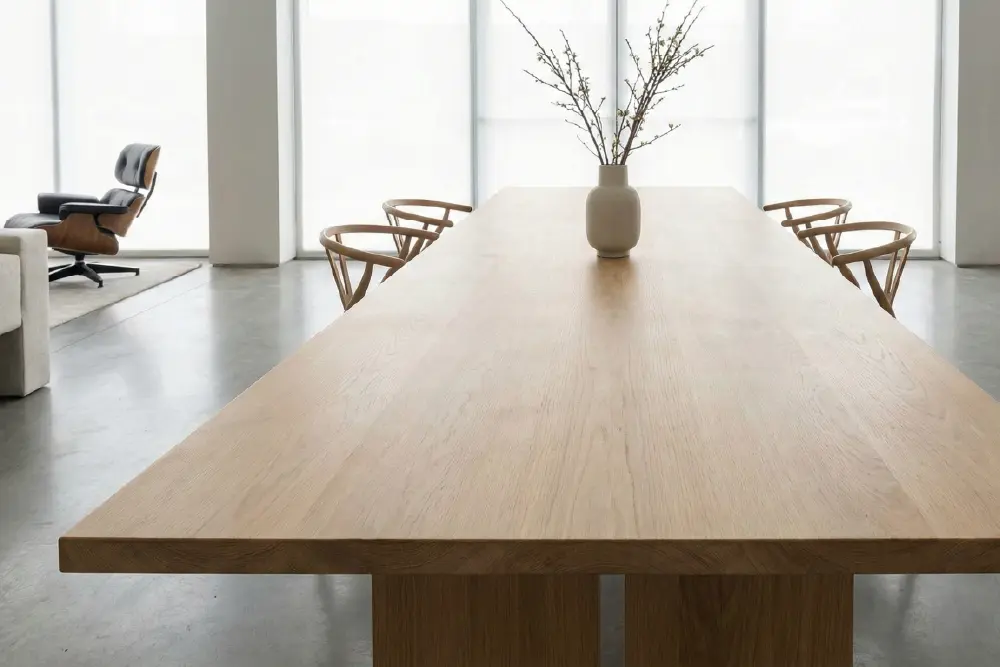
Core Principle: Mandating Low Wood Movement Risk Components.
Any component that involves a wide, flat surface, or that is part of a complex assembly where even minor movement can compromise function, must be made from Quarter Sawn lumber.
- High-Risk Components (Require Quarter Sawn):
- Table Top Construction (especially wide surfaces).
- Wide Panel Stability (door panels, side panels of large case goods).
- Drawer fronts (for fine-fitting drawers).
Beyond movement, specifiers must be alert to other problems. Learn more about identifying common wood defects that can compromise quality and durability.
Critical Case Study: Table Top Construction and Wide Panel Stability.
A dining table top is the perfect example. It is a wide panel that is subject to changes in humidity on both its top and bottom surfaces, making it highly susceptible to cupping.
When MPP Furniture, a leading Indonesian Furniture Manufacturer, constructs a Table Top Construction for an Expertly Handcrafted dining table, our internal quality control protocols often mandate Quarter Sawn lumber for the field of the top (the visible, central planks). This ensures the maximum Dimensional Stability under real-world conditions. This is part of our commitment to Attention to Detail that translates into long-term value for our clients.
This process also includes ensuring ethical sourcing. You can review our commitment to sourcing legally compliant materials and our certification protocols.
For a deeper look at our systems, read our article on detailed quality control in manufacturing.
When Plain Sawn is Acceptable (Budget Consideration).
We are here to provide solutions that meet market demands. Plain Sawn material is the industry standard for a reason—it’s cost-effective and perfectly suitable for components where movement is contained or negligible.
- Acceptable Use (Plain Sawn):
- Legs and bases (when narrow).
- Internal frame parts.
- Mouldings (when small).
- Case good components where the piece is narrow and part of a larger, constrained assembly.
A simple yet crucial step to mitigate Wood Movement Risk is to clearly delineate the required cut for each component in your technical drawings before manufacturing even begins.
Conclusion: Eliminating Wood Movement Risk via Commercial Specification
The choice between Plain Sawn and Quarter Sawn is a critical engineering decision that dictates the long-term Solid Wood Furniture Durability and success of your projects. To prevent costly warranty claims, specifiers must move beyond simple material selection and explicitly mandate the proper cut for high-risk components in their Wood Tech Pack Specifications. The actionable step for improving your Furniture Warranty Mitigation strategy is clear: update your documentation to require Quarter Sawn material on all wide, critical surfaces where Dimensional Stability is non-negotiable.
As a Reliable Manufacturer and experienced Indonesian Furniture Supplier, MPP Furniture is dedicated to transparency and partnership. We use our Expertly Handcrafted process and Attention to Detail to build products that truly last. Our minimal complaint ratio of 0.56% and free consultation services prove our commitment to flag potential Wood Movement Risk before production starts.
Ready to upgrade your Commercial Wood Specification and secure long-term furniture performance? Contact us today to benefit from our free consultation and product development services.
Your next best-seller might be here
Request a quotation and custom options tailored to your needs today via WhatsApp or email.
Frequently Asked Questions
Does the species of wood (e.g., Teak vs. Mahogany) affect the movement difference between the cuts?
Yes, the species affects the degree of movement, but not the principle. Every species has inherent Tangential Shrinkage and Radial Shrinkage values. While Teak is naturally more dimensionally stable than many other woods (meaning its overall movement is less), it will still exhibit greater movement tangentially than radially. Therefore, the Quarter Sawn cut will always be the more stable option for any given species.
Is there a scenario where Quarter Sawn wood is not the better choice for furniture components?
While Quarter Sawn offers superior Dimensional Stability, it may not always be the better commercial choice. For narrow components like chair rungs or simple furniture legs, the added cost of Quarter Sawn material offers little practical benefit. Additionally, some high-end, period-style furniture designs specifically require the "cathedral" look of Plain Sawn for visual authenticity. The decision should always balance stability needs against aesthetic preference and budget constraints.
What is the ideal moisture content (MC) for wooden furniture being manufactured for export?
The ideal moisture content for furniture destined for indoor use in North America, Europe, or Australia is typically between 6% and 8%. This range minimizes Wood Movement by matching the wood's moisture level to the expected average Equilibrium Moisture Content (EMC) of heated and air-conditioned end-use environments.
Beyond the cut (Plain Sawn/Quarter Sawn), what measures prevent wood warping in wide panels?
Warping prevention requires a multi-step approach. Critical measures include: A) Proper Acclimation: Stacking the wood with stickers to allow airflow and equalize moisture before assembly. B) Balanced Construction: Applying identical finishes or veneers to both sides of the panel (top and bottom) to control moisture exchange evenly. C) Specialized Joinery: Using hardware like slotted screws or floating panel systems that allow for controlled seasonal movement.

I am a self-taught graphic designer with a deep passion for exploring the creative world through various tools and techniques. I have honed my skills in Adobe Illustrator, Photoshop, and Lightroom, while continuously expanding my knowledge by diving into After Effects and Premiere. Photography has become an integral part of my life, and I actively engage with it to capture moments and experiment with visual storytelling.
My fascination with color theory, histograms, and innovative design approaches drives my work, as I am always seeking new ways to push the boundaries of my creativity. From photography models and motion graphics to textures, collage, and surrealism, I am captivated by the endless possibilities in design and constantly strive to challenge myself with fresh and exciting ideas.

0 Comments