Is a third-party inspection really needed for every order? Not always; however, it is one of the clearest ways to create transparency when purchasing from Indonesian furniture suppliers. It gives both sides the same facts before shipment, making conversations simple, cutting risk, and building long-term trust.
Many overseas buyers face uncertainty, wondering if the final furniture will match what they approved from afar. At MPP, we understand that distance and communication gaps can cause concern, which is why our internal QC is strict across materials, machining, assembly, finishing, and packing, and we go further by promoting full transparency through third-party inspection as reassurance.
Before diving deeper, here’s the key message: third-party inspection is not about doubt; it’s about creating transparency that benefits both buyers and suppliers. It provides proof of quality, reduces misunderstandings, and builds stronger business relationships based on trust.
Understanding the Role of Third-Party Inspection in Furniture Sourcing
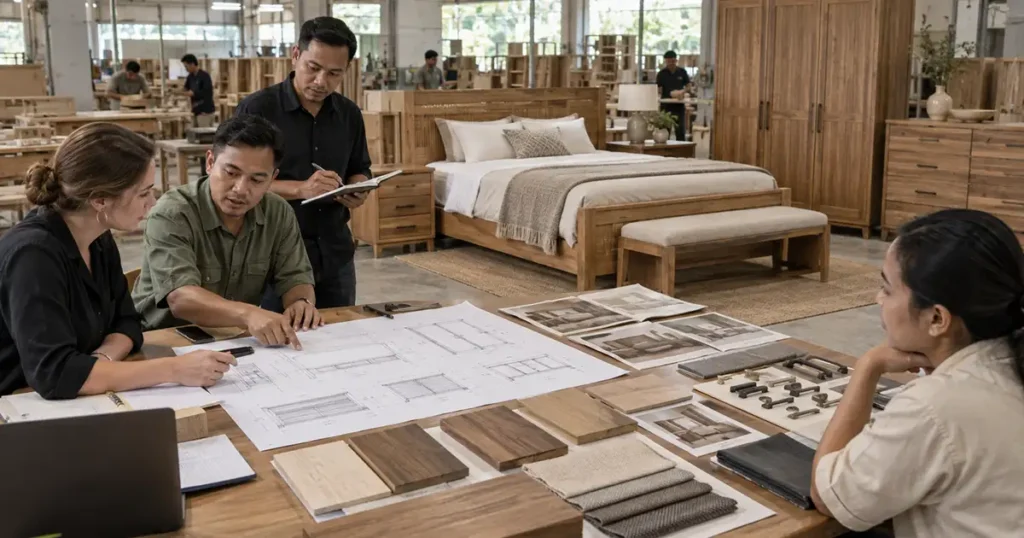
Third-party inspection is an independent check by a qualified team that compares finished goods against the specs in your PO or purchase contract. Inspectors look at samples from the lot, measure key points, review color and finish, and verify packing details. They also document what they see with clear photos and notes.
The point is not to “catch” a supplier, but to confirm that the order matches what was agreed. This helps both buyer and factory speak with facts, not guesses.
Why Transparency Is the Real Value of Third-Party Inspection
Transparency is the main benefit. Sourcing across borders adds distance, time zones, and language barriers, and a neutral report closes those gaps. It makes it easier to approve shipments, release payments, and plan store launches.
For first-time buyers, a neutral report can replace a factory visit; for repeat buyers, it can serve as a spot check during peak seasons. For the factory, a pass result is proof that the process is working, and for both sides, the report becomes a reference for future orders.
In a related study, InTouch Quality (2023) explains that pre-shipment inspection not only ensures product quality but also strengthens a company’s market reputation. This supports the idea that inspection is an investment in credibility and customer trust, aligning perfectly with how MPP views transparency in every shipment.
How Third-Party Inspection Builds Mutual Trust Between Buyer and Indonesian Furniture Suppliers
What buyers gain
- Confidence before shipment: You get objective proof on color tone, finishing quality, joinery, dimensions, and packing.
- Fewer disputes: Clear photos and measurements make decisions simple.
- Better planning: If an issue appears, you know early and can choose rework, partial ship, or SKU swap.
What suppliers gain
- Validation of quality: A pass result strengthens the factory’s reputation with your team and any new stakeholders.
- Clear direction: If something needs attention, the report pinpoints it, so rework is fast and focused.
- Long-term trust: Consistent pass results reduce friction and speed up approvals over time.\
Shared benefit
Inspection creates a shared truth; that shared truth is the base of a long partnership.
From MPP’s point of view, as an Indonesian furniture manufacturer, we are genuinely pleased when a third-party inspection takes place. It gives us another layer of confirmation that our quality meets expectations before shipping.
For us, TPI is not only about making the buyer feel secure; it also makes us confident. Our principle is simple: we’d rather rework a product if a third-party inspector finds a defect than have an issue when the goods reach the buyer.
Common Misconceptions About Third-Party Inspection
| Misconception | Reality | What it means for you |
| “Inspection means I don’t trust my supplier.” | It shows professionalism and due diligence. | Trust grows faster when both sides agree on facts. |
| “Inspection always delays shipment.” | Early planning keeps timelines smooth. | Book windows in the PI so production and inspection fit together. |
| “Strong factories don’t need inspection.” | Good factories welcome validation. | A pass report is a strong signal for future orders. |
When to Conduct Third-Party Inspection (Timing That Works Best)
Pre-Shipment Inspection (PSI) is the most common, done when the order is complete and packed, before container loading. It gives you final confirmation on specs and packing.
For large programs, custom designs, or tight color tolerances, many buyers also add During-Production (DUPRO) checks around 30–60% completion. This can catch issues early and keep finishing or weaving on track.
MPP supports any of these paths. Our role is to help you pick the right level of oversight for the order at hand.
In our experience as an Indonesian furniture supplier, we have conducted both During-Production and Pre-Shipment Inspections for many buyers, and we continue to do so today. For instance, one of our buyers conducted a DUPRO inspection at our Indonesian furniture manufacturing site to ensure every production stage met quality expectations, helping us enhance quality further.
Another buyer in the United States requires all new furniture items to undergo laboratory testing with Bureau Veritas to confirm product construction standards before ordering; this process has strengthened their customers’ trust in our quality and reliability.
This consistent practice shows how open we are to collaboration with third-party agencies. We, as one of the leading Indonesian furniture manufacturers, welcome these inspections because they confirm our standards before shipment, giving buyers confidence and ensuring that every container leaves our facility meeting expectations.
When Should You Use Third-Party Inspection? (Quick Decision Guide)
| Scenario | Recommendation |
| New supplier + high-value or custom SKUs | PSI recommended; consider DUPRO for early detection and alignment. |
| Large volume or retail program with strict returns | PSI is often required; add spot checks on top SKUs. |
| Repeat order with stable specs and a strong track record | TPI optional; consider virtual check + factory photo report. |
| Small pilot/trial order with simple SKUs | Often skip TPI; use golden sample, labeled swatches, and packing photo/video. |
| Tight color/finish tolerances or complex sets | Add DUPRO at 30–60%; plus PSI before loading. |
| Budget-limited but risk-aware | Limited-scope PSI focusing on top-value/high-risk SKUs. |
If you're unsure, Indonesian furniture suppliers, like us, MPP, can help map the right oversight level based on risk, budget, and timeline.
How to Communicate Expectations Clearly (With or Without Third-Party Inspection)
Clear expectations drive good results. Keep it simple and visual.
- Write specs in plain language and attach drawings with key dimensions.
- Agree on the finish tone with a golden sample or labeled swatches.
- List what photos and videos you want and when you want them.
- Put the review window in the PO or PI so production, inspection, and vessel dates line up.
- Confirm documents upfront, including legality for wood products and any retailer label formats.
This level of clarity helps even when you skip a full external check on lower-risk orders.
How Reliable Indonesian Furniture Manufacturers Handle Third-Party Inspections (MPP Example)
Open access: We are comfortable with onsite audits and virtual checks. Many buyers start with a video walk-through of machining, assembly, finishing, and packing areas. We also share labeled photos during key milestones.
Easy coordination: Our team prepares spec sheets, drawings, finish swatches, and packing details for the inspector. We align dates with your PI, vessel cut-off, and any retailer program timelines.
In-house QC that matches external checks: Our QC lists cover moisture targets, joinery strength, sanding grade, finish uniformity, weaving tension (for rattan), and carton protection. This mirrors what third-party teams look for, so there is no friction on inspection day.
Packaging visibility: We welcome checks on inner protections, corners, and carton tests aligned to common retail needs. Barcodes, labels, and shipping marks are checked against the PO.
Trust data that backs the process: We track satisfaction and complaints closely. Our current record: 99% client satisfaction and a 0.56% complaint ratio over shipped orders. Lead times are transparent, typically 45–60 days depending on mix and volume. Updates go out weekly by default.
The message is simple: we do not fear outside eyes. We invite them.
Why Some Manufacturers Resist Third-Party Inspection (and What That Signals)
Most Indonesian furniture suppliers that take the process seriously are relaxed about neutral checks. Resistance can be a sign of weak process control or rushed schedules. Watch for:
- Pushing to skip any form of review
- Refusing a virtual walk-through
- Inconsistent documents or missing legality papers
- Sudden pressure to load before a planned pre-shipment check
These are signals to slow down and ask more questions. A reliable supplier treats inspection as a normal part of export business.
Conclusion: Transparency Builds Confidence, Not Doubt
Third-party inspection is more than a quality step; it is a transparency step that helps both buyer and supplier move with confidence. You may not need it for every order, but when risk, volume, or program rules are high, it is a smart spend.
As one of the trusted Indonesian furniture manufacturers, MPP supports whatever level of oversight fits your goals and budget. We are open to third-party teams, we share data freely, and we stand behind the work we ship. If you want a furniture supplier that treats transparency as standard practice, we are ready to talk.
Still Wondering Your Needs for Build Your Collection Line?
Schedule a Consultation and Discuss Your Needs with Us
FAQs
Do I need a third-party inspection for a small order?
Not always; for sample runs or simple SKUs, many buyers use virtual checks and photo packs. For big sets or tight finishes, a PSI is helpful.
Can I hire any inspection agency in Indonesia?
Yes, pick a reputable team with furniture experience. MPP works with your chosen agency and prepares everything they need.
Will inspection slow down my shipment?
If you plan the window in your PI and share dates early, the process fits the timeline. Lack of planning, not inspection itself, is what causes delay.
What if my budget is tight?
Use a limited-scope check on top-value SKUs, or pair factory photo packs with a virtual call; you still get visibility at lower cost.
Is inspection still useful after I trust my supplier?
Yes, but you can scale it. Many buyers do full PSI on the first orders, then switch to spot checks or virtual reviews on repeat orders.
Helpful internal reads from MPP
- Supplier vetting questions and red flags: https://mppfurniture.com/indonesian-furniture-supplier-checklist/
- Step-by-step buying guide for Indonesia: https://mppfurniture.com/how-to-buy-furniture-from-indonesian-suppliers/
- Why visiting your supplier matters: https://mppfurniture.com/visit-indonesian-furniture-supplier-important/
- Sourcing factors for export success: https://mppfurniture.com/indonesian-furniture-manufacturers-3-key-factors/

Hi, I’m Salman, founder of MPP Furniture, an Indonesian furniture manufacturer serving global retailers and project-based clients.
I began my career in my family’s export-oriented furniture company, gaining hands-on experience in production, construction, finishing, material performance, and product development. With a clear understanding of how international buyers evaluate furniture quality and reliability, I founded MPP Furniture to deliver export-ready products with consistent standards.
Here, I share insights from the perspective of a furniture manufacturer working directly with production teams on the factory floor, focusing on manufacturing and supplier evaluation.
Connect on LinkedIn
0 Comments