
In November 2025, a European furniture retailer from Sweden contacted our team. He was not searching for new designs, lower prices, or shorter lead times. His goal was simple: he wanted to feel calm again.
For years, he had worked with the same manufacturer. But repeated quality issues slowly took control of his business. Cracked wood, unstable joinery, and customer complaints became recurring problems. Each shipment arrived with uncertainty. Growth plans were delayed because the risk felt too high.
This case study explains how choosing the right Indonesian furniture manufacturer helped him regain control, restore confidence, and move his business forward again.
Why Repeated Furniture Quality Failures Stop Business Growth
At a certain point, the problem was no longer the furniture itself. It was the constant uncertainty before every shipment. Each delivery arrived with anxiety, not confidence.
When every production decision feels risky, business growth slows down. Plans to scale, launch new collections, or enter new markets are delayed. The business shifts from building forward to managing damage.
The retailer focused on indoor furniture collections for the European market. His product range included console tables, coffee tables, sideboards, and low cabinets.
Over time, several problems kept appearing:
- Wood cracking after arrival in Europe
- Joinery loosening during normal use
- Inconsistent quality between production batches
- Rising customer complaints and returns
The real issue was not cost. It was mental pressure that built up over time. The buyer no longer felt safe relying on his production pipeline.
For a retailer preparing new collections and exhibitions, unstable joinery is not just a quality issue. It directly risks brand credibility in front of distributors and long-term partners.
Time spent fixing recurring defects also meant less time to develop new collections or expand market reach. Instead of planning the next collection, most energy was spent preventing the same problems from happening again.
He explained that he was not the type of buyer who switches suppliers often. But the same problems kept happening, and he no longer felt safe scaling his business.
Why the Buyer Looked for a New Indonesian Furniture Manufacturer
Before contacting us, the buyer spent time researching Mindi wood, the material used by his previous supplier. He wanted to understand why the same problems kept happening.
When he found our article explaining Mindi Wood's behavior and risks, it matched his real experience. That clarity helped build initial trust before any commercial discussion started.
Learn about the technical properties and risks of Mindi Wood in furniture production
After that, he contacted us to ask whether we could produce his existing furniture models using mindi wood. We confirmed that it was possible and provided a price quotation based on his specifications. Once the pricing aligned with his expectations, he decided to move forward to the next step.
Only after the technical discussion and price confirmation did he request samples, not as an experiment, but as a way to validate whether the problems he faced before could be prevented at the factory level.
Why the Sample Request is Important Before the Factory Visit
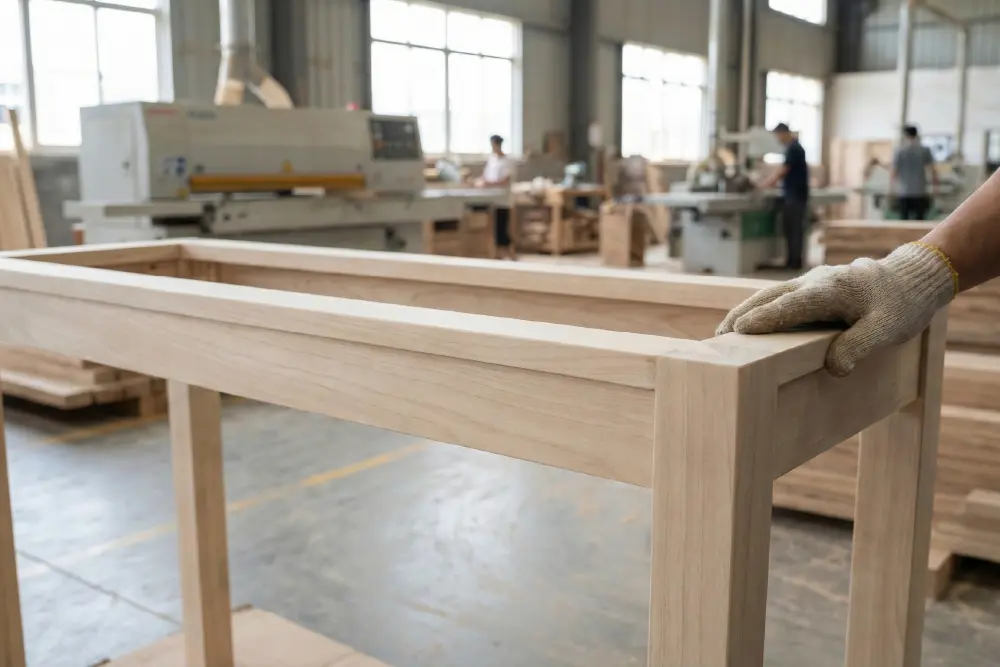
For the buyer, the sample request was not a casual trial. It was a serious checkpoint before committing further. He needed proof, not promises.
The main question was simple but critical: could this factory reproduce the same look he was used to, but with a safer and more reliable construction?
The samples needed to match the existing look and proportions he was familiar with. Visual consistency was non-negotiable.
At the same time, the construction had to reduce the risks it faced before. Stability and repeatability mattered more than experimental changes.
Requested samples:
- Indoor console table
- Indoor coffee table
- Initial preference: Mindi Wood
At that time, Mindi Wood's stock was not available. Instead of forcing material availability, we explained the situation clearly and proposed Sungkai wood as an alternative with lower structural risk.
We explained why Sungkai wood helps lower structural risk, especially for indoor export furniture:
- Less movement after kiln drying, which helps joints stay tight over time
- Better performance across humidity changes, from production floor to container shipping to heated European interiors
- Lower probability of cracks, gaps, and loosened joinery during long-term use
What furniture buyers must understand before choosing Sungkai Wood furniture
This made Sungkai a safer option for maintaining structure without changing the visual proportions of the design. The buyer agreed to proceed, as long as the final appearance and proportions stayed consistent with his original designs.
During the sample discussion, one concern became very clear. On the coffee table design, the buyer worried that the slatted construction could become loose or develop gaps over time, based on his previous experience. He even proposed using the same joint system applied by his former supplier.
We suggested a different construction system. The goal was not only to prevent slats from opening, but also to make the design more efficient and repeatable for production. While developing the samples, we already considered how the construction would behave not just once, but across repeated production runs.
The result matched the buyer’s expectations. The slats remained tight, the structure felt solid, and the overall appearance stayed consistent. The buyer’s feedback was simple: the product felt more refined and more convincing.
For us, the sample phase was not only about appearance. It was about proving that a safer construction and a scalable production system could exist at the same time.
Understanding the Real Problem with Mindi Wood in Furniture
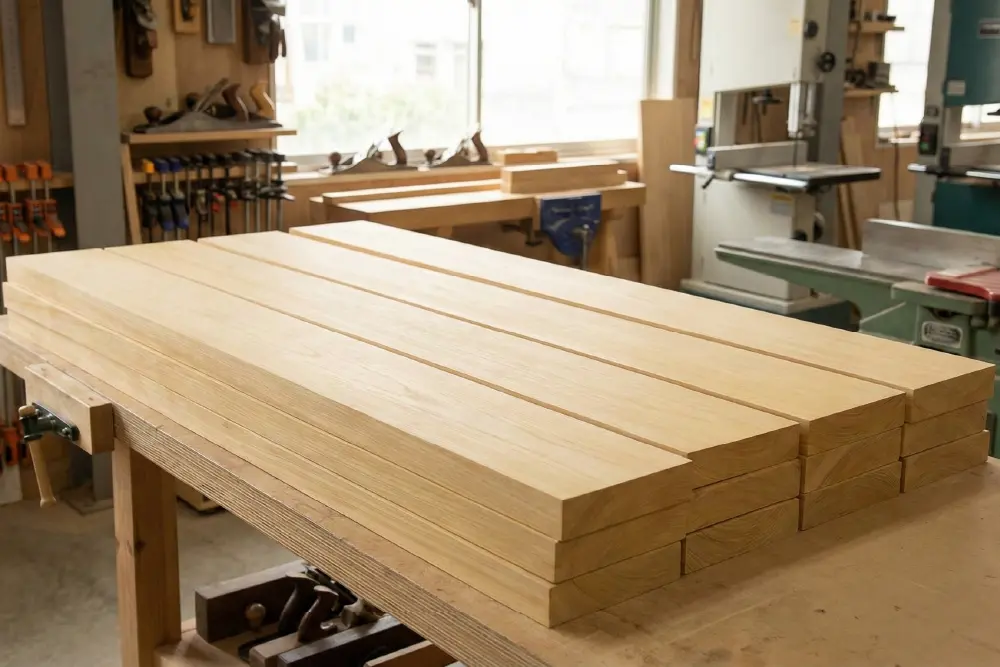
Before reviewing the samples, we discussed the root causes behind the failures at his previous manufacturer. This type of failure is something we often see when Mindi wood is processed without controlled moisture management and proper joinery engineering.
Wood Movement Risk
Mindi wood is a living material. Even after drying, it has a higher tendency to move compared to some other hardwoods.
This risk increases when furniture is shipped across different climates. Changes in humidity can trigger movement that affects the structure over time.
Moisture Content Control
Safe moisture content must be below 12 percent for export furniture. Surface dryness alone is not enough.
Without controlled kiln drying, internal stress remains inside the wood. This hidden stress often leads to cracking after shipment.
Joinery Engineering
Weak joinery is not a finishing problem. It is an engineering problem that starts at the construction stage.
Mortise and tenon joints must fit precisely. If the tolerance is wrong, the glue cannot cure properly, and long-term stability is compromised.
Learn why Sungkai Wood became a reliable hardwood alternative
Factory Visit to Verify Production System and Quality Control
For the buyer, the factory visit was the moment where assumptions had to be replaced by proof. After reviewing samples and technical discussions, this visit was meant to answer one final question: Does this factory truly have the system to prevent the same problems from repeating?
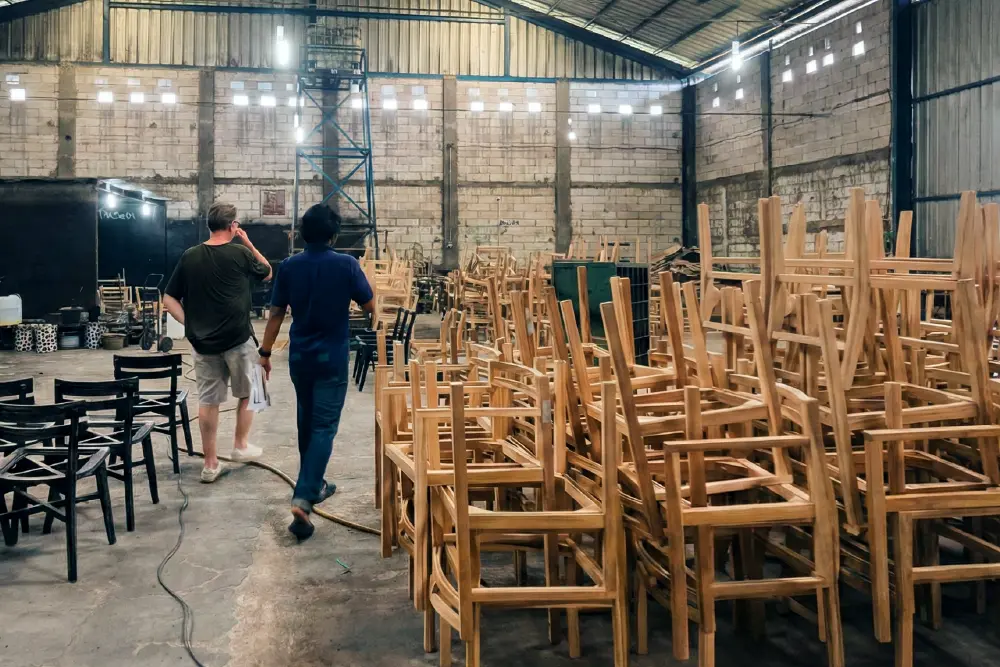
The buyer visited our factory in December 2025. During the visit, he audited the full production system:
- Sawmill
- Kiln drying chambers
- Machinery area
- Assembly lines
- Finishing section
- Packaging process
Seeing that we operate our own kiln drying chambers was a major reassurance. He understood that material stability was managed internally, not left to chance.
Sample Evaluation and Trust Building
This was the moment where expectations met reality. After discussions, samples, and a factory walkthrough, the buyer needed to see whether the results on the table truly reflected the systems and promises behind them.
When the buyer inspected the finished samples, his focus was clear:
- Joinery strength
- Structural stability
- Consistent finishing quality
The samples met his expectations. More importantly, the construction felt controlled and predictable. This was the level of reliability he had been missing.
Scaling Up: From Trial to 38 Furniture Samples
After the initial samples met expectations, confidence started to build. The buyer was ready to move beyond testing and prepare for real market execution.
After the first visit, the buyer expanded the scope significantly.
He requested:
- 38 furniture samples
- A mix of running collections and new collections
- All indoor furniture
Product range included:
- Console tables
- Coffee tables
- Low tables
- Sideboards
- Low cabinets
Timeline:
- November 2025: First contact
- December 2025: First factory visit
- January 2026: Second visit to inspect 18 new samples
- February 2026: All samples completed
- March 2026: Exhibition preparation
After seeing our production capacity, he even began discussing the possibility of expanding into Indonesian dining chair collections.
What Changed After Choosing the Right Indonesian Furniture Manufacturer
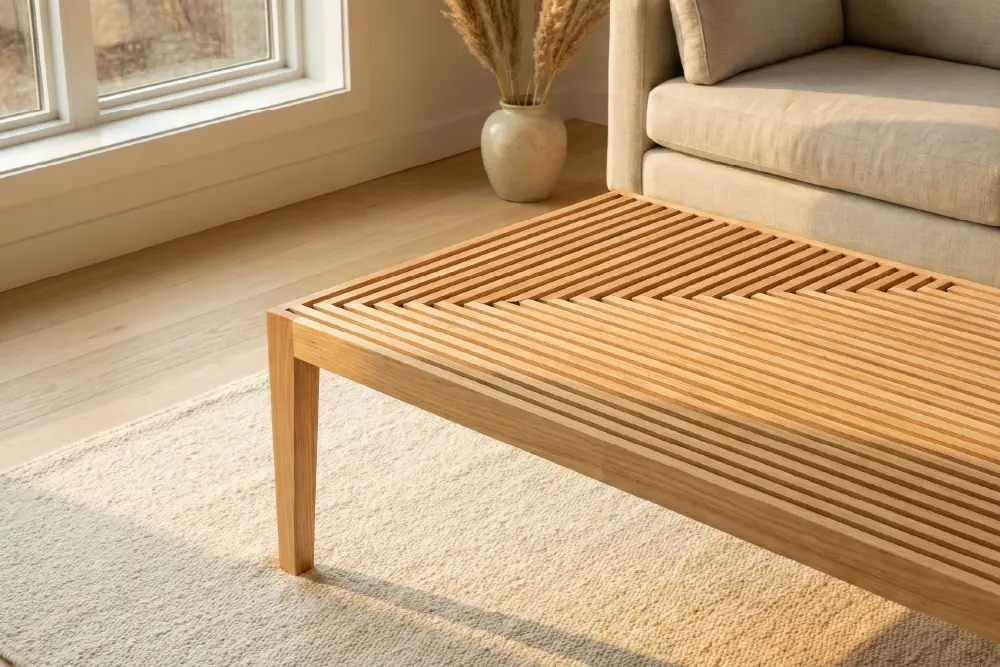
After finding the right manufacturing partner, the biggest change was mental. Production stopped being a constant source of stress.
With stable joinery and predictable outcomes, planning became easier. Decisions were no longer reactive but intentional.
For this retailer, stability mattered more than speed. With a major exhibition scheduled for March, product failure was no longer an option.
The results were clear:
- No recurring cracking issues
- Strong and consistent joinery
- Predictable production outcomes
- Confidence restored before a major exhibition
Most importantly, the buyer felt calm again. He could plan growth without worrying about repeated quality failures.
How to Evaluate an Indonesian Furniture Manufacturer Before Switching
Switching factories should start with evaluation, not urgency. Many quality problems repeat because the root cause is never addressed.
Based on cases like this, several indicators help buyers assess whether a manufacturer can support long-term stability.
- Does the factory control kiln drying internally or rely on external suppliers?
- Can they explain moisture content targets clearly, not only show finished samples?
- Do they understand joinery tolerance and structure, not just appearance?
- Are problems discussed openly and calmly, instead of being denied?
These points often determine whether quality problems stop or repeat. When these questions cannot be answered clearly by a factory, quality issues usually return in the next shipment, even if the first sample looks acceptable.
Deep down, in evaluating Indonesian furniture manufacturers, and what factors you should consider
Final Message: Why Choosing the Right Supplier Determines Business Stability
This case shows that repeated furniture problems rarely come from design or pricing. They come from production systems that fail to control wood behavior and construction risk.
For buyers, long-term stability depends on choosing an Indonesian furniture supplier who understands material movement, controls the process, and can explain problems clearly before they appear.
If quality issues keep repeating, the next step is not changing designs or suppliers impulsively, but starting with a technical diagnosis. If you are facing similar challenges, start with a conversation with us
Facing recurring joinery or cracking issues?
Start with a technical conversation before switching suppliers.

Hi, I’m Salman, founder of MPP Furniture, an Indonesian furniture manufacturer serving global retailers and project-based clients.
I began my career in my family’s export-oriented furniture company, gaining hands-on experience in production, construction, finishing, material performance, and product development. With a clear understanding of how international buyers evaluate furniture quality and reliability, I founded MPP Furniture to deliver export-ready products with consistent standards.
Here, I share insights from the perspective of a furniture manufacturer working directly with production teams on the factory floor, focusing on manufacturing and supplier evaluation.
Connect on LinkedIn

0 Comments