
Mindi Wood keeps showing up in sourcing conversations. Not because it's the premium option. Because it solves a specific problem that many furniture retailers face right now.
Teak prices have climbed to the point where margins no longer work for mid-range retail. Mahogany sits in a similar bracket. Oak and walnut imports carry tariffs and logistics costs that squeeze profitability.
Meanwhile, your customers still expect solid hardwood furniture at prices they're willing to pay.
Mindi wood is often chosen by buyers who want the appearance and character of teak but at a more affordable price point.
That positioning explains why it's become a strategic material choice for retailers operating in competitive markets where price sensitivity runs high.
Why Mindi Wood Matters for Furniture Retailers
Mindi wood comes from the Melia azedarach tree, which is widely grown across Indonesia's furniture manufacturing regions.
In Indonesia, it's widely grown and harvested responsibly, making it available for export in large quantities.
The wood has light to medium brown coloring with straight grain patterns. This characteristic matters more than it sounds. Straight grain means consistent finishing results across production batches.
For retailers with multiple locations, that consistency prevents the situation where furniture from one shipment looks noticeably different from that in another.
Mindi accepts stains exceptionally well. Manufacturers can finish it to resemble walnut, oak, or darker woods.
This versatility lets retailers position products across different aesthetic categories without changing base material. One production run can serve multiple market segments through finishing variation alone.
Typical retail furniture applications include dining sets, bedroom furniture, console tables, and display cabinets.
Basically, indoor furniture where appearance matters, but the piece won't be exposed to outdoor weather or extreme conditions.
Understanding the Cost Structure of Mindi Wood Furniture
Raw Material Procurement
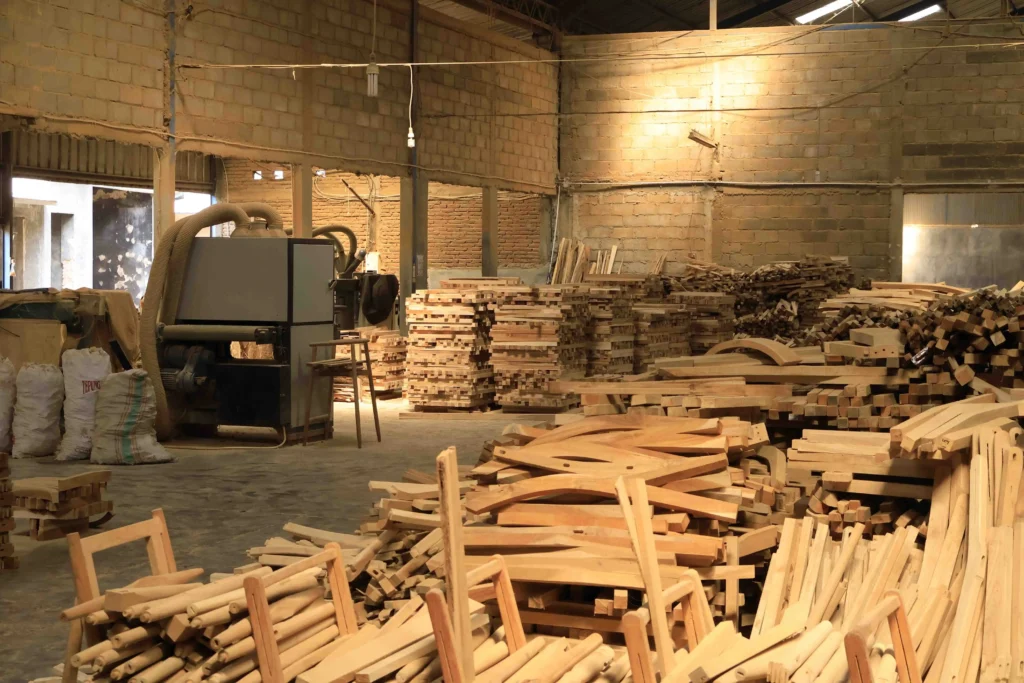
Mindi grows faster than teak or mahogany. Faster growth cycles mean more predictable supply and lower timber costs per cubic meter.
Indonesian manufacturers source mindi locally, avoiding import logistics that add cost layers to exotic woods.
Manufacturing Efficiency
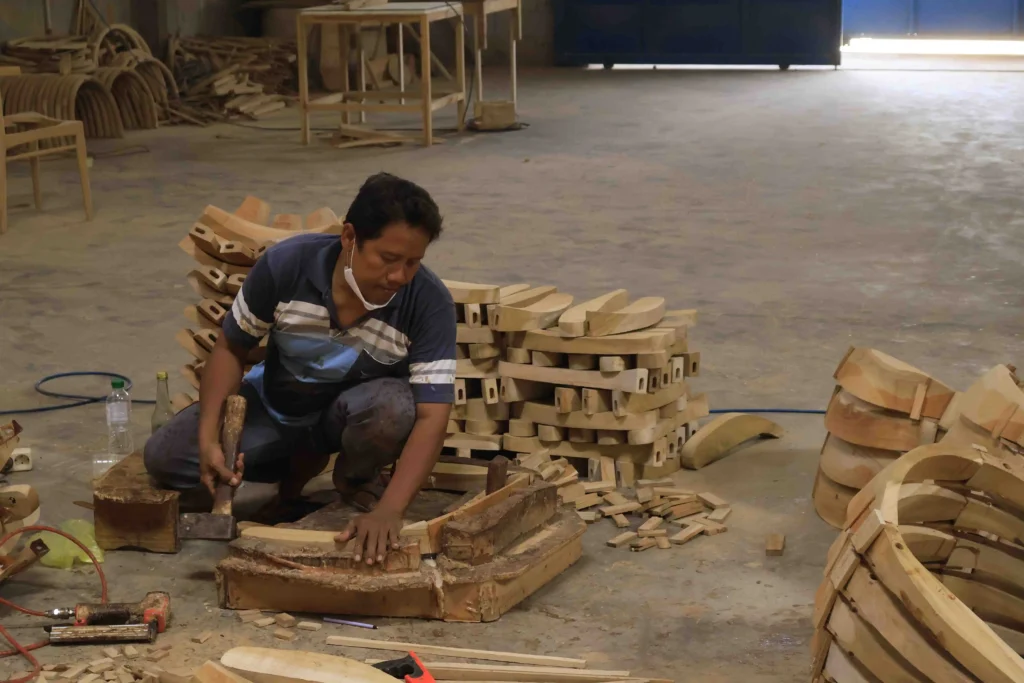
Mindi machines easily. It's softer than teak, meaning cutting, shaping, and joinery operations require less tool wear and shorter processing times. These efficiencies translate directly to lower labor hours per unit produced.
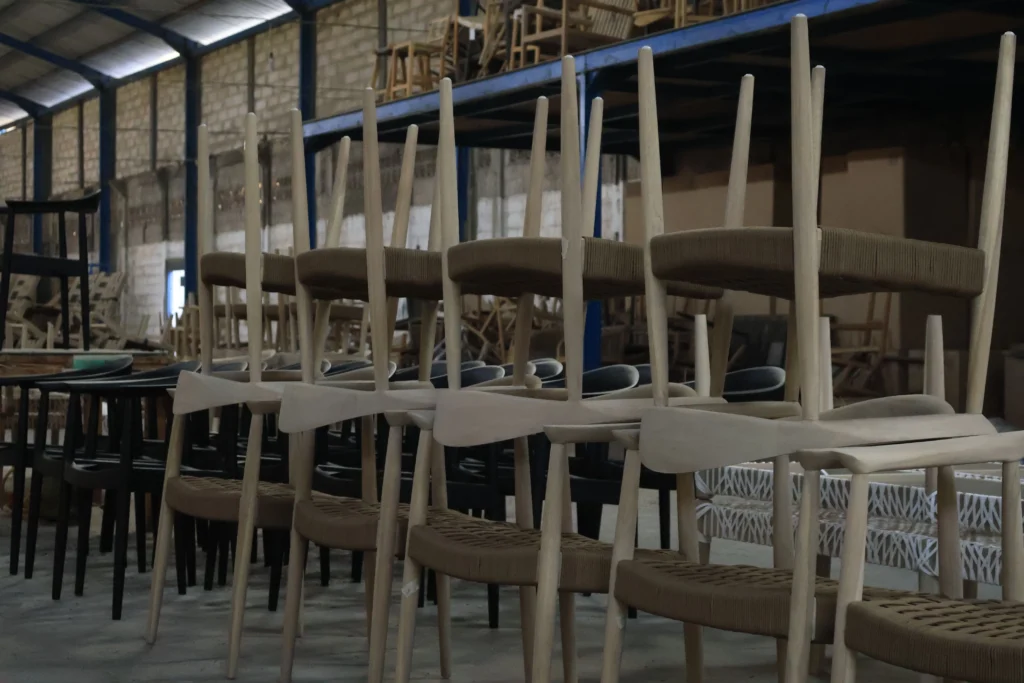
At MPP Furniture, we've been manufacturing with mindi for years, serving retailers worldwide.
Our production data shows that mindi pieces typically require 15-20% less machining time than equivalent teak furniture.
That time difference compounds across large production runs.
Finishing Costs
While Mindi accepts stains well, it requires proper sealing to protect against moisture and insects. This adds steps compared to naturally resistant woods like teak.
However, modern finishing systems handle this efficiently at scale.
The cost structure breaks down roughly like this for a typical mindi dining chair:
- Raw material: 25-30% of wholesale cost
- Labor (machining, assembly, finishing): 30-35%
- Overhead (factory operations, QC, packaging): 20-25%
- Manufacturer margin: 10-15%
Compare this to teak, where raw material alone might consume 40-45% of wholesale cost, and the pricing advantage becomes clear.
Key Factors That Influence Mindi Wood Furniture Costs
Several variables beyond base material costs affect final pricing.
- Design complexity. Simple, clean-lined furniture costs less to produce than intricate carved pieces. Mindi's workability makes it suitable for both, but complex designs increase labor hours.
- Finishing requirements. Natural or light stains require fewer coats than dark walnut or ebony finishes. Each additional finishing step adds labor and material cost. Distressed or antiqued finishes require even more handwork.
- Production volume. Manufacturers generally apply a 3-4 times markup on gross material costs to cover overhead, marketing, and logistics expenses. Higher production volumes distribute fixed costs across more units, reducing per-piece pricing.
- Quality control standards. Export-grade mindi furniture requires kiln drying to a moisture content below 12% to prevent movement across different climates. Manufacturers with in-house kiln systems control this process. Those relying on external lumber yards face greater variability and potential quality issues that surface months after delivery.
- Hardware and components. Quality drawer slides, hinges, and fasteners cost the same regardless of wood species. For budget furniture, hardware can account for 10-15% of the total cost. This percentage stays constant whether you're using mindi or mahogany.
Comparing Mindi Wood Furniture Costs with Other Popular Materials
Let's look at real numbers for a standard dining chair, FOB Indonesia pricing for container quantities:
- Teak dining chair: $180-220 per unit
- Mahogany dining chair: $150-180 per unit
- Sungkai dining chair: $110-140 per unit
- Mindi dining chair: $95-125 per unit
These ranges assume similar construction quality and finishing standards. The price spread within each category reflects design complexity and finishing choices.
Distributors commonly resell products at 1.5-2x their acquisition costs, while retailers often double wholesale prices before applying any promotional discounts.
Using mid-range pricing, here's how retail economics work:
Teak chair:
- FOB cost: $200
- Distributor/importer markup (1.75x): $350
- Retail price (2x wholesale): $700
- Retailer gross margin: $350 per chair
Mindi chair:
- FOB cost: $110
- Distributor/importer markup (1.75x): $192.50
- Retail price (2x wholesale): $385
- Retailer gross margin: $192.50 per chair
The teak chair generates a higher absolute margin per unit. But Mindi opens different strategic possibilities.
A retailer can price mindi at $385 and maintain healthy margins, or price more aggressively at $325-350 to drive volume while still achieving profitability targets.
Durability, Lifespan, and Long-Term Value of Mindi Wood Furniture
Mindi performs well for indoor residential furniture under normal use conditions.
Mindi wood has a hardness of 1.8 to 2.2 on the Janka hardness scale, making it suitable for furniture, flooring, and other high-wear applications.
For context, oak rates are around 1.2-1.3 Janka. Teak sits around 1.0-1.1. Higher numbers mean harder wood. Mindi is actually harder than teak, which surprises many buyers.
The expected lifespan with proper care is 10-15 years for residential use. Commercial settings with higher traffic see shorter lifespans of 7-10 years. This compares to teak's 20+ year residential lifespan and 15+ years in commercial environments.
The durability difference is about surface wear. Mindi shows scratches and dents more readily than premium hardwoods.
For retailers, this creates customer service considerations. Buyers need to understand proper care and set realistic expectations about how furniture ages.
Some retailers position this as a feature rather than a limitation. Mindi furniture, marketed as "lived-in" or "family-friendly," acknowledges that it will show wear while emphasizing affordability, making replacement less painful if needed.
Long-term value depends entirely on your retail positioning and customer expectations. For budget-conscious buyers seeking solid wood at accessible prices, mindi delivers strong value.
For premium buyers expecting heirloom-quality furniture, mindi doesn't compete with teak or mahogany.
How Mindi Wood Furniture Fits Different Retail Business Models
1. Budget to Mid-Range Furniture Retailers
Tiered pricing, often referred to as a "Good/Better/Best" structure, can guide shoppers toward higher-value purchases without alienating budget-conscious buyers.
Mindi slots perfectly into the "Good" tier. Retailers can offer solid hardwood furniture at entry-level pricing while reserving mahogany or teak for "Better" and "Best" tiers. This structure gives customers choices while protecting margins across categories.
We've seen retailers successfully use Mindi for their core collections priced in the $1,200-1,800 range for complete bedroom sets, while positioning mahogany collections at $2,400+ for buyers seeking premium materials. The Mindi collections often drive the majority of volume in these categories.
2. High-Turnover Retailers
Stores that emphasize fast inventory turnover and frequent collection updates benefit from Mindi's lower capital commitment per unit.
You can stock more SKUs with the same investment, test market response faster, and pivot to trending styles without massive inventory write-offs.
If you're planning product lines with high sales volume and fast-moving SKUs, Mindi wood is one of the most strategic choices you can make.
3. Online Furniture Retailers
E-commerce furniture businesses face particular challenges with returns and customer satisfaction. Lower-priced mindi reduces financial exposure per transaction.
If a piece is damaged in shipping or the customer isn't satisfied, the loss is $400 rather than $800.
This risk reduction matters when you're managing thousands of transactions monthly without physical showroom experiences to build buyer confidence before purchase.
4. Private Label and OEM Retailers
Mindi's finishing versatility makes it excellent for custom branding.
Retailers developing proprietary furniture lines can achieve differentiated aesthetics through finishing choices while controlling costs by selecting efficient base materials.
At MPP Furniture, we produce mindi furniture for several private label clients.
The material's consistency and finishing flexibility let them create distinctive collections that feel premium without premium material costs.
How Retailers Can Optimize Mindi Wood Furniture Costs with Indonesian Manufacturers
1. Order Volume Optimization
MOQs for mindi furniture are typically lower than for premium woods. Many Indonesian manufacturers accept a minimum of 50-100 pieces per SKU for mindi, compared to 100-200 for teak. Use this flexibility to test more designs with less capital commitment.
2. Finishing Strategy
Complex multi-step finishes increase costs disproportionately for budget materials. Work with manufacturers to identify 2-3 finishing options that deliver visual impact without excessive labor.
Our data shows that limiting finishing choices to pre-approved standards reduces per-unit costs by 8-12%.
3. Collection Planning
Concentrate volume in fewer core SKUs rather than spreading orders across many designs. This allows manufacturers to batch production, reducing setup costs that are distributed across your units.
4. Container Mix Strategy
Mindi's lower per-unit cost means you can fit more pieces in a container before hitting customs value thresholds that trigger higher duty rates.
Plan mixed container shipments strategically to maximize volume while managing landed costs.
5. Quality Specification Clarity
Mindi requires proper kiln drying and finishing to perform well in the long term. Specify minimum standards upfront.
Acceptable moisture content (below 12%), finishing system (number of coats, types of sealers), and hardware quality. Vague specifications lead to cost-cutting that later creates customer service problems.
6. Manufacturer Capability Assessment
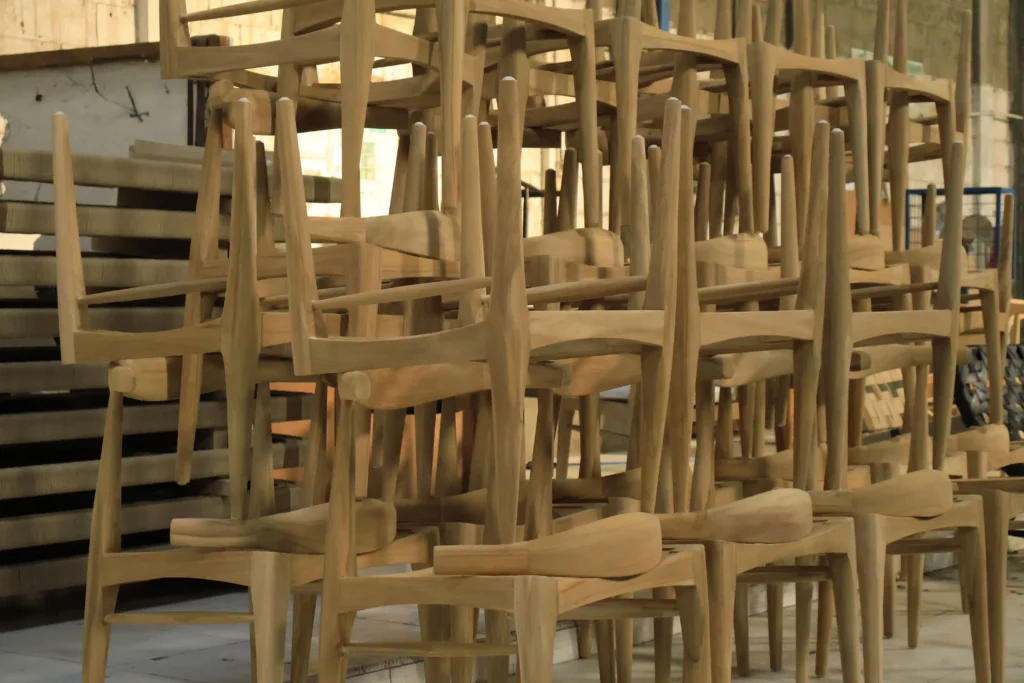
Not all Indonesian furniture manufacturers handle mindi equally well. Those with in-house kiln-drying and finishing capabilities deliver more consistent results than factories that assemble from purchased components.
We at MPP Furniture manufacture mindi furniture across our 16,000 m² facility with complete process control from lumber to finished product.
This integration prevents the quality inconsistencies that plague mindi sourcing when manufacturers lack proper drying infrastructure.
For retailers considering mindi wood, our articles on trying mindi wood furniture from Indonesia and mindi wood from Indonesian furniture suppliers provide a deeper technical context. We also cover styling approaches for how to style Mindi furniture.
Beyond Mindi specifically, retailers can explore our full range of Indonesian furniture collections to see how different materials fit various retail strategies.
Ready to Source Mindi Wood Furniture Strategically?
At MPP Furniture, we help retailers navigate material choices based on business model, target customer, and margin requirements.
With 20+ years of manufacturing experience and full in-house production control, we deliver consistent mindi furniture that performs reliably at price points that work for competitive retail environments.
🌍 Proven mindi furniture production for international retailers
🛠️ Complete quality control from kiln drying through finishing
📊 Flexible MOQ structures for market testing
✅ Free product development for custom designs
👉 Let's discuss whether Mindi Wood fits your retail strategy and pricing requirements.
Email Us: sales@mppfurniture.com
WhatsApp: +62 821-4630-5858
Planning your next best-selling collection?
Request catalog, pricing info, MOQ, and custom options today — we’ll respond quickly.

A passionate writer with 2+ years of experience in SEO who turns complex ideas into informative & helpful content. I share the challenges & important considerations when preparing a global furniture project, hoping to help MPP Furniture’s readers make more informed business decisions.

0 Comments