
In furniture sourcing, many buyers focus on finish, color, and design samples. Those things matter, but they do not carry weight, stress, or human movement. Chairs do.
A chair is the hardest-working piece of furniture in any collection. It gets pushed, dragged, leaned on, and dropped. Because of that, chair construction becomes the fastest way to judge a factory’s real capability.
Among all construction methods, mortise tenon joinery stands out as the clearest signal of engineering discipline. It shows whether a factory understands structure, tolerances, and long-term durability, not just appearance.
What Is Mortise Tenon Joinery?
A mortise tenon is a traditional woodworking joint where one part, the tenon (male), fits tightly into a matching hole, the mortise (female).
In professional woodworking standards, mortise and tenon joinery is classified into multiple structural variations based on load direction and application, as explained in an overview of different mortise and tenon joint types published by the Architectural Woodwork Institute (AWI).
This joint creates a mechanical lock. When glued and pressed correctly, the two wood components act as a single structural unit, not two parts held together by surface force.
In furniture joinery, this method is widely used for:
- Chair legs to rails
- Table legs to aprons
- Bed frames
- Load-bearing frames
Unlike screws or dowels, the strength comes from wood-to-wood contact across a large surface area, not from metal fasteners.
The History of Mortise Tenon: Why It Survived for Centuries
Mortise tenon joints predate modern machinery. They were used in ancient architecture, shipbuilding, and timber framing because they could handle movement, weight, and vibration.
The reason this method survived is simple:
It works under stress.
The fundamental logic behind mortise and tenon construction, allowing wood movement while maintaining mechanical strength, has been consistently documented in traditional woodworking education, including a detailed explanation of classic mortise and tenon principles by Ecochoice.
Wood expands and contracts with humidity. Mortise tenon joints accommodate that movement without loosening. Screws and nails fight wood movement, so they eventually fail.
In short, this joint stayed relevant because physics never changed.
Structural joinery only performs as intended when wood movement is properly managed, which is why manufacturers must apply a clear framework for mitigating wood movement risk in furniture construction.
Why Mortise Tenon Is Used in Furniture, Especially Chairs
Chairs experience dynamic stress. That means:
- Vertical load from body weight
- Side load from leaning
- Torsional force from movement
Most furniture failures happen at the joint, not in the wood itself.
Mortise tenon handles this because:
- The joint resists pulling apart
- The joint spreads stress across fibers
- The joint locks movement in multiple directions
This is why chair frames built with proper mortise and tenon construction stay solid for years, even in restaurants, hotels, and contract projects.
Mortise Tenon vs. Other Joinery Types
Not all furniture joints are designed to carry stress. Many are chosen because they are fast, cheap, or visually clean. To understand why mortise tenon performs better, it helps to first understand how other common joinery types actually work.
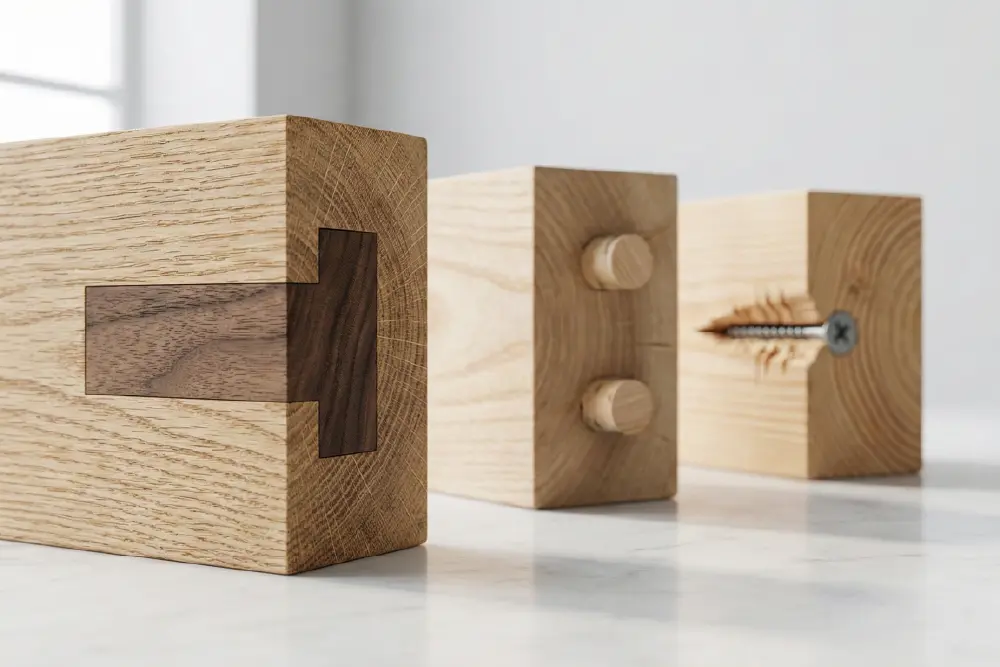
1. Mortise Tenon Joint (Structural Interlock)
This joint uses a projecting tenon fitted tightly into a matching mortise hole. Strength comes from deep wood-to-wood contact and mechanical locking.
- The load is distributed across long grain fibers
- Resists pulling, twisting, and side pressure
- Designed for movement and repeated stress
This is why it is widely used in chairs, tables, and bed frames.
2. Dowel Joint (Alignment-Based Joint)
A dowel joint uses round wooden pins inserted into drilled holes to connect two parts.
What it does well:
- Helps align parts during assembly
- Faster to produce than a mortise tenon
Where it fails:
- Small contact surface area
- Strength depends heavily on glue quality
- Repeated movement slowly loosens the joint
In chairs, dowel joints often feel solid at first but develop wobble over time.
3. Screw Joint (Fastener-Based Joint)
Screw joints rely on metal fasteners biting into wood fibers.
What it does well:
- Very fast assembly
- Easy to repair short-term
Where it fails:
- Screws do not lock the structure; they clamp it
- Vibration enlarges the screw hole
- Wood movement reduces holding power
This joint is common in knock-down or flat-pack furniture, but rarely survives long-term commercial use without reinforcement.
4. Butt Joint (Surface Contact Joint)
A butt joint connects two flat surfaces directly, usually supported by glue, screws, or nails.
What it does well:
- Simple and cheap
- Clean appearance in samples
Where it fails:
- No mechanical interlock
- All stress is carried by glue or fasteners
- Fails quickly under side load
This joint is acceptable for non-load-bearing panels, but risky for chairs.
Various mortise and tenon configurations are designed to address different structural demands, but regardless of variation, joint performance depends on proportion, fit, and load transfer, as discussed in a technical comparison on choosing the right mortise and tenon joint published by Woodsmith.
Why Mortise Tenon Outperforms All of Them
The difference is not tradition. It is engineering logic.
- Dowels align parts; mortise tenon locks them
- Screws clamp parts; mortise tenon integrates them
- Butt joints touch surfaces; mortise tenon connects structures
For furniture that must survive years of sitting, dragging, and leaning, a mortise tenon is not a premium feature; it is a structural requirement.
How Bad Joinery Affects Furniture Buyers
When joinery fails, the damage goes beyond the product.
Common consequences:
- Chairs wobble after weeks, not years
- Frames crack at stress points
- Customers complain or return products
- Importers face replacement claims
- Retailers lose trust and reputation
For B2B buyers, one container of failed chairs can erase months of margin.
This is why joinery quality is not a technical detail. It is a risk management issue.
For buyers sourcing furniture at scale, relying on samples alone is risky, which is why understanding the role of third-party inspection in furniture sourcing is critical to catching structural and quality issues before shipment.
How Good Mortise Tenon Joinery Is Made: The Production Benchmark
Strong mortise tenon joints do not happen by accident.
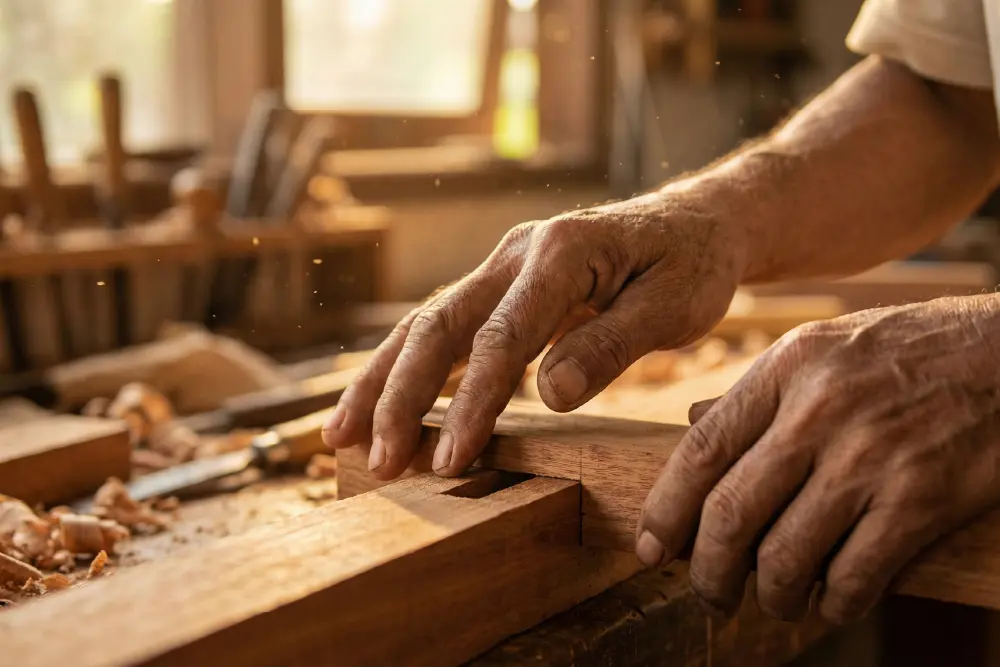
At a basic level, the mortise and tenon mechanism is often introduced through workshop-focused explanations that describe how the joint functions mechanically, such as this breakdown of mortise and tenon joint fundamentals by Kreg Tool; however, scaling this process for export-grade furniture requires far tighter tolerances and industrial consistency.
They require:
- Accurate cutting machines or CNC mortisers
- Controlled tolerances between mortise and tenon
- Proper tenon length and shoulder fit
- Correct adhesive application
- Consistent pressing pressure
In practice, the difference between good and bad factories is tolerance control.
If the joint is too loose, glue fills gaps, but strength drops.
If too tight, the wood splits or fails later.
Even the strongest joinery can fail prematurely if timber is not properly conditioned, which is why understanding how moisture content prevents cracks in furniture is essential for long-term durability.
At MPP Furniture, mortise tenon construction is treated as a structural system, not a decorative feature. Traditional craftsmanship is supported by modern machinery and strict quality control at every stage. This attention to detail is what allows chairs to pass real-world stress, not just showroom inspection.
How Buyers Can Spot Good Joinery During Inspection
You do not need to be an engineer to detect bad construction.
Simple checks:
- Wobble Test
Place the chair on flat ground. Apply side pressure. Any movement means weak joints. - Weight Feel
Proper joinery adds mass because parts interlock deeply. - Joint Visibility
Look under the seat. Clean, tight joints with no filler gaps signal precision. - Stress Simulation
Lift the chair by the backrest. A solid frame stays silent. Weak joints creak.
These checks reveal more than polished finishes ever will.
Conclusion: Mortise Tenon Is Not Optional for Serious Buyers
Mortise tenon joinery is not about tradition or style. It is about an engineering discipline.
Factories that master this joint usually:
- Control production tolerances
- Invest in proper machinery
- Apply strict quality control
- Understand long-term product behavior
MPP Furniture operates with this mindset. Every chair frame is treated as a structural product because B2B buyers cannot afford failure after shipment. That is why mortise tenon construction remains the internal standard, not an upgrade option.
If you want an Indonesian furniture supplier who thinks beyond samples and toward real-world use, joinery tells you everything you need to know.
Your next best-seller might be here
Request a quotation and custom options tailored to your needs today via WhatsApp or email.
Frequently Asked Questions
Why do chairs fail faster than tables?
Chairs fail relatively quickly because they experience constant movement and side loads that expose joint weaknesses during daily use.
Is a mortise tenon stronger than a dowel joint?
Yes. Mortise tenon construction provides a larger wood contact area and superior multi-directional strength compared to dowel joints.
Can a mortise tenon be used in modern furniture?
Yes. Modern machinery significantly improves production consistency while maintaining the traditional structural benefits of this joinery method.
How long should a mortise tenon chair last?
High-quality production techniques allow these chairs to remain stable for many years under typical commercial conditions.
Is a mortise tenon more expensive?
Manufacturing costs increase with this method, but the investment reduces long-term replacement expenses and warranty claims.

I am a self-taught graphic designer with a deep passion for exploring the creative world through various tools and techniques. I have honed my skills in Adobe Illustrator, Photoshop, and Lightroom, while continuously expanding my knowledge by diving into After Effects and Premiere. Photography has become an integral part of my life, and I actively engage with it to capture moments and experiment with visual storytelling.
My fascination with color theory, histograms, and innovative design approaches drives my work, as I am always seeking new ways to push the boundaries of my creativity. From photography models and motion graphics to textures, collage, and surrealism, I am captivated by the endless possibilities in design and constantly strive to challenge myself with fresh and exciting ideas.

0 Comments