Teak, mahogany, mindi, and sungkai are widely used by Indonesian furniture manufacturers. Each has its own strength and market positioning. But when furniture fails after export, the cause is rarely the wood species itself.
Cracks, warping, open joints, or surface mold often appear after the furniture arrives in the buyer’s market, not when it leaves the factory. In most cases, the strongest predictor of whether furniture will stay stable or fail is moisture content (MC). By the time these issues appear, the furniture is already with the buyer’s customers, where complaints, returns, and brand trust become the buyer’s responsibility
Moisture Content is not just a technical parameter; it is the foundation of furniture stability and a clear indicator of how professional a manufacturer truly is. Written from the perspective of a real Indonesian furniture manufacturer, this article explains how buyers can evaluate suppliers using MC and reduce post-shipment risk before it reaches their customers.
Why Furniture Cracks Show Up After Delivery to the Buyer’s Market
Most exported furniture does not crack immediately after shipment. In many cases, products leave the factory looking stable, pass inspection, and arrive without visible issues. Cracks, warping, or joint movement usually appear months later, after the furniture is exposed to a different climate in the buyer’s market.
From our manufacturing, these failures are rarely caused by design or construction alone. They occur because the wood continues to adjust to its new environment. When the moisture content is still too high at shipment, internal stress builds up slowly and releases itself through cracks and movement over time.
This delayed failure pattern is what makes moisture-related problems difficult for buyers. By the time defects appear, the furniture has already reached end customers, and the buyer must handle complaints, replacements, and potential damage to brand reputation.
Why Moisture Content Is the Foundation of Furniture Stability
Moisture Content refers to the amount of water held inside wood compared to its dry weight. Wood is a living material; it absorbs and releases moisture depending on its surrounding environment.
When moisture levels change, wood moves. This movement can be controlled, but it cannot be eliminated. That is why MC matters more than surface appearance, finishing, or even wood species.
Furniture made from teak, mahogany, mindi, or sungkai can all perform well when MC is controlled correctly. Buyers sourcing these materials can review how each wood behaves in export conditions, including teak wood from Indonesia, mahogany wood insights,mindi wood characteristics, and why sungkai wood requires careful control. The same materials can fail badly when MC is ignored.
In practical manufacturing terms, moisture content determines whether the entire furniture production system works or fails; if the MC is wrong, problems will appear later, even when the design, construction, and finishing look correct in the factory.
How High Moisture Content Causes Cracks, Warping, and Wood Movement
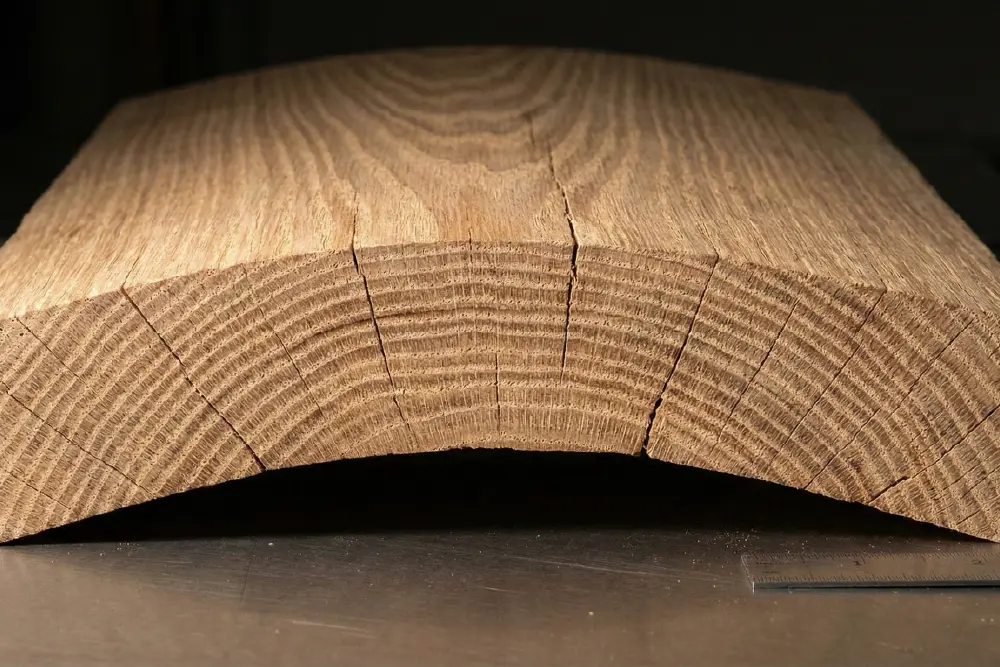
Cracking and warping are not random defects. They follow a clear physical process driven by moisture imbalance.
1. Moisture Imbalance Between Surface and Core
When wood leaves the factory with moisture content that is too high, the outer surface dries faster than the core once it reaches a drier climate.
The surface shrinks, the core resists, and internal stress builds up. Over time, the wood releases that stress through cracks, checking, or warping.
2. Why Small Wet Components Cause Big Structural Problems
Based on factory experience, problems rarely occur when all wood components are consistently dried below 12% MC. Issues usually start when even small parts enter production while still wet.
One common example is chair corner blocks or joint supports made from leftover wood that bypasses proper drying, which later leads to mold, termite risk, or joint movement after shipment.
3. How High MC Affects Glue Bonding and Finishing
High moisture content affects more than the wood itself. When wood is still wet, chemical reactions in glue do not perform optimally, even if the construction design is correct.
Finishing can also fail because coatings cannot penetrate wood pores properly, increasing the risk of peeling and uneven surfaces once the furniture reaches the buyer’s market.
Ideal Moisture Content for Export Furniture
There is no single magic number for moisture content, but from a manufacturing perspective, the rule is simple: wood must be dry enough to remain stable after shipment.
Based on factory experience, keeping moisture content consistently below 12% works as a general benchmark across furniture types and wood species. When MC is controlled at this level, the risk of movement, cracking, glue failure, and finishing problems drops significantly, regardless of whether the product is made from teak, mahogany, mindi, or sungkai.
This practical benchmark is also supported by external wood science research, including findings from the USDA Forest Products Laboratory’s Wood Handbook: Wood as an Engineering Material, which validates that this manufacturer-based approach aligns with established scientific findings.
The goal is not extreme dryness or category-based assumptions. The goal is stability through disciplined moisture control before production begins.
The Moisture Control Process Used by Professional Manufacturers

The moisture control system below reflects how MPP operates as a professional Indonesian furniture manufacturer supplying export markets. It is not a theoretical framework or an idealized factory model, but a practical production flow designed to make sure only dry and stable wood is allowed to move into machining, assembly, and shipment.
1. Pre-Cutting and Natural Resting Before Drying
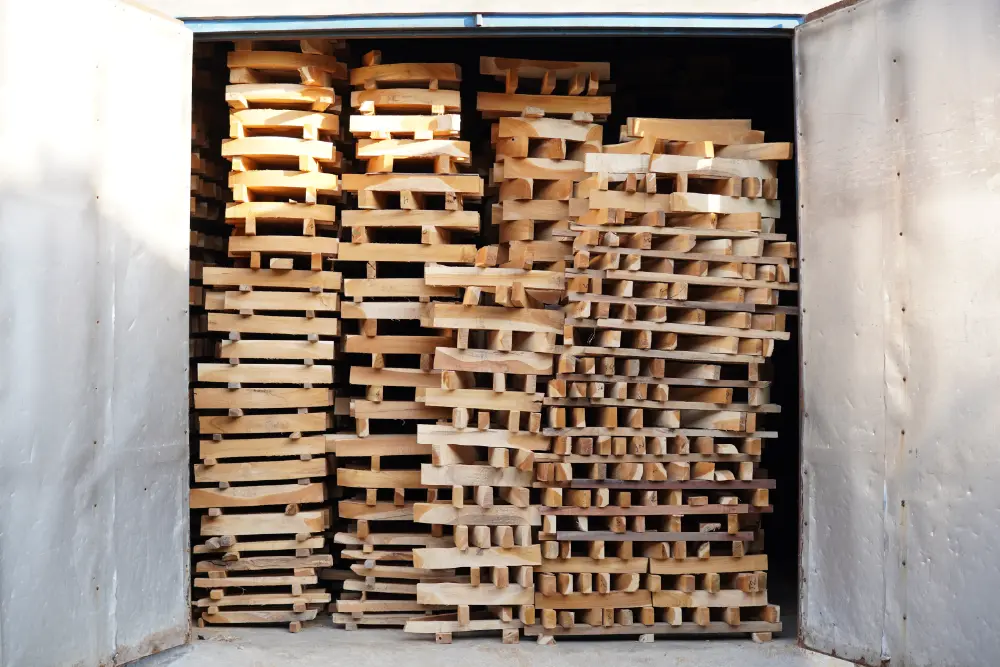
When wood first arrives, it is still wet. Instead of forcing immediate kiln drying, the wood is first cut into boards or components and allowed to rest naturally for several days. This step helps release surface moisture early and reduces internal stress before controlled drying begins.
2. Treatment and Gradual Kiln Drying Process
After initial resting, the wood goes through treatment for resin control, termites, and mold when needed. Kiln drying is then carried out gradually, with the temperature increased in stages rather than applied aggressively. This approach minimizes internal stress and lowers the risk of cracking later in the process.
3. Moisture Content as a Hard Gate Before Production
After approximately 14 days of kiln drying, the moisture content is checked through batch sampling. If MC is still above 12%, the wood returns to the kiln. Only wood that meets the maximum 12% MC requirement is allowed to exit the drying stage and move forward.
4. Multiple MC Checks Before Assembly and Shipment
Once removed from the kiln, the wood is rested again to allow natural movement to occur. Moisture content is checked before machining and assembly, and checked again before shipment. These repeated checkpoints are non-negotiable and exist to prevent unstable wood from reaching the buyer’s market.
This system is supported by dedicated in-house production and controlled facilities; buyers who want to understand factory capability in more detail can also review the machinery used by Indonesian furniture manufacturers.
How Buyers Can Use Moisture Content to Evaluate Indonesian Furniture Suppliers
Moisture content is not just a technical metric. For buyers, it is one of the clearest indicators of whether an Indonesian furniture supplier operates with discipline or relies on shortcuts that only look acceptable at the factory. In exporting furniture, moisture control often determines whether products remain stable after delivery or begin to crack months later in the market.
Suppliers that treat moisture content seriously usually plan production around drying time, material behavior, and risk control. Suppliers that do not often focus on surface appearance and speed, while hidden problems surface after export.
1. MC as a Signal of Production Discipline
Moisture content reflects how a manufacturer thinks about risk. When wet wood is allowed into machining or assembly, internal stress is locked into the product from the beginning. Even with correct construction and glue selection, bonding does not perform optimally on damp material.
For buyers, this is a warning sign. Furniture that looks solid at loading can still fail later if a moisture imbalance remains inside the wood.
At MPP, moisture control is treated as part of engineering, supported by full in-house production, precise QC, and consistent measurement points. While kiln drying equipment is helpful, what matters more is a consistent MC control system that prevents wet material from entering production at any stage.
2. Why Kiln Dry Facilities Matter During Factory Visits
Kiln drying capacity and usage reveal how seriously a manufacturer controls moisture content.
Air-drying depends heavily on the weather and cannot deliver consistent results for export furniture. During factory visits, you should look beyond surface claims and check whether:
- Kiln facilities are actively used, not just installed
- Drying cycles are managed according to wood type
- Moisture content is measured at defined stages, not only before shipment
Additionally, you should ask key questions:
- How many kiln chambers are in operation
- How drying cycles are managed for different wood types
- When MC is measured during production.
A reliable furniture suppliers like MPP operate multiple kiln drying chambers to support consistent MC control across wood species.
3. The Cost and Lead Time Trade-Off Behind Proper MC Control
Proper moisture control requires time, planning, and inventory discipline. Drying, resting, and repeated MC checks increase production cost and may extend lead time, but they reduce long-term risk.
Skipping MC control often leads to remakes, delays, and customer complaints after shipment. Many buyers still choose cheaper suppliers because their target market is price-driven or because the risks of moisture imbalance are not immediately visible.
In reality, MC is the starting point that determines whether the entire furniture production process succeeds or fails, regardless of how good the design or construction looks at the factory stage.
Should You Work with a Manufacturer Without Proper MC Control?
No. You should not work with Indonesian furniture manufacturers that do not have a clear and enforced moisture content control system. This is exactly why choosing a manufacturer with an MC system matters. Here are the reasons why MPP is the right Indonesian furniture manufacturer for you
Expertly Handcrafted with Engineering Discipline
MPP applies moisture control as part of its core production discipline. Every wooden and rattan product is handcrafted with precision, combining traditional craftsmanship with controlled drying processes, gradual kiln drying, and strict MC checkpoints to prevent unstable wood from entering assembly.
Attention to Detail Across Every MC Checkpoint
Moisture content is checked repeatedly throughout production, from post-kiln resting to machining, assembly, and before shipment. This attention to detail helps maintain dimensional stability, glue performance, and finishing quality when the furniture reaches the buyer’s market.
A Reliable Manufacturer for Long-Term Export Supply
With full in-house production, consistent MC control, and non-negotiable final checks before shipment, MPP is a reliable Indonesian furniture manufacturer. This system-driven approach helps buyers reduce post-shipment risk, minimize complaints, and build long-term trust with their customers.
What Moisture Content Really Means for Your Furniture Business
To conclude, moisture content (MC) is not a minor technical detail. It determines whether furniture remains stable after export or starts failing weeks later in the buyer’s market.
Buyers who understand MC can evaluate Indonesian furniture manufacturers more clearly, identify real production discipline, and avoid suppliers that rely on shortcuts. In practice, choosing manufacturers with a clear and enforced MC control system is one of the most effective ways to reduce post-shipment risk and protect long-term business reputation.
Planning your next best-selling collection?
Request catalog, pricing info, MOQ, and custom options today — we’ll respond quickly.
Frequently Asked Questions
1. What moisture content is safe for export furniture?
For indoor & outdoor furniture, <12% MC (Moisture Content) is generally safe when properly equalized to prevent warping or structural issues during transit.
2. Can finishing stop wood movement?
No. Finishing only slows down the moisture exchange process but does not stop movement entirely if the initial MC is incorrect for the destination climate.
3. Is a crack considered as a furniture defect?
Yes. Cracking is considered a furniture defect. One of the primary causes is a moisture imbalance between the wood and its surrounding environment.
4. Why does furniture crack after shipping?
Furniture often cracks because the wood rapidly adjusts to a new climate. If the wood was not dried correctly to match the destination's equilibrium moisture content, the resulting stress leads to cracking.

Hi, I’m Salman, founder of MPP Furniture, an Indonesian furniture manufacturer serving global retailers and project-based clients.
I began my career in my family’s export-oriented furniture company, gaining hands-on experience in production, construction, finishing, material performance, and product development. With a clear understanding of how international buyers evaluate furniture quality and reliability, I founded MPP Furniture to deliver export-ready products with consistent standards.
Here, I share insights from the perspective of a furniture manufacturer working directly with production teams on the factory floor, focusing on manufacturing and supplier evaluation.
Connect on LinkedIn



0 Comments