Retailers often struggle when outdoor furniture products look good individually but fail as a collection. The showroom feels inconsistent, the catalog looks scattered, and customers find it harder to imagine a complete outdoor space.
That is why sourcing Indonesian outdoor furniture should start with market direction, not separate product selection.
For residential buyers, the collection must feel comfortable, stylish, and easy to imagine at home. For commercial buyers, it must fit project requirements, brand concept, usage level, and long-term maintenance.
This guide explains how retailers can build outdoor furniture collections that look cohesive, sell better, and stay practical for production.
Why Cohesive Outdoor Furniture Collections Matter for Retailers
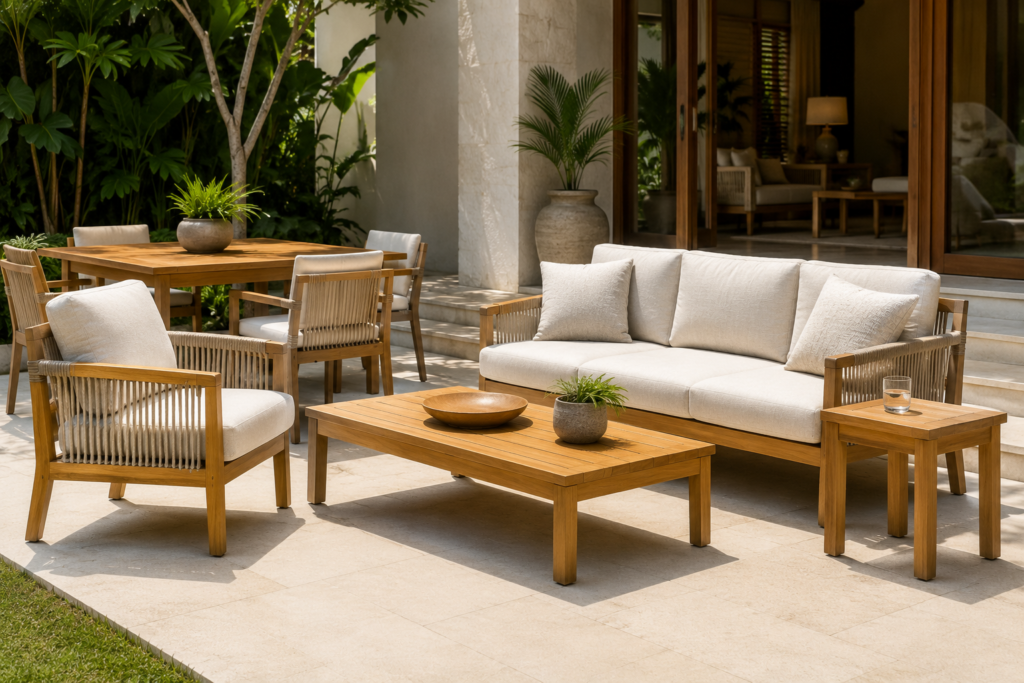
A cohesive outdoor furniture collection helps retailers present one clear story across a showroom, catalog, website, and project proposal. Instead of selling one dining chair or one lounge chair, the retailer sells a complete outdoor living direction.
This matters because customers now expect outdoor spaces to feel planned, not random. Houzz’s 2024 U.S. Outdoor Trends Study found that 33% of homeowners upgrading outdoor areas did so to extend their living space, and the number was higher among Gen X and Millennial homeowners.
For retailers, this means a scattered product lineup can make the buying decision harder. When the dining set, lounge chair, coffee table, and accent pieces share the same design language, customers can picture a complete patio, terrace, or poolside area faster. A coordinated collection also helps retailers reduce direct price comparison.
After defining whether the collection is residential, commercial, or both, retailers can use a separate product-mixing guide to plan how dining, lounge, sun loungers, and accent pieces work together.
How to Build Outdoor Furniture Collections for Residential Markets
Residential outdoor furniture should help customers imagine daily outdoor living. Your customer may be furnishing a patio, garden, terrace, balcony, poolside area, or family outdoor dining space.
The main goal is not only durability. The collection must feel welcoming, easy to place, and suitable for personal lifestyle needs.
Focus on Lifestyle and Visual Comfort
Residential customers usually respond to comfort and atmosphere first. They want outdoor furniture that makes their home feel warmer, calmer, and more complete.
The International Casual Furnishings Association’s 2025 Outdoor Trend Report found that 59% of consumers planned to buy new outdoor furniture or accessories, while 39% planned to buy multiple décor pieces. After updating their outdoor spaces, consumers expected to use them more for relaxing, spending time with family and friends, eating alfresco, socializing, and entertaining.
For this market, retailers can build collections around natural teak tones, soft cushions, woven details, and relaxed proportions. Neutral colors such as beige, sand, taupe, grey, off-white, and muted earthy tones can work across many residential styles.
This is one reason timeless Indonesian outdoor furniture can support retailers well. Natural materials and neutral palettes can fit coastal, tropical, resort, modern, rustic, and residential settings without relying on a single design trend.
Use Softer Design Directions
Residential collections often work best when the design feels warm and approachable. Softer lines, rounded edges, relaxed seating angles, and balanced cushion thickness can make the product feel easier to live with.
This does not mean the collection must look plain. Retailers can still create a clear personality through rope tone, cushion color, wood finish, slat detail, and styling direction.
For example, light teak with off-white cushions can support a coastal lifestyle collection. Natural teak with beige cushions can work for a broad retail market. Darker wood tones with grey cushions can create a modern patio collection.
Keep the Collection Easy to Display and Sell
A residential collection should be easy for sales teams and customers to understand. Retailers can start with a simple product line: a dining set, a lounge chair, a sofa, a coffee table, a side table, and an optional sun lounger.
The collection should offer enough variation without looking scattered. One frame language, one finish family, and one cushion direction can help the whole line feel connected.
This can also support a higher basket value. When customers can see how the lounge chair matches the coffee table and dining set, they are more likely to buy several pieces from the same collection.
How to Build Outdoor Furniture Collections for Commercial Projects
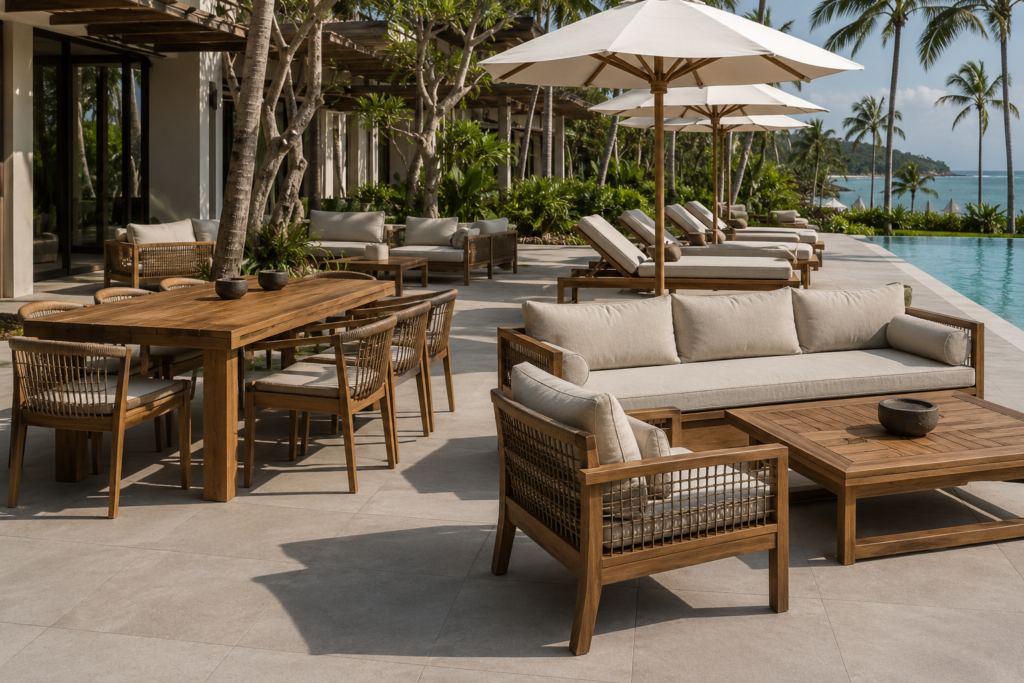
Commercial outdoor furniture needs a different planning process. A hotel, resort, restaurant, beach club, rooftop bar, villa project, and café terrace will not use furniture in the same way.
Retailers serving commercial customers need to think beyond visual appeal. The collection must fit the project’s function, traffic level, maintenance needs, and brand concept.
Start from the Project Requirement
A commercial collection should begin with questions about the setting.
- Will the furniture be used beside a pool?
- Will the staff move it every day?
- Is the location exposed to rain, heat, humidity, salt air, or food and drink spills?
- Will the furniture support long dining hours, short café visits, or relaxed resort lounging?
These questions affect product choice. A resort lounge area may need deep seating, sun loungers, side tables, and soft outdoor fabrics. A restaurant terrace may need stackable or space-efficient chairs, durable dining tables, and finishes that handle daily use.
Strengthen the Construction for High-Traffic Use
Commercial outdoor furniture is not just residential furniture with a stronger frame. It needs construction planning based on real usage.
High-traffic use can affect frame thickness, joinery, cushion density, rope tension, seat height, back angle, and finishing system. A chair used daily in a restaurant has different stress points than a lounge chair used on a private patio.
This is why retailers should review commercial requirements before sampling. A small design choice can affect comfort, maintenance, packing, cost, and repeat production.
Adapt the Design to the Brand Concept
Commercial customers also need furniture that supports the project's identity. A boutique resort may need warm teak and natural rope, while a rooftop venue may need cleaner lines and darker finishing.
From our experience, one buyer developed an outdoor furniture project for a resort in the Maldives. They chose a darker wood finishing because it matched their brand character: mature, calm, and premium.
This shows why commercial outdoor furniture should not be planned from strength alone. The design must also support how guests read the hotel, resort, villa, or restaurant brand.
Can One Outdoor Furniture Collection Serve Both Residential and Commercial Buyers?
With one strong base identity, one outdoor furniture collection from Indonesia can serve both residential and commercial markets. The collection should start from shared design DNA, such as frame language, wood finish family, cushion mood, rope direction, and material combination.
From there, retailers can branch the collection into two versions. The residential version can focus on softer comfort, home styling, and flexible placement, while the commercial version can adjust dimensions, frame strength, cushion density, fabric choice, and maintenance details.
This is where semi-custom development becomes useful. Buyers do not always need a fully new frame; small adjustments in proportion, finishing, rope color, cushion fabric, and construction details can create a collection that fits both markets without losing identity.
The easiest way to compare both markets is to look at the buyer goal, design focus, construction focus, and customization path. This helps retailers avoid building one collection that looks cohesive but fails in real use.
| Collection Factor | Residential Market | Commercial Market |
|---|---|---|
| Buyer goal | Create a comfortable outdoor living space for daily home use | Support a project setting such as a hotel, resort, restaurant, villa, or rooftop venue |
| Design focus | Warm, relaxed, easy to place, and suitable for personal lifestyle needs | Aligned with the brand concept, guest experience, traffic level, and project layout |
| Construction focus | Comfort, stability, safe daily use, and fewer post-purchase complaints | Stronger structure, suitable joinery, cushion density, rope tension, finishing system, and maintenance planning |
| Customization path | Often starts from existing designs or semi-custom changes, such as cushion color, finishing, and proportion | Often needs semi-custom or full custom adjustments based on project requirements, usage, and brand identity |
Construction Matters for Both Residential and Commercial Collections
Construction is often discussed more in commercial projects, but it also matters for residential collections. Poor construction can lead to complaints, returns, damaged brand reputation, and weak repeat sales.
For commercial use, construction must handle heavier daily use. For residential use, it must protect the customer experience after purchase.
Outdoor furniture also needs consistency across product categories. When a dining chair, lounge chair, and coffee table come from one collection, the finish, proportion, and detail quality should feel aligned.
This is where the Indonesian furniture supplier’s process matters. MPP Furniture combines handcrafted production, machinery support, and quality control at each stage, so buyers can move from design direction to repeatable production, not only one good sample.
Common Mistakes When Building Outdoor Furniture Collections
The first mistake is starting with products before defining market direction. A retailer may choose several attractive products, but the final collection can look random.
The second mistake is mixing too many styles in one line. A collection with coastal chairs, modern tables, rustic benches, and bold cushions may confuse buyers.
The third mistake is following trends without thinking about stock life. Trend ideas can be useful, but they need to fit the retailer’s market. For example, outdoor trends may include indoor-outdoor living, European-inspired details, sculptural forms, bold prints, lighting layers, and rattan or wicker appeal. But not every trend should become a product line.
The fourth mistake is treating commercial outdoor furniture as only a stronger version of residential furniture. Commercial projects need different thinking around layout, use, maintenance, and project identity.
The fifth mistake is ignoring brand DNA. A retailer should ask: What should customers remember about this collection? Warm resort living? Modern patio comfort? Natural teak simplicity? Urban outdoor dining?
Without that answer, the collection becomes hard to explain and easy to compare by price.
Why Working with the Right Indonesian Outdoor Furniture Manufacturer Matters
Retailers sourcing Indonesian outdoor furniture should choose a manufacturer that can support both collection identity and production consistency. A good manufacturer helps review market fit, materials, dimensions, construction, finishing, and repeat production before sampling begins.
When comparing Indonesian furniture suppliers, retailers should look beyond product photos. They should ask how the supplier supports product development, quality control, custom work, private label, OEM needs, and repeat orders.
MPP Furniture supports B2B buyers through free consultation, free product development, custom collection service, private label, OEM production, and full in-house production. Retailers can start from existing designs for speed, semi-custom for market fit, or full custom for stronger brand ownership.
For more details, you can review this guide to custom outdoor furniture from Indonesia.
Closing Remarks: Cohesive Collections Start from Market Direction
A cohesive outdoor furniture collection starts before product selection. Retailers need to define whether the line is for residential buyers, commercial projects, or both.
Residential collections need lifestyle clarity, visual comfort, and easy display value. Commercial collections need project fit, construction planning, and brand alignment. A collection serving both markets needs one strong design identity with adjusted specifications for each use.
In short, Indonesian outdoor furniture can support retailers well when the collection is planned with a clear market direction and reliable production support.
Planning an Indonesian Outdoor Furniture Collection for Your Market?
Share your target market, design direction, preferred materials, and product categories with MPP Furniture.
FAQs: Cohesive Outdoor Furniture Collections
1. What makes an outdoor furniture collection cohesive?
A cohesive outdoor furniture collection uses one clear design direction across frame style, finishing, materials, cushion tone, and product categories.
2. What is the difference between residential and commercial outdoor furniture collections?
Residential collections focus on lifestyle, comfort, and home styling. Commercial collections focus on project use, traffic level, brand concept, and maintenance needs.
3. Can retailers use one collection for both residential and commercial markets?
Yes. Retailers can use one collection for both markets when it has one strong design identity and adjusted specifications for each use case.
4. Why source Indonesian outdoor furniture for retail collections?
Indonesian outdoor furniture offers natural materials, handcrafted detail, flexible customization, and production support for retailers building cohesive product lines.

Hi, I’m Salman, founder of MPP Furniture, an Indonesian furniture manufacturer serving global retailers and project-based clients.
I began my career in my family’s export-oriented furniture company, gaining hands-on experience in production, construction, finishing, material performance, and product development. With a clear understanding of how international buyers evaluate furniture quality and reliability, I founded MPP Furniture to deliver export-ready products with consistent standards.
Here, I share insights from the perspective of a furniture manufacturer working directly with production teams on the factory floor, focusing on manufacturing and supplier evaluation.
Connect on LinkedIn
0 Comments