Furniture importers comparing Indonesian Furniture Manufacturers often receive different FOB quotations for chairs, tables, or cabinets that appear identical. Choosing the cheapest offer without checking specifications and responsibilities can lead to costly sourcing problems.
To compare manufacturers fairly, you need to evaluate what each factory will deliver, not just the quoted unit price.
This guide explains how to compare product specifications, quotation scope, samples, production capabilities, packing efficiency, quality control, and supplier reliability before placing a trial order.
Compare the Same Product and Normalize Quotation Scope
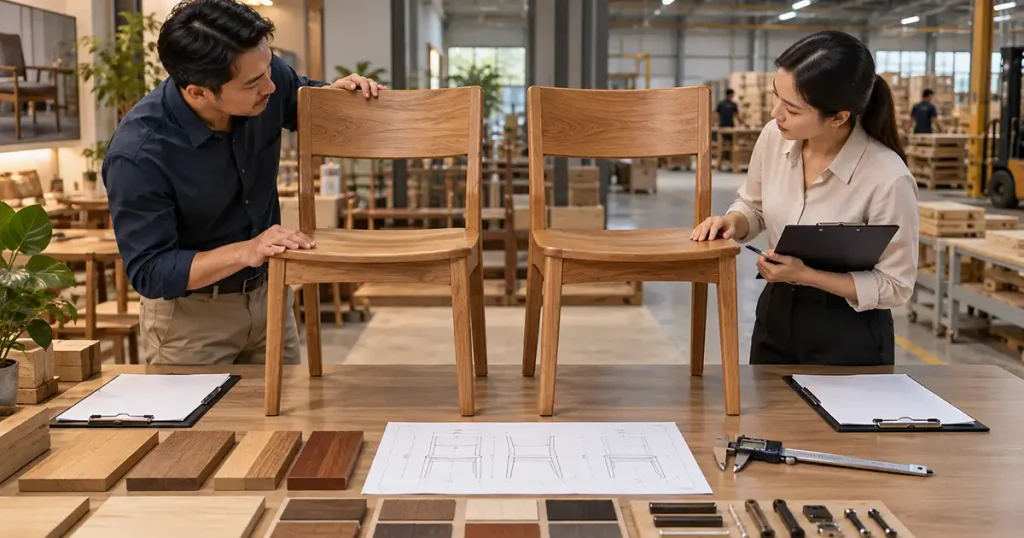
Send each shortlisted factory the same product specification, including wood species and grade, dimensions, construction, finish, hardware, and packaging. Ask suppliers to disclose substitutions rather than quoting a different product as an equivalent.
Next, confirm whether prices include export packing, testing, sample development, and export charges. Under ICC Incoterms 2020, FOB transfers risk when goods are loaded on board the vessel. If containers are handed to a carrier at a terminal before vessel loading, FCA is generally more suitable because delivery and risk transfer occur at the agreed handover point.
Record the agreed rule, named port or delivery point, and exclusions in writing. Incoterms do not automatically cover sample development or product testing, so clarify those charges separately.
Understand Why Manufacturer FOB Prices Differ
Differences in furniture manufacturing costs may reflect wood utilization, production methods, labor efficiency, finishing steps, subcontracting, or overhead. None of these factors proves that a higher price means better quality or a lower price means better efficiency.
In our published furniture pricing review, we described a European buyer whose lower-priced teak furniture from another supplier contained a high share of sapwood. The material difference matters because wood grade and intended use affect product performance.
Ask each manufacturer to explain the production assumptions behind its price and confirm that they match your approved requirements.
Compare Sample Accuracy and Product-Specific Manufacturing Capability
Evaluate Sample Accuracy and Development Costs
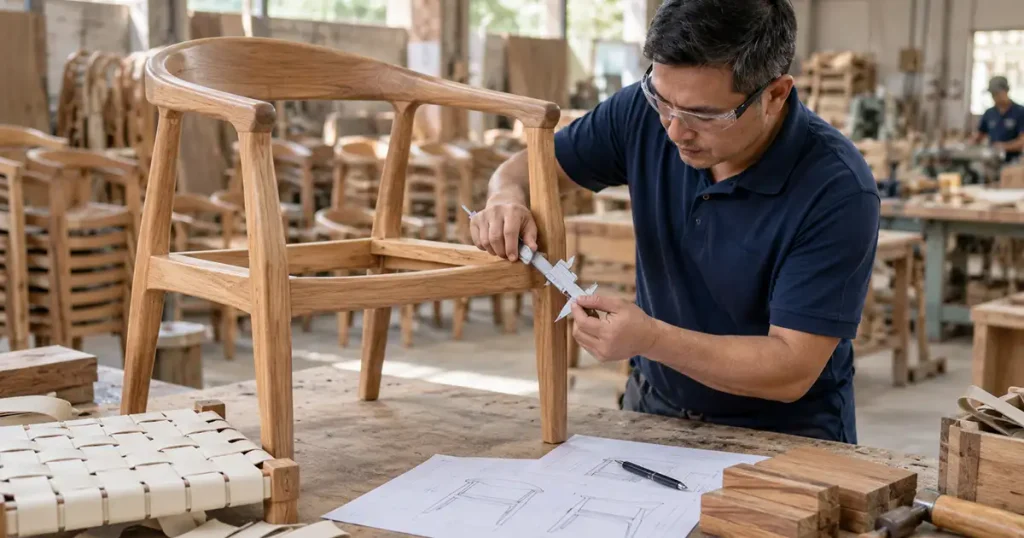
Check how the factory converts technical drawings and material requirements into a physical sample. Ask about sampling fees, revision charges, approval cycles, and how the final sample becomes the bulk-production reference.
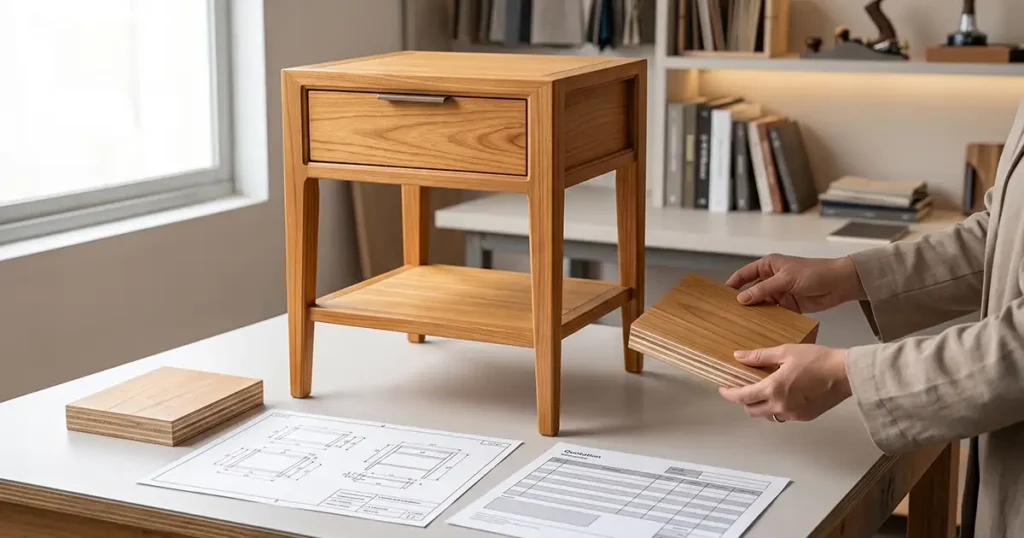
In our bedside table cost review, a full-solid Sungkai specification exceeded the buyer's target price. We reviewed possible changes to less-visible components while keeping the original appearance and function as the reference.
Match Manufacturing Capability to Product Complexity
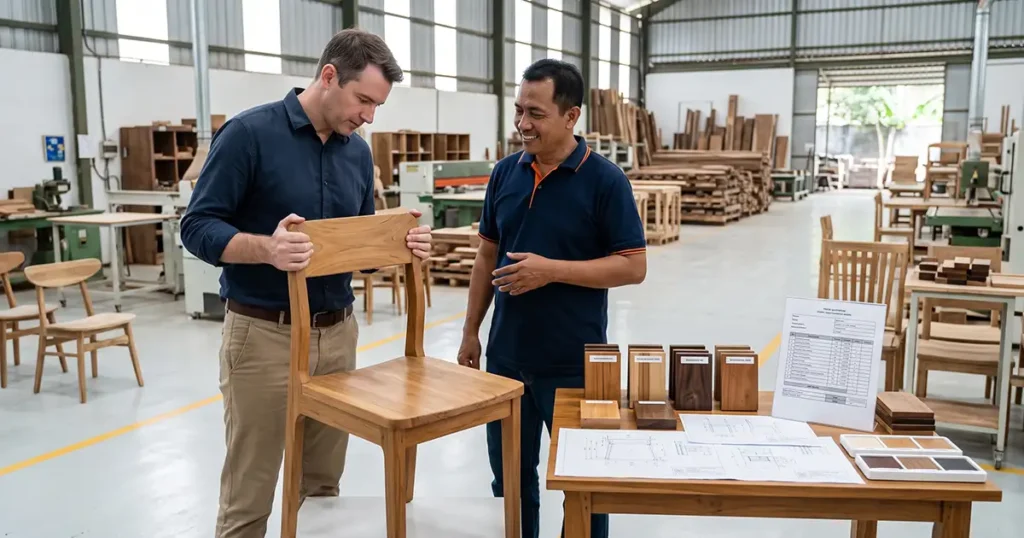
Curved solid wood dining chairs require different skills from cabinets, tables, or woven rattan furniture. In our chair checks, early units can be compared side by side for profile, seat height, and joint alignment against the approved sample; factory size alone cannot demonstrate this product-specific ability.
Compare Packing, CBM, and Container Efficiency
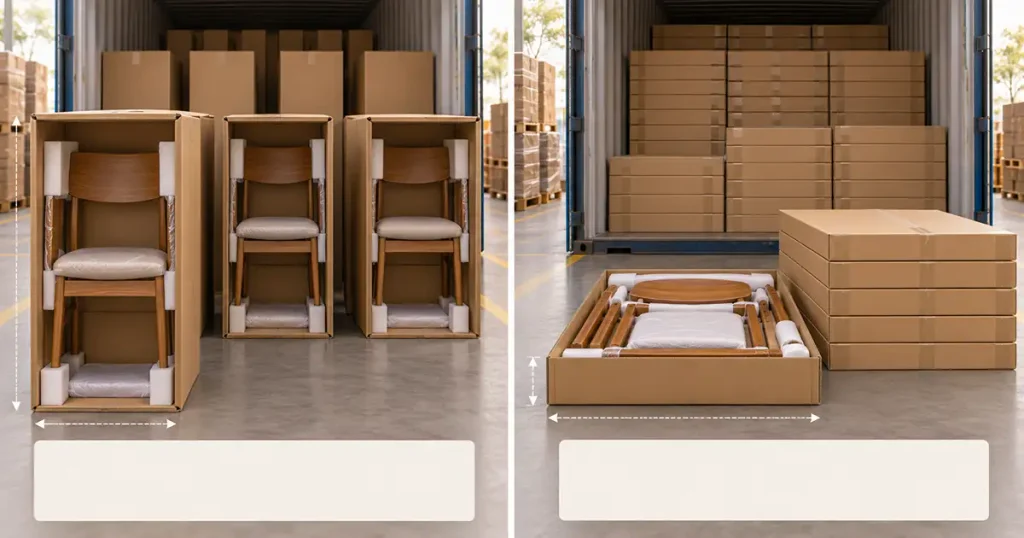
Request actual carton sizes, gross weights, packed cubic meters (CBM), protection details, and units per container. Compare assembled and knock-down configurations, but do not accept smaller cartons at the expense of damage protection.
For example, Factory A offers $100 FOB at 0.30 CBM per unit, while Factory B offers $108 at 0.20 CBM. Using a hypothetical freight allocation of $200 per CBM, FOB plus allocated freight becomes $160 for A and $148 for B, before other import costs.
Our bedroom furniture packaging guide explains why the packed sample, hardware placement, and actual CBM should be reviewed before bulk production. Freight savings are useful only when products can also arrive safely.
Evaluate MOQ, Assortment Flexibility, and Lead-Time Reliability
Evaluate MOQ and Mixed-SKU Flexibility
Furniture retailers need minimum order quantities (MOQ) that fit inventory plans. Ask furniture suppliers whether they can combine SKUs, finish variations, and mixed-container orders, including any setup fees or price changes.
Verify Capacity and Delivery Commitments
Check available production slots, material supply, current factory commitments, and the point when quoted lead time begins. For mixed orders, a container is not ready until all required SKUs have cleared inspection and packing.
Our furniture factory lead-time guide separates deposit-to-loading timing from production duration. MPP's published 45 to 60-day production range is order-dependent, not a fixed promise from deposit to vessel departure.
Verify QC Evidence, Revision Control, and Claim Handling
Request Inspection Evidence
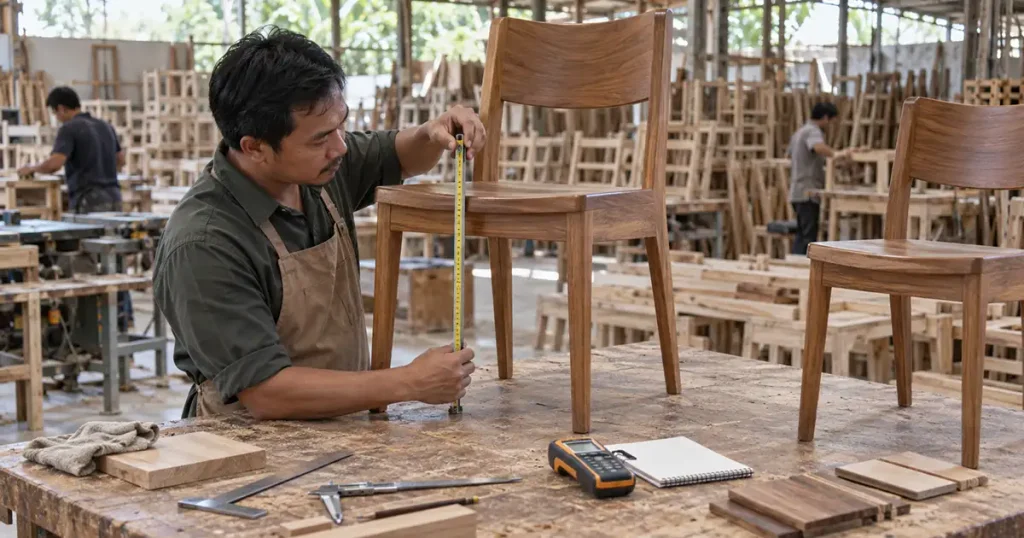
Ask for material checks, moisture readings, dimensional records, finish inspections, and final QC results. At MPP, we check construction and dimensions after sanding, review finishing and weaving, and inspect products before packing.
Our manufacturer verification documents guide identifies further records buyers can request to assess factory legitimacy and capability.
Check How Revisions Are Controlled
Confirm that drawings, material changes, finish samples, and hardware revisions have version numbers and written approvals. Ask how updated instructions reach production and QC teams.
Evaluate Claims and Repeat-Order Consistency
Compare each manufacturer's defect reporting, investigation process, correction or replacement terms, and repeat-order references. Reliable furniture exporters should explain their response after shipment, not only their inspection process before it.
Use a Weighted Manufacturer Scorecard Before a Trial Order
Score shortlisted factories from 1 to 5 using comparable evidence, then multiply each rating by the criterion weight. The example below uses hypothetical ratings, not MPP production results.
| Evaluation Criteria | Weight | Factory A | Factory B |
| FOB Price & Quotation Transparency | 15% | 5 | 3 |
| Sample Accuracy & Product Capability | 25% | 4 | 5 |
| Packaging & Container Efficiency | 15% | 2 | 5 |
| MOQ & Assortment Flexibility | 10% | 4 | 3 |
| Lead-Time & Capacity Reliability | 15% | 3 | 4 |
| QC, Revision & Claim Management | 20% | 3 | 5 |
| Weighted Score (Out of 5) | 100% | 3.50 | 4.35 |
Factory B scores higher overall despite its weaker price rating. Use the scorecard to choose trial-order candidates, but require satisfactory product testing, legal compliance, factory verification, and delivery feasibility first.
Final Thoughts: Choose Manufacturing Value, Not Just the Lowest FOB Price
The best fit for furniture sourcing is the manufacturer that can repeat your approved product, support your purchasing plan, and manage problems responsibly. Compare equivalent offers and verified evidence before committing to a trial order.
Compare More Than Price, Find the Right Manufacturing Partner
If you are comparing Indonesian furniture manufacturers for a new collection, share your drawings, target market, quantities, and packaging requirements with MPP Furniture. Our team can discuss product development, manufacturing options, and the trade-offs behind your quotation before you commit to production.
FAQ: About Comparing Indonesian Furniture Manufacturers
1. Why do Indonesian furniture manufacturers quote different FOB prices?
FOB prices differ because material grades, production methods, labor efficiency, finishing processes, and quotation inclusions can vary. Buyers should compare equivalent specifications before deciding which manufacturer offers better value.
2. How can furniture importers compare manufacturer quotations fairly?
Send the same product specifications to every shortlisted manufacturer. Compare material requirements, included costs, exclusions, sample development, packaging, FOB terms, and production evidence before evaluating the final price.
3. Can a manufacturer with a higher FOB price offer a lower total sourcing cost?
Yes. Better container utilization, fewer product revisions, and reduced damage risk can offset a higher FOB price. Buyers should calculate shipping costs and evaluate potential quality-related expenses before comparing total sourcing value.
4. What evidence should buyers request before placing a trial furniture order?
Request approved samples, production capability records, relevant certifications, QC inspection reports, actual packing measurements, production schedules, and written claim-handling terms. Confirm that these documents match the intended product specifications and order quantities.
5. How should buyers score Indonesian furniture manufacturers before a trial order?
Use a weighted scorecard covering quotation transparency, sample accuracy, manufacturing capability, packaging efficiency, MOQ flexibility, lead-time reliability, and QC performance. Rate each manufacturer using documented evidence, while treating mandatory quality and compliance requirements as separate pass-or-fail conditions.

A versatile content creator with a strong foundation in product photography and videography, and a comprehensive brand strategy. Capable of creating engaging content to connect consumers and producers, web analytics, and engaging visual content to drive interest and growth for a product or brand.

0 Comments