Retailers sourcing furniture from Indonesia should start with the date the products must be ready for sale, then work backward through production, quality control, packing, shipping, customs, and warehouse receiving.
Starting too late can mean stock arrives after a collection launch, promotion, or seasonal selling period has already begun. That shortens the time available to sell the collection and can disrupt the retail campaign built around it.
This guide shows you how to work backward from your target selling date and how the planning window changes between repeat orders, new collections, and custom furniture development.
Start With the Retail Selling Calendar
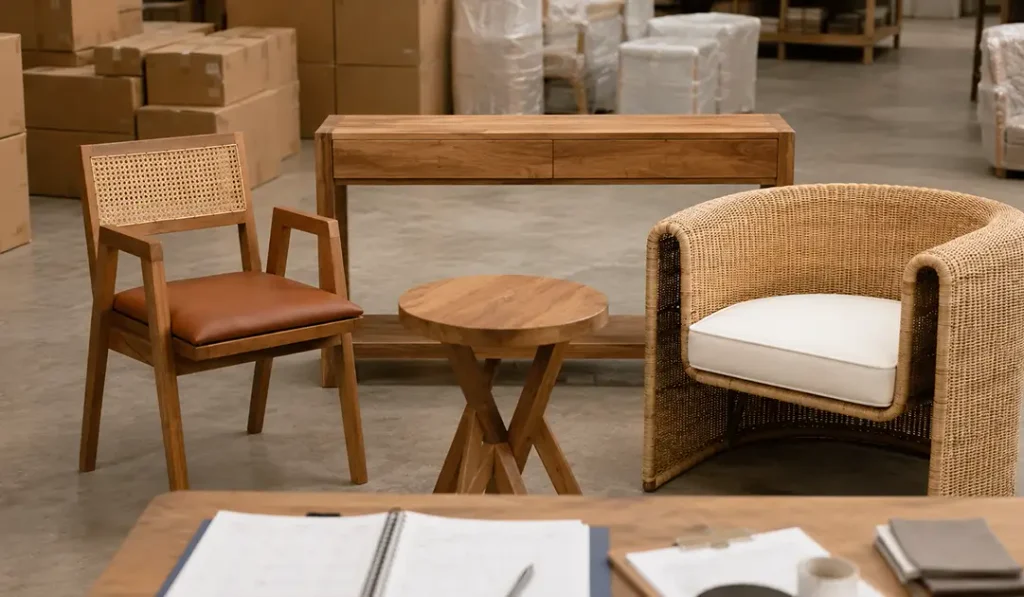
First, define the target selling date. This is when the collection should already be available in your showroom, stores, or website.
Use your retail calendar as the reference point. This may include a new collection launch, a promotional campaign, the outdoor furniture season, a showroom refresh, a holiday sales period, or a planned clearance before new stock arrives.
Retail furniture already works around these cycles. For example, Manhattan Home Design notes that retailers often clear older inventory in January and July to make room for new collections in February and August. The exact months differ by market, but the planning principle is the same: inventory needs to be ready before the commercial period it is meant to support.
Second, set the stock-ready date. This is when the furniture should already be available in your warehouse before the selling period begins.
The gap between the stock-ready date and selling date gives your team time for receiving, product photography, merchandising, store distribution, website setup, and campaign preparation.
For example, if you plan to launch a collection in September, the furniture may need to reach your warehouse in August rather than during the launch month.
This makes your retail calendar the starting point. Factory timing is then checked against that commercial target, not the other way around.
Work Backward From the Stock-Ready Date
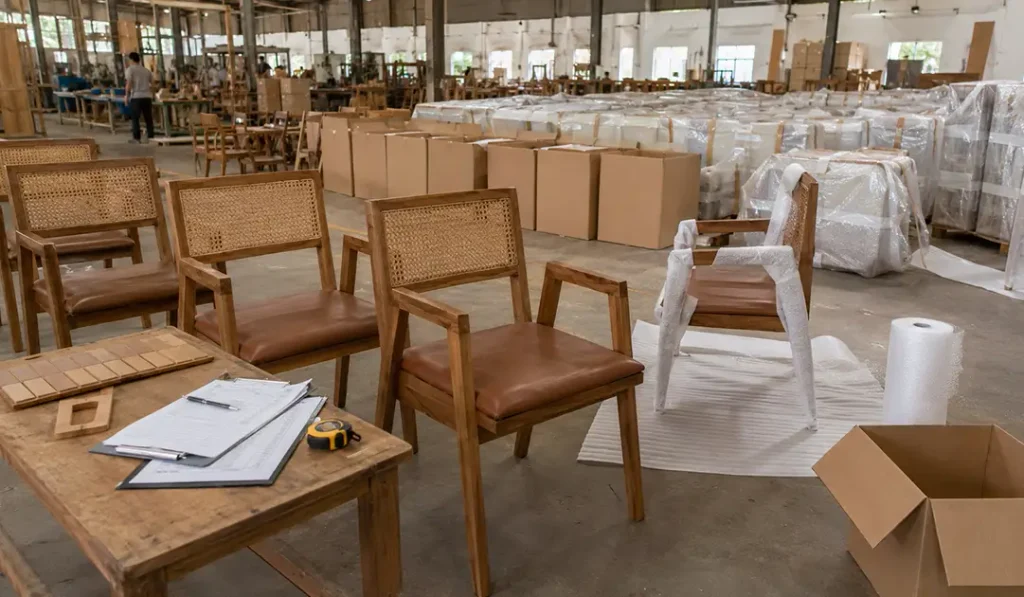
Once the stock-ready date is clear, work backward to determine when the order needs to start.
The planning window generally needs to account for:
Stock-ready date → warehouse receiving → customs and inland delivery → ocean freight → export and vessel preparation → inspection, production, and packing
Some of these activities can overlap rather than happen in a fixed sequence. The point is that production lead time alone does not tell you when to start an import order.
Factory capacity also affects the timeline because it determines when the manufacturer can allocate a production slot for your order. Factory capacity can also change during busier production periods. A retailer may have enough time based on production duration alone, but the order can still start later if the required production slot is already occupied.
If you want to understand this factor further, you can read our guide on the best time to buy furniture from an Indonesian factory.
For repeat or running products, the timeline can usually move toward production once the PO and agreed product specifications are confirmed.
For new or custom products, planning needs to start earlier because product development, sampling, revisions, and approval happen before bulk production. We will discuss this difference further below.
It is also wise to leave a reasonable buffer before the stock-ready date. This gives the schedule some room for changes in production,, vessel schedules, customs, or warehouse receiving without pushing the arrival into the planned selling period.
For the detailed process covering QC, packing, export documents, freight booking, and customs, you can read the Shipment Guide for Importing Furniture from Indonesia.
Repeat Orders Can Be Planned Around Proven Demand
Repeat orders are usually easier to plan because the product, design, construction, specifications, and production method have already been established. The manufacturer has produced the item before, so the team already understands which parts need more attention and how to handle them more efficiently.
From our experience as a manufacturer, repeat production can sometimes be completed around 7 days faster than the first production run. This is not a fixed rule, but it can happen because the team already knows the difficult parts, the right production sequence, and how to avoid issues found during the earlier run.
For repeat or approved products, around 3 to 4 months before the intended selling period can be used as a practical planning baseline. It should not be treated as a fixed number because order volume, factory capacity, destination, and shipping conditions can still affect the timeline.
Retailers can use historical sales, sell-through, current stock, stock already in transit, and demand forecasts to decide when the next order should begin.
The important point is not to wait until inventory is almost depleted before starting production. Furniture has a longer replenishment cycle, so the reorder discussion may need to begin while the current stock is still selling.
For repeat products, the focus is therefore replenishment timing based on proven demand, not product development.
New and Custom Furniture Development Needs More Planning Time
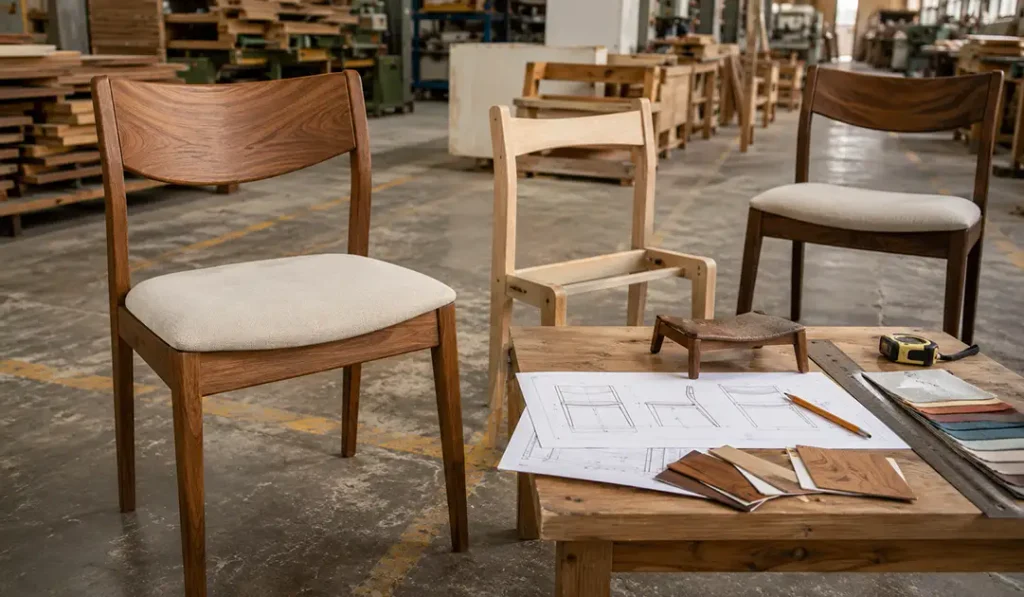
New collections and custom furniture should be planned earlier because bulk production cannot begin until the product is sufficiently developed and approved.
Based on our furniture development team's experience, the part that often takes more time is testing and refining the sample. A design that looks proportional on a drawing may still need adjustments once it becomes a full-size piece, especially in comfort, construction strength, dimensions, or visual proportion.
This may require sample revisions before the buyer gives final approval. That is why custom furniture lead time should not be compared directly with a repeat-order timeline. The additional planning time happens before bulk production starts.
For retailers, the practical point is simple: if a new collection has a fixed launch date, development should begin early enough that sampling and revisions do not reduce the time available for production.
MPP handles product development and production in-house, supported by machinery that allows the development team and production team to work closely when adapting custom furniture for bulk manufacturing.
Retailers preparing their first furniture sourcing program can also read the strategy for importing Indonesian furniture for the first time for a broader discussion of supplier selection and first-order preparation.
How MPP Furniture Helps Plan Your Import Timeline
You do not need to know exactly when to place the PO before starting a sourcing discussion with MPP Furniture. As an Indonesian furniture manufacturer, we can begin with your target selling date or required warehouse arrival date and work backward from there.
MPP helps map the timing based on whether you are planning a repeat order, new collection, or custom furniture development. Product approval, production, QC, packing, and shipping preparation are considered as one connected timeline, so the order can be planned around when the furniture actually needs to be ready for your market.
This gives retailers a clearer starting point for planning the next buying cycle, without having to calculate every production and shipping stage on their own.
Final Thoughts: So, How Far in Advance Should You Order?
No fixed number applies to every furniture import from Indonesia. The right planning window depends on whether you are ordering a repeat product, developing a new collection, or creating custom furniture, as well as factory capacity and the shipping timeline.
For repeat or approved products, around 3 to 4 months before the intended selling period can be a practical planning baseline, but it should not be treated as a guaranteed timeline. New and custom products should start earlier because sampling, revisions, and approval happen before bulk production.
The main principle is simple: start with the date the furniture needs to be ready for sale, set your stock-ready date, then work backward and add a reasonable buffer.
In short, do not ask only, “When should I place the order?” Ask, “When must this furniture be ready for my customers?”
Plan Your Import Timeline With More Clarity
Share your target selling date or required warehouse arrival date with us. We can work backward with you across product development, production, QC, packing, and shipping preparation, so your next buying cycle is planned with a clearer and more predictable timeline.
FAQ About Indonesian Furniture Import Planning
1. How far in advance should retailers order furniture from Indonesia?
There is no fixed timeline for every order. For repeat or approved products, around 3 to 4 months before the intended selling period can be a practical baseline, while new or custom furniture should be planned earlier.
2. Is production lead time the same as the full furniture import timeline?
No. Production lead time only covers the manufacturing period. Retailers also need to account for inspection, export preparation, ocean freight, customs, inland delivery, warehouse receiving, and a reasonable buffer.
3. Why do custom furniture orders need more planning time?
Custom furniture needs additional time before bulk production for product development, sampling, revisions, and approval. A design may also need adjustments after the first sample is reviewed for proportion, comfort, construction, or other specifications.
4. Can factory capacity affect when my furniture order starts?
Yes. Factory capacity affects when a production slot can be allocated. Even if the production duration fits your schedule, planning too late may mean the preferred production slot is no longer available.
5. Should retailers plan from the order date or the selling date?
Start from the selling date, not the order date. Set when the furniture needs to be ready in your warehouse, then work backward through the import and production timeline to determine when the order should begin.

Hi, I’m Salman, founder of MPP Furniture, an Indonesian furniture manufacturer serving global retailers and project-based clients.
I began my career in my family’s export-oriented furniture company, gaining hands-on experience in production, construction, finishing, material performance, and product development. With a clear understanding of how international buyers evaluate furniture quality and reliability, I founded MPP Furniture to deliver export-ready products with consistent standards.
Here, I share insights from the perspective of a furniture manufacturer working directly with production teams on the factory floor, focusing on manufacturing and supplier evaluation.
Connect on LinkedIn
0 Comments