If you like a furniture design but the quotation is above your target buying price, changing the wood can seem like the most direct way to lower the cost. The idea makes sense, but a cheaper wood price does not reduce every part of the finished furniture price.
This article will help you estimate the possible savings more realistically. You will see why a large reduction in wood cost may result in a much smaller reduction in total custom furniture pricing.
As an Indonesian Furniture Supplier, we see material decisions closely connected with collection positioning, target retail price, and purchasing budget. We will break the calculation into simple parts, then show how buyers can evaluate a revised quotation per SKU.
Changing the Wood Doesn’t Change the Rest of the Furniture Specification
Retailers may change the wood species while still asking for the same dimensions, design details, construction target, finish standard, cushion, weaving, hardware, and packing. In that situation, only part of the furniture manufacturing cost is directly affected.
This is why a lower timber price should not be treated as a direct discount on the entire quotation. Our guide to what affects custom furniture cost explains how material, design, finishing, quantity, and production requirements work together in the final price.
A new wood species can still affect timber yield, machining, sanding, or finish preparation. Your manufacturer should recalculate the SKU instead of simply subtracting the difference between two raw wood prices.
A Big Saving on Wood Can Be a Small Saving on the Finished Product
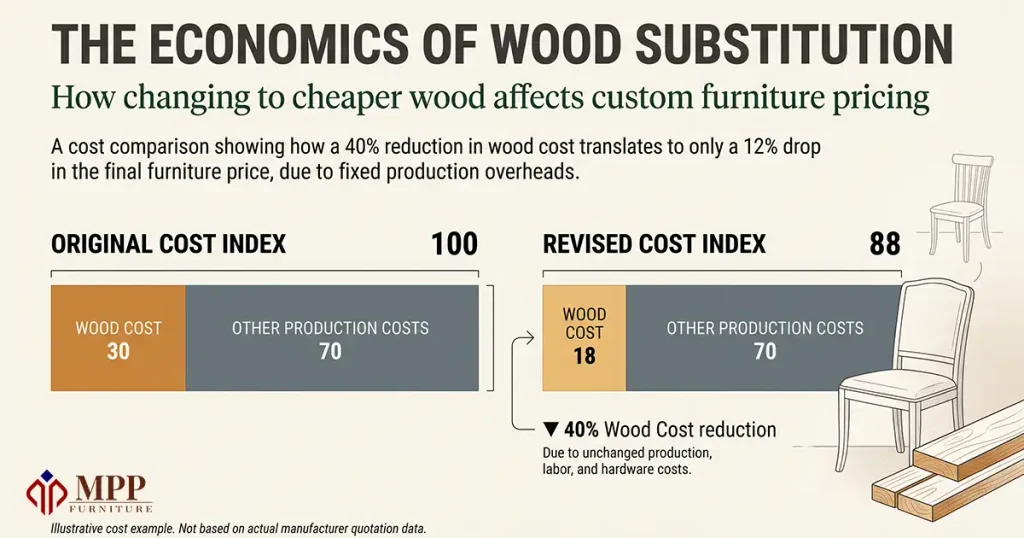
The easiest way to understand the saving is to separate the cost that changes from the cost that stays similar. If wood represents only part of the total furniture cost, even a large reduction in that component creates a smaller reduction in the finished product.
Which Costs Stay the Same When Only the Wood Changes?
Labor, glue, finishing, weaving, cushion, hardware, packing, and some export handling may stay similar when their specification and production basis remain the same. This follows the same decision logic described by ACCA’s relevant-cost principle: focus on costs that actually change because of the decision.
These costs are not automatically identical in every case. A new species may require different cutting allowances, surface preparation, machining, or finishing work.
How a 40% Saving on Wood Becomes a 12% Saving Overall
Assume a furniture cost index of 100, where wood represents 30 and all other cost components represent 70. If the wood component falls by 40%, the wood cost drops from 30 to 18, making the new total 88.
The saving on wood is 40%, but the saving on the finished product is only 12%. These figures are an illustration only, not MPP quotation data, a standard cost ratio, or a promised reduction in furniture prices.
Why the Same Wood Change Can Produce Different Savings Across Designs
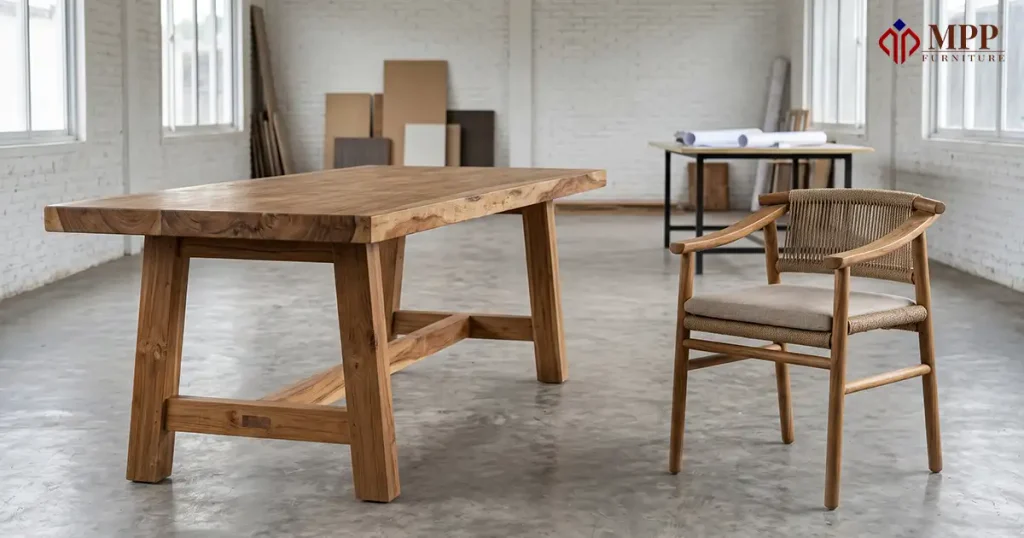
The same material substitution can produce different savings because every SKU has a different cost mix. A product with more solid wood can react differently from one with more upholstery, weaving, hardware, or production work.
Dining Tables vs. Woven or Cushioned Dining Chairs
A dining table may use large tops, thick legs, and long rails, while a woven or cushioned dining chair also carries costs from weaving, foam, fabric, upholstery, hardware, assembly, and packing. The non-wood portion can therefore represent a different share of the total custom furniture cost.
This does not mean tables always produce greater savings. Compare the cost composition of each SKU before estimating how much cheaper wood can reduce the quotation.
How Design Complexity Affects the Potential Saving
Curved components, tight joints, wide parts, sanding, shaping, and detailed assembly still require production work even when the wood is cheaper. A lower material rate does not automatically reduce the work required to manufacture the same design.
We saw this decision process with an Australian buyer in July 2026. The original indoor dining chair collection was specified in teak, but after reviewing the target retail price, finish direction, and preference for a lighter natural look, we discussed sungkai and developed a new sample before the revised direction was approved.
The important point was not simply that the alternative wood had a different cost. It still had to fit the chair design, appearance direction, collection position, and target price.
How to Read a Revised Quotation After Changing the Wood

Compare the original and revised quotations using the same drawing revision, quantity, finish reference, hardware, packing, MOQ condition, and commercial basis. Our wood furniture manufacturer cost comparison explains why matched quotations are more useful than assuming a fixed percentage saving from a wood substitution.
Compare the Same SKU on the Same Quotation Basis
If one quotation uses a different quantity, finish, packing method, or Incoterm, you are no longer comparing only the wood change. Ask your supplier to separate material, construction, finishing, packing, and commercial changes where possible.
Check What Changed Instead of Assuming Every Cost Fell
Your revised quotation should reflect the production factors that actually changed, such as timber cost, yield, machining, finishing preparation, or engineering. Working with an Indonesian Custom Furniture Manufacturer can make this discussion easier because material and production decisions can be reviewed at SKU level.
Will Changing the Wood Be Enough to Meet Your Target Price?
The final question is not whether the alternative wood is cheaper. It is whether the revised unit price gets close enough to your target buying price while the product still suits your collection, retail position, and appearance requirements.
Material changes can also affect the finished appearance after different components come together. In one MPP development process, the selected wood finish and woven color looked suitable separately, but the wood appeared too warm when combined, so we adjusted the finish reference before approval.
If the original quotation is indexed at 100, your target is 82, and the revised material brings the cost to 88, the material change solved part of the price gap but not all of it. You can accept the revised position, return to the original material, or review another specification with your manufacturer.
Final Thoughts: Compare the Saving, Not Just the Wood Price
Cheaper wood can reduce custom furniture pricing, but the saving should be measured on the finished SKU rather than the timber price alone. The share of the total cost that actually changes determines how far the quotation can move.
For retailers and B2B buyers, this makes price discussions more practical. Compare the revised furniture cost with your target buying price, then decide whether the new specification still supports the role of that SKU in your collection.
Review Your Target Price With MPP Furniture
Need to bring a quotation closer to your target buying price without losing the design direction? Send MPP Furniture your drawings, quantities, current material, finish references, target market, and target buying price. Our team can review material and specification options through free consultation and free product development for custom, private-label, and OEM furniture projects.
FAQ: Custom Furniture Pricing and Wood Changes
1. Does cheaper wood always make custom furniture much cheaper?
No. The final saving depends on how much of the total furniture cost comes from wood and whether other production costs also change.
2. If wood cost falls 40%, will the furniture price also fall 40%?
No. The 40% reduction applies only to the wood portion of the cost. The finished furniture saving depends on how large that portion is within the total cost.
3. Why can two furniture designs get different savings from the same wood change?
Each SKU has a different combination of wood, labor, finishing, weaving, cushion, hardware, packing, and production work. The same material substitution can therefore affect each SKU differently.
4. How should buyers compare a revised quotation after changing wood?
Compare the same drawing, SKU, quantity, finish, hardware, packing, and commercial basis. Then check which cost components actually changed before deciding whether the revised quotation meets your target price.

Hi, I’m Salman, founder of MPP Furniture, an Indonesian furniture manufacturer serving global retailers and project-based clients.
I began my career in my family’s export-oriented furniture company, gaining hands-on experience in production, construction, finishing, material performance, and product development. With a clear understanding of how international buyers evaluate furniture quality and reliability, I founded MPP Furniture to deliver export-ready products with consistent standards.
Here, I share insights from the perspective of a furniture manufacturer working directly with production teams on the factory floor, focusing on manufacturing and supplier evaluation.
Connect on LinkedIn
0 Comments