Importing furniture from Indonesia to the EU can look straightforward until your shipment reaches customs. Missing documents, unclear timber records, or an incorrect customs declaration can delay stock that your store has already planned to sell.
The challenge is knowing which rules apply now, especially with IEU-CEPA still awaiting implementation and new EUDR obligations approaching. Before confirming your first order, you need to know what your Indonesian manufacturer must provide and what remains your responsibility as an EU importer.
The Rules That Apply Today, Not After IEU-CEPA
You do not need to wait for the Indonesia-European Union Comprehensive Economic Partnership Agreement (IEU-CEPA) to start importing furniture. The agreement has not entered into force, so existing EU customs rules and applicable tariffs still govern your shipment.
The more immediate change is the EU Deforestation Regulation (EUDR). Its main obligations apply from 30 December 2026 to large and medium operators, including micro and small operators already covered by the EU Timber Regulation. Most other qualifying micro and small operators have until 30 June 2027.
Meanwhile, check your exact furniture classification in the EU's TARIC database. Many wooden furniture lines already carry a 0% standard customs duty, but the applicable rate depends on your product code and measures in force.
Step 1: Get Your Importer Setup Ready

Before paying your supplier, establish who will handle the EU customs declaration and timber compliance requirements. Your factory can prepare Indonesian export documents, but that does not automatically complete your obligations in Europe.
Obtain an EORI Number for Customs Declarations
An Economic Operators Registration and Identification (EORI) number identifies your business when dealing with EU customs authorities. Getting this number from your national central customs authority isn't an instant magic trick, so you will want to apply well ahead of your shipment's arrival.
If you are a non-EU resident, keep in mind that you will need an established EU representative like a trusted customs agent to act on your behalf. An EORI number is valid across the EU, so you do not need a separate registration for every destination country.
Work With a Customs Broker or Declarant Who Handles Timber Products
A customs broker can classify furniture, prepare declarations, calculate applicable charges, and coordinate clearance. Choose one familiar with wooden furniture, FLEGT licensing, and EUDR requirements.
Ask the broker to review your product descriptions and shipping terms before you confirm the purchase order. Correcting a classification or missing document before production is usually easier than resolving it at the port.
Confirm Your Role Under EUDR: The First Operator Placing the Product on the EU Market Submits the Due Diligence Statement
For covered wood products, the first EU operator placing goods on the market generally must conduct due diligence and submit a due diligence statement when the regulation applies.
You will need relevant supply-chain information, including wood species, quantities, production location, and geolocation data. Your supplier provides supporting evidence, but the responsible EU operator must assess compliance.
The EUDR officially repeals the EU Timber Regulation (EUTR), making a compliance upgrade mandatory. You must submit your due diligence statements via the EUDR Information System, which opened for registrations in late 2024. Register early to avoid scrambling with logins while your container waits at the port!
Step 2: Collect the Right Documents From the Factory
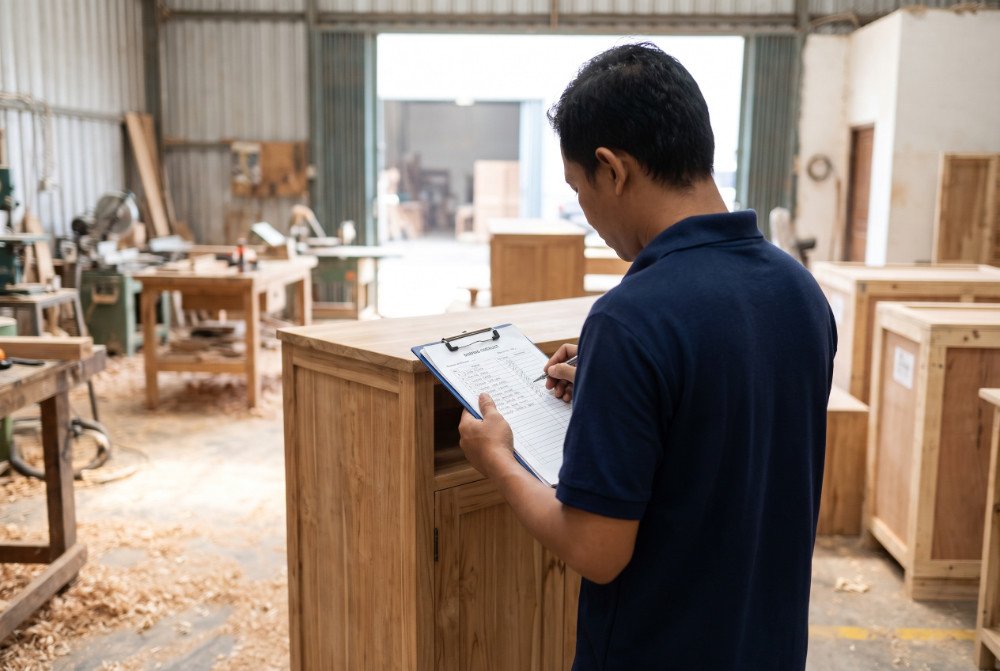
Importing wooden furniture into Europe requires documents that describe the same shipment consistently. Before dispatch, request and check:
- Commercial invoice: Buyer, seller, product descriptions, quantities, values, and agreed shipping terms.
- Packing list: Carton counts, dimensions, weights, product codes, and quantities.
- Bill of lading: Carrier-issued transport document covering the shipment.
- FLEGT license: Shipment-specific legality documentation for Indonesian timber products covered by the licensing system.
- EUDR supporting data: Applicable wood traceability, geolocation, and source information.
- Additional documents: Origin evidence, ISPM 15 wood-packaging treatment evidence, or other records where required.
Match product descriptions, quantities, shipment details, and timber information across the documents. A small difference on paper can create a bigger problem during customs checks.
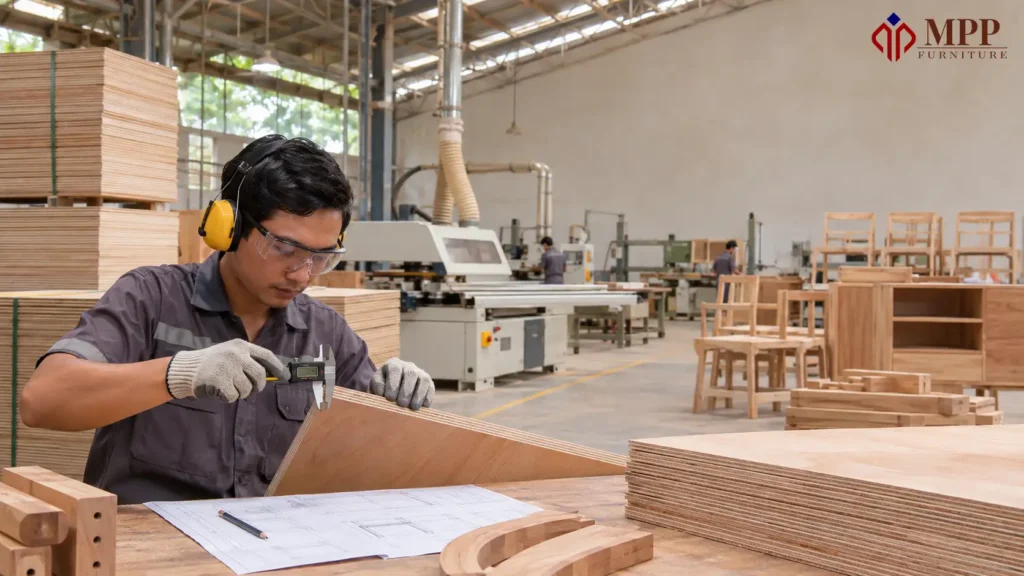
At MPP Furniture, our export workflow includes document preparation, product inspection, packing, and container loading checks. As Indonesian furniture manufacturers, we combine in-house production with staged quality checks so buyers can review product and shipment details before dispatch.
If you are still preparing your first factory order, our guide to how to buy furniture from Indonesian suppliers explains the broader process from product selection to container loading.
FLEGT and EUDR: How the Two Fit Together
FLEGT and EUDR address related concerns, but they are not interchangeable. Understanding their different roles helps importers avoid assuming that one document completes every compliance requirement.
A Valid FLEGT License Is Deemed to Meet the EUDR Legality Requirement
Under the EUDR, timber products covered by a valid FLEGT license are deemed to satisfy the regulation's legality condition. This recognition helps importers document compliance with applicable laws in the country of production.
For more background on how Indonesia verifies timber legality, read our article about FLEGT-licensed timber from Indonesia.
It Does Not Replace the Deforestation-Free Evidence or the Due Diligence Statement
FLEGT licensing does not remove the EUDR requirement to demonstrate that covered products are deforestation-free. Responsible operators must still obtain the necessary evidence and submit the applicable statement.
Request traceability records early, especially when furniture contains different wood species or timber from several sources. A supplier's legality certificate alone does not provide every detail required for EUDR assessment.
For more information about manufacturer certification, read how SVLK certification simplifies furniture imports while keeping its timber-legality benefits separate from EUDR obligations.
Downstream Buyers Keep the Due Diligence Statement Reference Number Instead of Filing a New Statement
Under the revised EUDR, downstream operators generally do not submit another due diligence statement for products already covered by an upstream operator's statement.
The first downstream operator must retain specified supplier information and, where applicable, the original statement reference number or declaration identifier. Later downstream businesses have different obligations, so confirm your exact role before deciding which records to retain.
For buyers checking a manufacturer's credentials before ordering, our guide to verifying an Indonesian manufacturer's SVLK certification explains how to review certificate identity, validity, and scope.
Step 3: Customs Clearance and Costs

Before your beautiful furniture even docks, your carrier must present an Entry Summary Declaration (ENS) at the first EU point of entry. Once it arrives, the goods are placed into temporary storage under customs supervision for a maximum of 90 days.
To clear the shipment, you or your appointed broker will submit the Single Administrative Document (SAD), the standard EU-wide import declaration form, along with your supporting documents. Customs authorities will then review the classification, declared value, origin, and applicable licenses before releasing the goods.
Import costs can include customs duty, import VAT, brokerage charges, port handling, and inland transport. A 0% customs duty does not mean a tax-free shipment, because VAT follows the applicable member state rules.
The VAT applied to your imported furniture is exactly the same rate as if you bought the product right in your domestic market. The good news for VAT-registered businesses? You can easily reclaim this import VAT as input tax, just like you would claim back your regular domestic VAT payments.
Product compliance matters too. Furniture placed on the EU market must meet applicable safety and chemical requirements, including relevant restrictions on substances used in coatings, adhesives, or upholstery.
When discussing custom furniture specifications, buyers can also consult our Indonesian custom furniture manufacturer page to understand available material, design, and production options.
Plan the Timeline Around December 30, 2026
If your furniture will be placed on the EU market after 30 December 2026, confirm whether the EUDR applies to your company and shipment. For covered imports, the necessary information should be available before the goods leave Indonesia.
Do not wait until the container is ready to request geolocation or wood-source records. Collecting missing traceability information can take longer than expected and affect shipping plans.
Retailers also need to account for production, freight, clearance, and warehouse receiving. For a more detailed planning approach, read how far in advance retailers should plan furniture imports from Indonesia.
Final Thoughts: Key Takeaways Before You Place Your First EU Order From Indonesia
You can import Indonesian furniture into the EU without waiting for IEU-CEPA. What matters is preparing your EORI registration, customs broker, shipment documents, and applicable timber compliance evidence before confirming the order.
FLEGT provides recognized timber-legality evidence, while EUDR adds deforestation-free and due diligence requirements for covered products. Handling these responsibilities early reduces avoidable surprises when your furniture reaches Europe.
At MPP Furniture, we support buyers through product development, in-house manufacturing, quality control, and export-document coordination. Contact our team to discuss your furniture specifications, documentation needs, and shipment plan before placing your next order.
FAQs About Importing Furniture From Indonesia to the EU
1. Can I import furniture from Indonesia to the EU before IEU-CEPA takes effect?
Yes. Imports can proceed under existing EU customs and product compliance rules. IEU-CEPA preferences cannot be claimed until the relevant agreement provisions enter into force.
2. Do I need an EORI number to import Indonesian furniture?
Yes. Businesses carrying out EU customs operations generally need an EORI number. Obtain it before lodging your import declaration.
3. Does a FLEGT licence replace EUDR due diligence?
No. A valid FLEGT licence satisfies the EUDR legality condition for covered timber, but does not replace deforestation-free evidence or applicable due diligence statements.
4. Is import duty always zero for wooden furniture?
No. Several wooden furniture tariff lines have a 0% standard duty, but the correct rate must be checked against the product's classification in TARIC.
5. Who is responsible for EUDR documentation?
The responsible EU operator handles applicable due diligence and statement submission. The Indonesian manufacturer supports the process by supplying relevant material and traceability information.
Ready to Place Your First EU Order From Indonesia?
At MPP Furniture, we support buyers through product development, in-house manufacturing, quality control, and export-document coordination. Contact our team to discuss your furniture specifications, documentation needs, and shipment plan.

I am a Web Designer, Technical SEO Specialist, and writer with 6+ years of experience in website optimization and search visibility. For more than a year, I have supported MPP Furniture’s growth, and I am currently expanding my role as an author to help B2B furniture buyers make more informed business decisions through informative, practical, and impactful articles.

0 Comments