A pristine website and convincing sales answers do not prove a supplier actually owns the factory making your furniture. Discovering a hidden middleman after wiring the deposit means facing invisible markups, playing telephone to fix defects, and losing control over your production schedule.
Because trading companies rarely introduce themselves as traders, you must learn to spot their subtle red flags and ask technical questions only real manufacturers can answer. Before committing to a long-term supplier, here is how to strip away the marketing and verify who truly runs the production floor.
Why This Distinction Matters More Than It Seems
The difference affects much more than the name on the quotation. A trading company normally buys production capacity from another factory, so its selling price may include another margin layer that is not visible to the buyer.
Accountability can also become less direct. If a finish fails, dimensions are wrong, or a shipment needs urgent replacement units, your contact may need to ask another company before giving you a technical answer or production slot.
This does not mean every trading company is a poor supplier. The problem starts when you believe you are working directly with the producer, while the supplier has limited control over production, QC, or scheduling.
For a deeper explanation of what this difference means when production problems or delays happen, read why a direct manufacturer is your safe option in a supply chain crisis.
Valued at USD 9.7 billion in 2026 and projected to reach USD 15.2 billion by 2034, the booming Indonesian furniture market naturally attracts opportunistic middlemen. With such high stakes, understanding exactly who you are dealing with matters more than ever. Separating genuine factories from clever marketers is your best defense against inflated pricing and lack of direct accountability.
Signs You Might Be Dealing With a Trading Company

Vague or Evasive Answers About Which Factory Actually Produces the Goods
Ask a simple question: “Where will my furniture actually be produced?” A direct manufacturer should be able to give you a clear factory location and explain which production stages happen there.
Be cautious when answers keep changing from “our factory” to “our partner factory,” or when sales cannot explain who controls machining, assembly, finishing, and packing. One vague answer may be a communication problem, but repeated vagueness is a reason to investigate further.
For a broader supplier evaluation process beyond ownership, read how to choose the best Indonesian furniture manufacturers for export.
A Catalog Spanning Product Categories No Single Factory Would Realistically Produce In-House
A broad catalog is not proof that a supplier is a trader. Some established factories have multiple production lines, but an unusually wide mix of unrelated materials and products should lead to more questions.
For example, ask which categories are made internally and which are sourced elsewhere. A trustworthy supplier should be comfortable explaining the boundary between its own production and subcontracted work.
Inability to Arrange a Factory Visit or Provide Recent Production Floor Footage
A supplier may have valid reasons why a physical visit cannot happen immediately, but showing current production should not become a permanent mystery. Ask for a live video call or recent footage that moves through raw materials, machining, assembly, finishing, QC, and packing.
Do not settle for a one-minute promotional video with no production context. For buyers planning a closer inspection, read why visiting an Indonesian furniture supplier is important.
How to Actually Verify Direct Manufacturing

Start with the legal company identity rather than the brand name shown on a website. For an Indonesian supplier, ask for business registration details, the NIB, and registered activities related to furniture manufacturing, then compare the company name and factory address with the information provided by sales.
Next, compare that address with other records available to you, such as export documents, certification records, shipping information, invoices, or inspection reports. One matching document is useful, but several consistent records tell a stronger story.
Then move from paperwork to production knowledge. Ask how the wood is dried, what happens before machining, which machines create the main joints, where QC takes place, and who has authority to stop a batch. For instance, when asked about wood drying, a trader might just brush it off with "it is well dried," but a genuine manufacturer will instantly specify their Moisture Content (MC) standard, such as 10-12% for export, and explain their kiln-dry process.
You are not trying to give the supplier an exam. You are simply checking whether their answers sound like they come from people who actually breathe sawdust and make furniture every day.
At MPP Furniture, we welcome these technical exams because our entire manufacturing process is managed strictly in-house. Our team can transparently walk you through every single stage, from raw wood preparation and machining to assembly, finishing, and final packaging. Because we embed dedicated quality control checkpoints at every production milestone, nothing is ever left to guesswork.
What a Genuine In-House Manufacturer Should Be Able to Show You
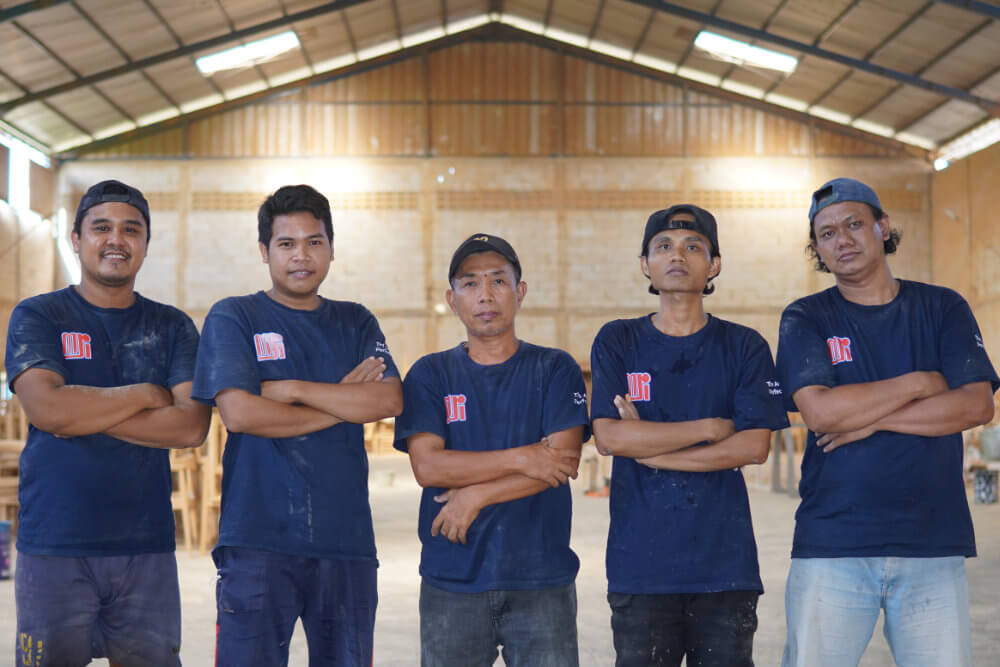
Real-Time or Recent Video of the Actual Production Floor
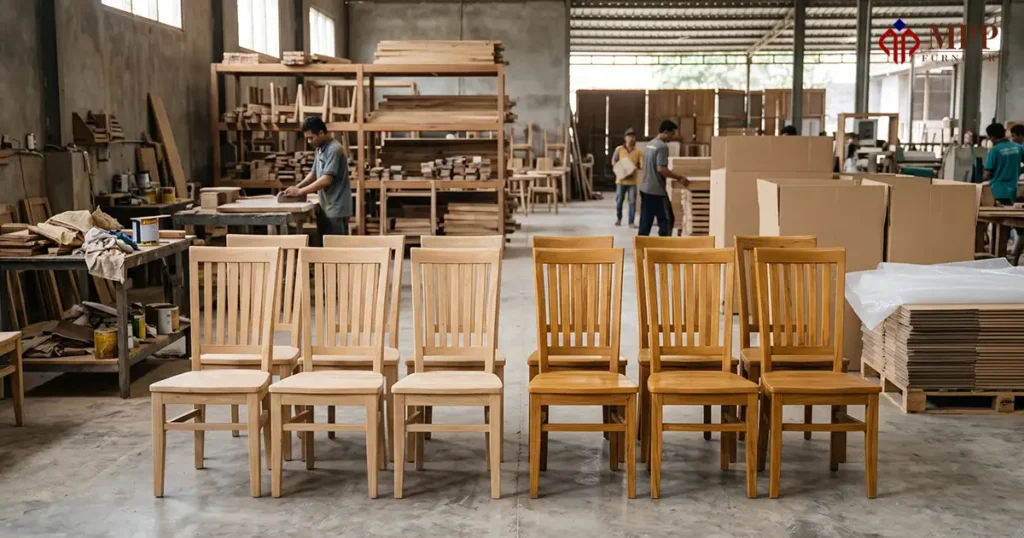
A real production floor should show work in progress, not only finished samples arranged for presentation. Ask to see raw material storage, machinery in use, unfinished frames, finishing areas, QC checkpoints, and packing activity.
At MPP Furniture, transparency is part of how we build buyer confidence. Buyers can review how an Indonesian furniture supplier handles production before deciding whether the manufacturing setup fits their program.
Direct Answers About Machinery, Workforce Size, and Daily Output
A manufacturer should know what its machines can do, which processes still depend on skilled handwork, and what realistic production capacity looks like. Furniture manufacturing is rarely just machines or just craftsmanship; stable output comes from combining both.
At MPP Furniture, wooden and rattan furniture is handcrafted by experienced teams while machinery supports accuracy, repeatability, and production efficiency. We also check details throughout production because design consistency and finishing quality are easier to control before a product reaches final inspection.
Willingness to Connect You With In-House QC or Production Staff, Not Just Sales
Sales should not be the only doorway into a supplier. When the discussion becomes technical, a genuine manufacturer should be able to involve QC or production staff who understand the issue directly.
Try asking what happens when moisture, construction, dimensions, or finishing fall outside the approved specification. The speed and clarity of the answer can tell you a lot about whether production knowledge sits inside the company or several phone calls away.
This collaborative approach is exactly how we operate at MPP Furniture. While our dedicated sales team is your welcoming first doorway, we never hesitate to bring our field experts to the table when discussions turn technical. Since our production and QC are entirely in-house, you can easily speak directly with the people who are actually building your furniture.
Why This Verification Step Protects More Than Just Price
Direct production control becomes especially important when something goes wrong. A factory that owns its schedule, workforce, and machinery can decide whether replacement units, rework, or production adjustments can be prioritized.
Traceability also becomes simpler when machining, assembly, finishing, and QC are managed within a single operation. This direct control is crucial because, according to industry data from Eightx, e-commerce return rates for furniture sit at a painful 22.7%. When reverse logistics for a defective table can easily wipe out your entire profit margin, working directly with an in-house manufacturer allows you to trace and fix these defects on the production floor before the goods ever reach your shipping container.
That matters for long-term programs because sourcing relationships are tested after the first successful shipment, not before it. Buyers need a supplier that can repeat specifications, respond to changes, and solve issues without passing responsibility from one company to another.
At MPP Furniture, we support that relationship with in-house production, free consultation, free new product development, and custom design support. The purpose is not simply to produce an order but to give buyers a production partner they can work with as collections and requirements change.
Final Thoughts: Key Takeaways Before You Confirm Who You’re Buying From
The in-house factory vs trading company distinction affects pricing, accountability, production access, and the supplier's ability to respond when conditions change. It is not just terminology printed on a company profile.
Pay close attention when a supplier cannot clearly state where production happens or who controls it. A genuine manufacturer should be able to show the production floor, explain its processes, answer technical questions, and connect you with people beyond the sales desk.
Do not depend on one certificate, one photograph, or one factory video. Compare the legal entity, factory address, production evidence, technical answers, and commercial documents until they tell the same story.
That extra verification takes time before the first order, but it can save much more time after it. When you are choosing a supplier for a long-term program, knowing who actually owns and controls production is one of the smartest checks you can make.
FAQ: Verifying Your Furniture Manufacturer
1. Why is buying from an in-house factory better than a trading company?
Buying directly from an in-house factory eliminates hidden middleman markups. It also gives you direct control over quality assurance, production schedules, and faster defect resolutions.
2. What is the biggest red flag of a disguised trading company?
The most obvious warning sign is vague or shifting answers about the exact factory location, combined with an inability to show a live video of the active production floor.
3. Are all furniture trading companies bad to work with?
Not necessarily. However, major risks arise when a trader falsely claims to be a direct manufacturer, leaving you vulnerable to poor quality control and zero priority during production delays.
4. How do I legally verify an Indonesian furniture manufacturer?
Always ask for their Business Registration Number (NIB). Cross-check to ensure the registered company name and factory address match their export documents, invoices, and shipping records.
Ready to Partner with a Genuine In-House Manufacturer?
Stop guessing who actually makes your furniture. Explore MPP Furniture's transparent production capabilities or contact us directly to discuss your long-term custom, private-label, or OEM development needs.

I am a Web Designer, Technical SEO Specialist, and writer with 6+ years of experience in website optimization and search visibility. For more than a year, I have supported MPP Furniture’s growth, and I am currently expanding my role as an author to help B2B furniture buyers make more informed business decisions through informative, practical, and impactful articles.
0 Comments