A furniture production update is difficult to use when it says an order is 70% complete but does not show which model is still behind. For buyers managing several dining chair models in one container, actual quantities by production stage give a clearer picture than one overall percentage.
This furniture production report template gives you a practical format for tracking each model from frame and weaving through finishing, QC, rework, and packing. It can also help when you are comparing production visibility between manufacturers, including an Indonesian Furniture Supplier.
You will see a multi-model report example, a two-period comparison, and a way to spot the model that may affect packing. We will also show how a late finish change can be recorded without removing the original packing target.
What Should a Dining Chair Production Report Show?
Start with quantities, not percentages. For each model, you should be able to see the order quantity, completed frames, weaving progress where applicable, finishing, QC-passed units, rework, packed units, blockers, and packing target.
A good furniture production report should follow the actual furniture manufacturing process. For woven chairs, frame and weaving need separate numbers because a completed frame does not mean the chair is close to packing.
This becomes more useful when several products from an Indonesian Dining Room Furniture order are planned for the same container.
Furniture Production Report Template for a Multi-Model Dining Chair Order
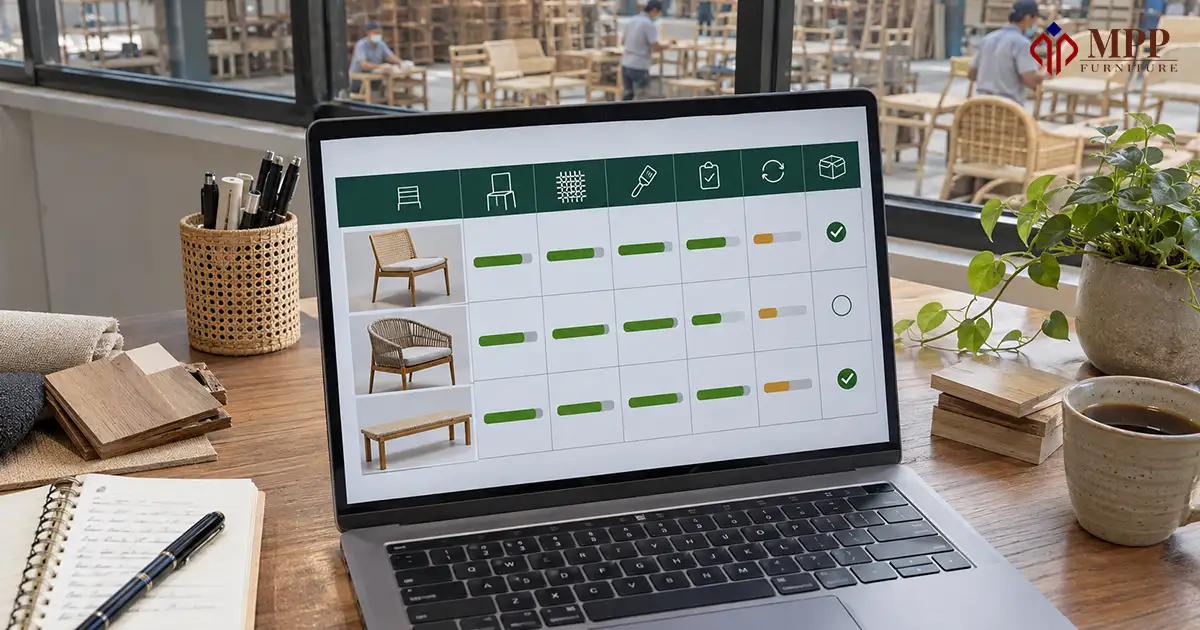
Production Report Template
The example below is illustrative. You can copy the format into a spreadsheet or ask your supplier to use a similar furniture report.
| Model | Order Qty | Frame | Weaving | Finishing | QC Passed | Rework | Packed | Packing Target |
| Dining Chair A, Synthetic Rattan | 120 | 120 | 90 | 70 | 60 | 5 | 45 | 18 Nov |
| Dining Chair B, Rope | 120 | 110 | 65 | 50 | 40 | 4 | 30 | 22 Nov |
| Bench | 60 | 55 | N/A | 40 | 35 | 2 | 25 | 20 Nov |
The numbers matter because they show where each model actually sits. They also make it easier to compare one report with the next instead of relying on a general completion figure.
Track Each Chair Model Separately Even When Some Frames Are the Same
In real furniture orders, two chairs can use similar frames but different woven materials. One model may use synthetic rattan while another uses rope, so the weaving stage can move at a different pace even when frame production is similar.
This is why model-level reporting matters. If both frames are nearly complete but one weaving quantity remains low, the buyer can see where attention is needed.
From my own production experience, reports were usually issued every two weeks at total PO level. That worked for a general update, but checking each model separately gave a clearer view when different materials or processes were involved.
Compare Reports to See Where Production Has Stopped Moving
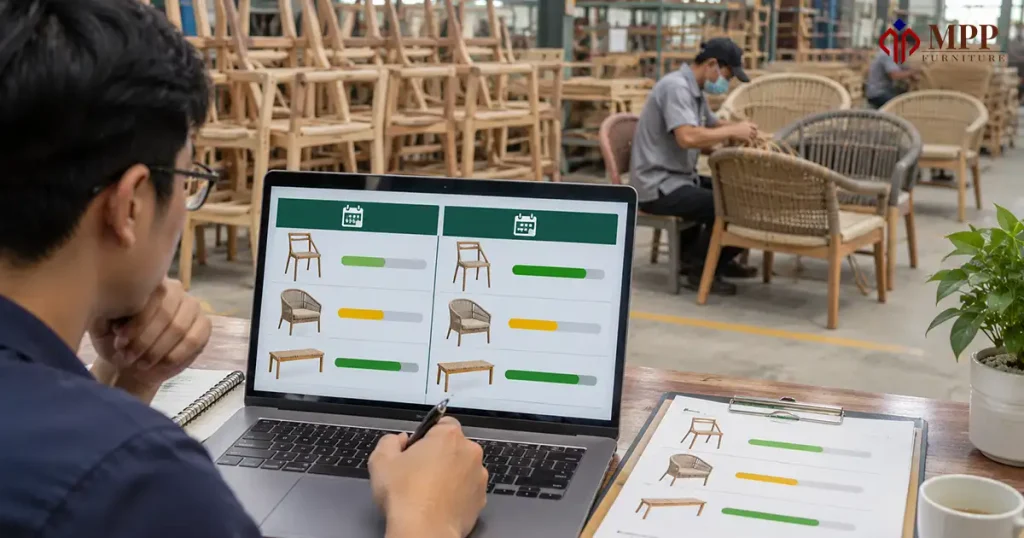
Report 1 vs Report 2 Example
| Dining Chair B Stage | Report 1 | Report 2 | Change |
| Frame completed | 90 | 110 | +20 |
| Weaving completed | 65 | 65 | 0 |
| Finishing completed | 35 | 50 | +15 |
| QC passed | 25 | 40 | +15 |
| Packed | 15 | 30 | +15 |
The frame count moved, but weaving did not. That does not automatically mean the order is late, but it is the first stage I would check.
In practice, I would ask the QC team in the related division, inspect the products physically on the production floor, then confirm the situation with the production head. A slow number can sometimes mean the product needs extra handling before it can move to the next stage.
QIMA’s production monitoring guide also describes scheduled weekly reporting as one way to follow production status. In furniture orders, weekly or biweekly reporting can work, as long as buyers compare movement between reports.
Separate QC-Passed, Rework, and Packed Quantities
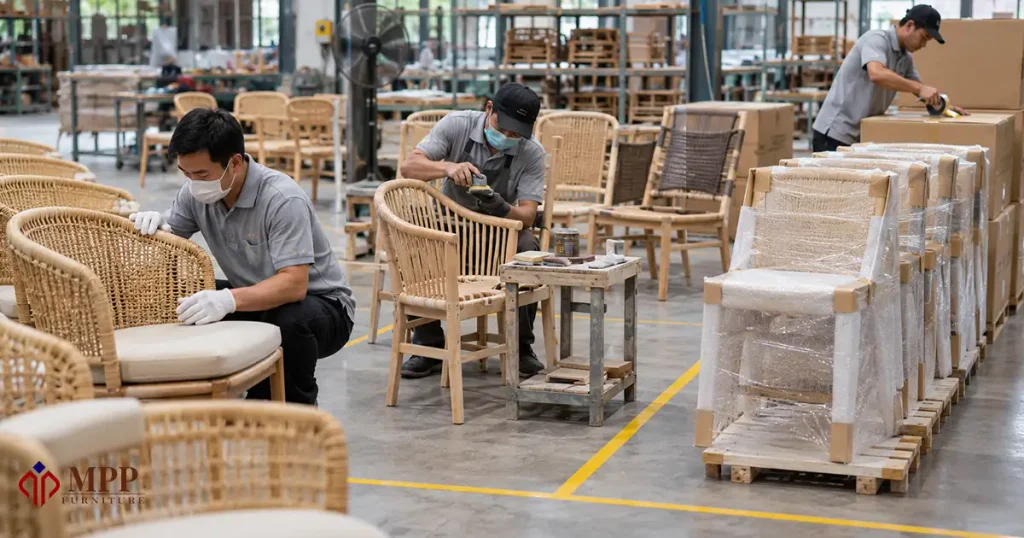
“Finished” does not mean “ready to ship.” A report could show 100 finished chairs while 86 have passed QC, 14 require rework, and only 70 are packed.
Repeat-order products usually have fewer production issues because the construction and process are already familiar. New products may have minor bottlenecks, but these can often be resolved quickly once the production and QC teams identify the cause.
MPP also checks furniture during production and before packing. You can read more about that process in our guide to furniture quality for international retailers.
Check Which Model Could Delay the Whole Container
When several models are planned for the same container, the fastest model does not set the schedule. The model that reaches QC and packing last can become the one that determines complete packing readiness.
For example, if Dining Chair A is packed by 18 November, the bench by 20 November, and Dining Chair B by 22 November, buyers should monitor Dining Chair B most closely.
Our guide to furniture production lead time explains why mixed-SKU orders should be followed by production milestones rather than one overall completion percentage.
Record Production Changes and Revised Packing Dates in the Same Report
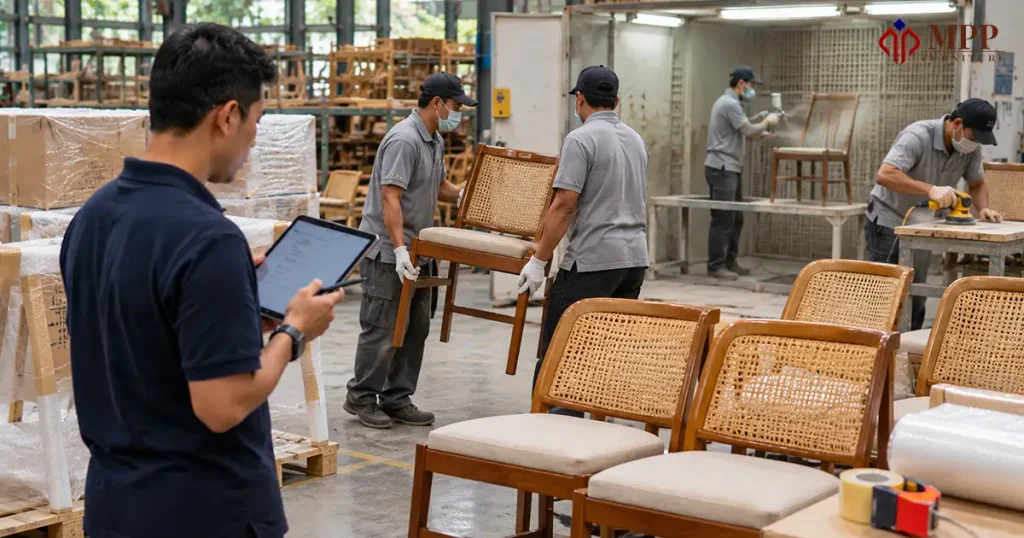
Example: Buyer Requests a Finish Change Near Packing
Late production changes are uncommon, but they can happen. In one recent case from my own experience, the buyer requested a finish color change when the product had already reached the packaging stage.
MPP has also documented a similar real production situation where an approved warm finish had already been applied before the buyer requested an unfinished appearance. That required color removal and another finishing cycle before the affected products could return to QC, as explained in our article about a teak dining chair finish change during production.
| Model | Affected Qty* | Change | Rework | Original Packing | Revised Packing |
| Dining Chair B | 40 | Finish color revision | Surface preparation, finishing, QC | 22 Nov | 29 Nov |
*Quantity and dates are illustrative.
Keep both packing dates visible. If the first date disappears from the report, the buyer loses the history of what changed and why.
Final Decision: Ask for Model-Level Progress, Not One Overall Percentage
A useful furniture production report should quickly show which model moved, which stage did not move, and which model still needs the most work before packing. This is more useful than reading one percentage for the entire PO.
Use actual quantities, compare one report with the next, separate QC from rework and packing, and keep original and revised dates when production changes. Treat packed quantity as the final factory-reporting milestone, while container loading and vessel departure remain separate logistics events.
Need Clearer Production Updates for Your Dining Chair Order?
Share your chair models, quantities, finish specifications, packaging requirements, and target loading date with MPP Furniture. Our team can discuss how your order can be planned and reported from production through QC and packing, including free consultation for custom, OEM, private-label, and export furniture requirements.
FAQ: Furniture Production Reports for Dining Chair Orders
1. What should a furniture production report include?
A furniture production report should show order quantity, progress by model, production-stage quantities, QC-passed units, rework, packed units, blockers, and planned or revised packing dates.
2. How often should buyers receive a furniture production report?
Weekly or biweekly reporting can work for bulk furniture orders. The important point is that each report uses the same production stages so buyers can compare actual movement over time.
3. Why should each dining chair model be reported separately?
Different models can move at different speeds even when they use similar frames. Different weaving materials, finishing work, QC results, or rework can make one model slower than another.
4. Can one unfinished chair model delay the whole container?
Yes. If all models are planned for the same container, one model that has not cleared QC and packing can hold the complete order from reaching packing readiness.
5. Does slow progress always mean production is delayed?
No. A slow stage can mean the product needs extra handling, correction, or another production step before moving forward. Buyers should ask what caused the slower movement and whether enough time remains for the next stages.

A versatile content creator with a strong foundation in product photography and videography, and a comprehensive brand strategy. Capable of creating engaging content to connect consumers and producers, web analytics, and engaging visual content to drive interest and growth for a product or brand.
0 Comments