An Indonesian mahogany headboard can work especially well as a statement piece because it occupies one of the most visible areas of a bedroom. That gives mahogany more space to contribute its wood tone, grain, finish, shape, and detailing to the overall impression of the bed.
For furniture retailers, this does not mean an entire bedroom collection needs to be made from mahogany. The headboard can carry more of the collection's visual identity while the supporting pieces follow the same overall direction.
The real question is not simply whether mahogany is a good furniture wood. It is whether putting mahogany in such a visually prominent position helps create the bedroom collection your target customers will want to buy.
This article explains why the headboard is a strong place to use mahogany, how it can work as a focal piece without defining the entire collection, and what retailers should consider before moving into product development.
Why Do Headboards Naturally Become a Focal Point in the Bedroom?
The bed usually takes up a large share of the bedroom, and the headboard adds a strong vertical element behind it. As a result, people often notice the headboard before smaller furniture pieces around the room.
Size matters, but it is not the only factor. Silhouette, color, material, texture, and proportion can all change how the bed feels at first glance. Architectural Digest has also highlighted how designers use headboards as focal points and experiment with their scale, shape, and materials to give bedrooms more personality.
For a retailer, that visual position creates an opportunity. Instead of expecting every item in a bedroom range to attract the same amount of attention, the headboard can establish the collection's visual direction first while smaller supporting pieces help complete the overall look.
This is especially useful when you want a bedroom collection with a recognizable identity without creating a heavily matched furniture set.
Why Does Mahogany Get More Visual Exposure on a Statement Headboard?
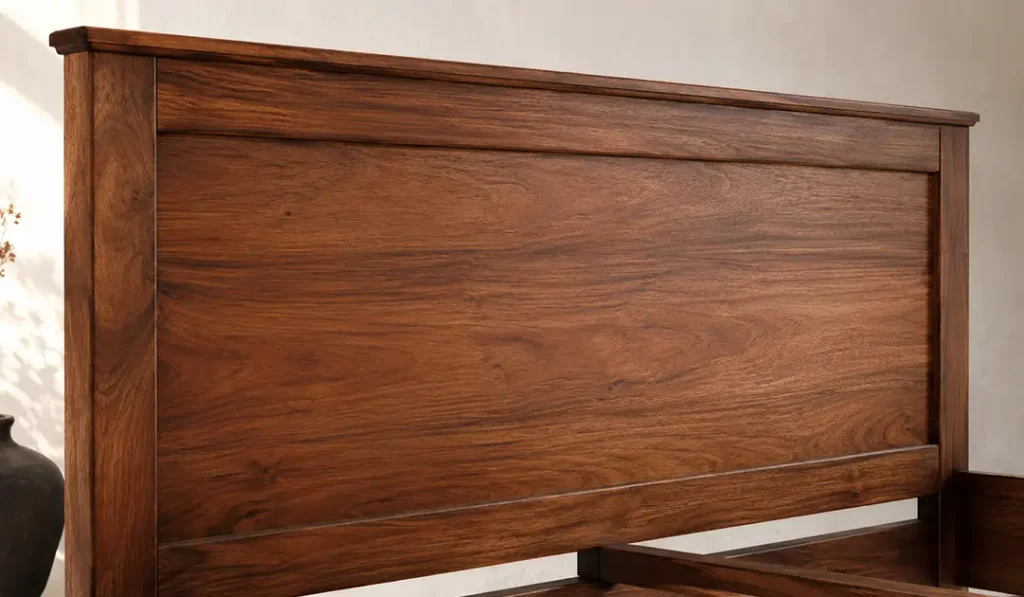
Mahogany becomes more visually meaningful when buyers can see it across a broad exposed surface. On a headboard, that gives the wood grain, finish tone, edge profile, and detailing more room to contribute to the overall design.
This is similar to how mahogany performs in other applications where larger visible surfaces help the material become part of the product's visual identity. You can see this broader use of the material in the guide to ideal mahogany furniture applications. The same principle works vertically on a headboard, where the material sits close to eye level and becomes part of the bedroom's main visual composition.
But a solid mahogany headboard does not have to rely on heavy carving or a traditional look. Headboard design has also moved toward cleaner forms and mixed-material combinations, including woven panels or other material inserts within a mahogany frame.
In short, the value comes from giving the material enough room to contribute to the design, not from adding decoration simply because mahogany is being used. This gives you more freedom to use mahogany across different design directions instead of treating it as a material limited to formal or classic bedroom furniture.
A Mahogany Headboard from Indonesia Can Be the Hero Piece Without Making the Whole Collection Mahogany
One of the most useful commercial reasons to consider a mahogany headboard is that the material does not need to continue across every SKU. You can use mahogany where it has the strongest visual role, then build the surrounding assortment with other materials that support the same collection direction.
For example, if an Indonesian mahogany headboard uses a woven rattan panel, you might repeat rattan in a nightstand detail, bench, or lighting piece. But repeating the same material is only one way to connect the collection. A similar profile, shape direction, proportion, or finish tone can create an equally clear visual relationship between products.
This creates cohesion without making every product look identical. The headboard can remain the hero piece, while the supporting furniture plays a quieter role around it.
This is also why choosing mahogany for one statement product should still be considered within the wider assortment plan. Design direction, target customer, price position, and repeatability all affect how well the material fits the range. The guide on mahogany for indoor furniture assortments looks at those broader considerations in more detail.
This approach gives you more room to build a recognizable bedroom collection without committing every supporting piece to mahogany.
Does a Mahogany Statement Headboard Fit Your Retail Market?
A visually strong product still has to make sense for the customer who will eventually see it on the showroom floor or product page. So the right direction depends on how you position the collection and what kind of customer you want to attract.
Start with your target customer. A collection aimed at buyers who prefer warm, classic interiors may use mahogany differently from one built around a cleaner transitional direction. The material can support both, but the proportion, finish, and level of visual presence should follow the intended style.
From MPP Furniture’s experience, buyers who choose mahogany for a headboard often consider two practical factors: price and the wood’s natural color tone. Mahogany can offer a warm, distinctive wood character at a more affordable price point than teak, which can make it a practical option when the headboard needs to carry strong visual presence without pushing the entire bedroom collection into a higher material cost.
Next, consider how much visual weight the headboard should carry. A tall, darker, fully exposed mahogany headboard will create a different impression from a lighter design with slimmer wood sections or mixed materials.
Price position also matters. Mahogany should contribute enough character and perceived value to support the intended retail offer, rather than being used simply because it is associated with higher-end furniture.
In short, the best mahogany statement headboard is not the one with the most wood or the most detail. It is the one that fits your customer, design direction, and wider bedroom assortment.
From Headboard Direction to Product Development
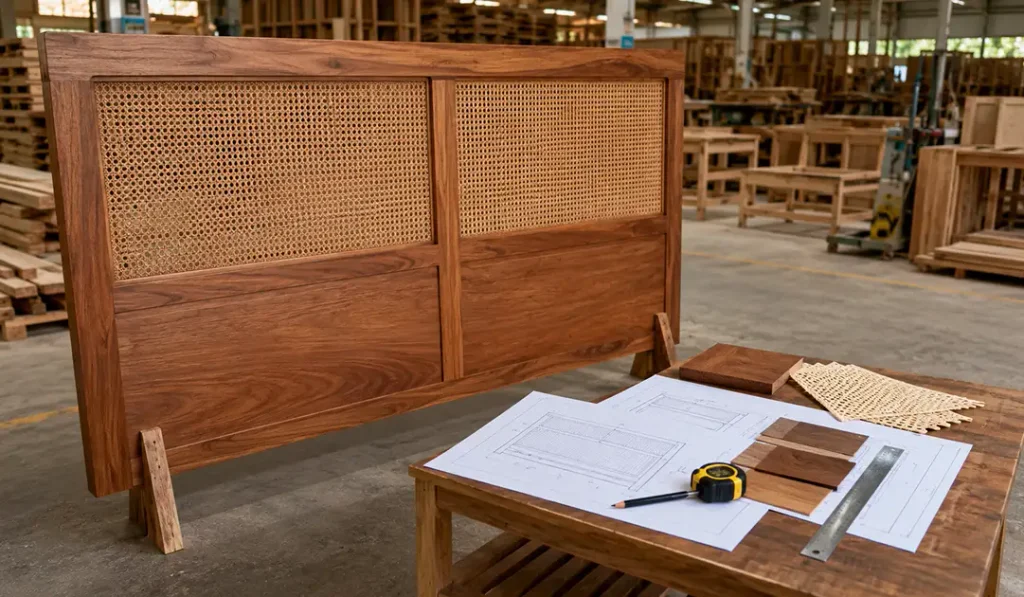
Once you have decided that a mahogany statement headboard fits your market, the discussion can move from product direction to product development.
At that stage, the buyer and manufacturer can define the silhouette, dimensions, level of exposed mahogany, finish direction, material combinations, and target product position. These decisions can then be tested through product development and sample approval before moving into repeat production.
In actual product development, revisions often come down to proportion. For example, a buyer may ask to reduce the width of a solid wood section from 5 cm to 4.5 cm, or adjust the spacing between the upper and lower horizontal rails so the woven area feels better balanced. Small changes like these can noticeably change how heavy, open, or refined the headboard looks.
For buyers who want to explore these options in more detail, our guide to custom bedroom furniture in Indonesia covers different approaches to headboard forms, dimensions, materials, finishes, and mixed-material combinations.
This is also where working closely with an Indonesian furniture manufacturer becomes useful. At MPP Furniture, buyers can discuss the intended market, design direction, materials, and finish before the concept moves into development.
From there, the selected direction can be translated into a custom design and sample for review, rather than forcing the collection into a predetermined material or style.
Final Thoughts
A mahogany headboard makes the most sense when its material character supports the bedroom collection you want to build. The surrounding furniture does not need to repeat the same wood, as long as the products still feel visually connected.
For retailers, the commercial value comes from matching the headboard with the target customer, design direction, and wider assortment. Once that direction is clear, the concept can move into development, sampling, and preparation for repeat production.
Already Have a Mahogany Headboard Concept in Mind?
Discuss it with MPP Furniture to develop the design, material combination, finish direction, and sample before introducing the product to your market.
FAQs About Mahogany Headboards
1. Is mahogany a good wood for a headboard?
Yes. Mahogany works well for headboards because a broad exposed surface gives its grain, tone, finish, and detailing more visual impact. It works best when that look fits the retailer’s target customer and bedroom collection.
2. Does a mahogany headboard require matching mahogany bedroom furniture?
No. A mahogany headboard can act as the hero piece while nightstands, dressers, benches, and storage furniture use complementary materials. Cohesion can come from finish, proportion, detailing, hardware, or repeated design elements.
3. Does a statement mahogany headboard have to be large or decorative?
No. A statement headboard can gain visual presence from proportion, silhouette, exposed material, grain, or finish. It does not need to be oversized, heavily carved, or highly decorative.
4. Can mahogany be combined with upholstery or rattan in a headboard?
Yes. Mahogany can be used as an exposed frame or panel alongside upholstery, rattan, or other woven elements. The combination should support the intended style, visual weight, price position, and target customer.
5. How can retailers decide whether a mahogany headboard fits their bedroom collection?
A mahogany headboard fits a bedroom collection when its visual character, price position, proportion, and material presence match the retailer’s target customer and wider assortment. Supporting pieces do not need to use the same wood as long as the collection still feels visually connected.

Hi, I’m Salman, founder of MPP Furniture, an Indonesian furniture manufacturer serving global retailers and project-based clients.
I began my career in my family’s export-oriented furniture company, gaining hands-on experience in production, construction, finishing, material performance, and product development. With a clear understanding of how international buyers evaluate furniture quality and reliability, I founded MPP Furniture to deliver export-ready products with consistent standards.
Here, I share insights from the perspective of a furniture manufacturer working directly with production teams on the factory floor, focusing on manufacturing and supplier evaluation.
Connect on LinkedIn
0 Comments