When furniture buyers compare wood veneer vs solid wood for cabinet collections, choosing one material may seem simpler. But cabinet components serve different purposes.
Consider solid wood for frames and shaped details, and well-built veneered panels for broad surfaces. Choose by function, appearance, stability, and target buying price.
For buyers working with an Indonesian Furniture Supplier, this guide covers material selection, veneer appearance, construction stability, and approval for consistent bulk production and repeat orders.
Which Cabinet Components Should Use Solid Wood or Decorative Veneer?
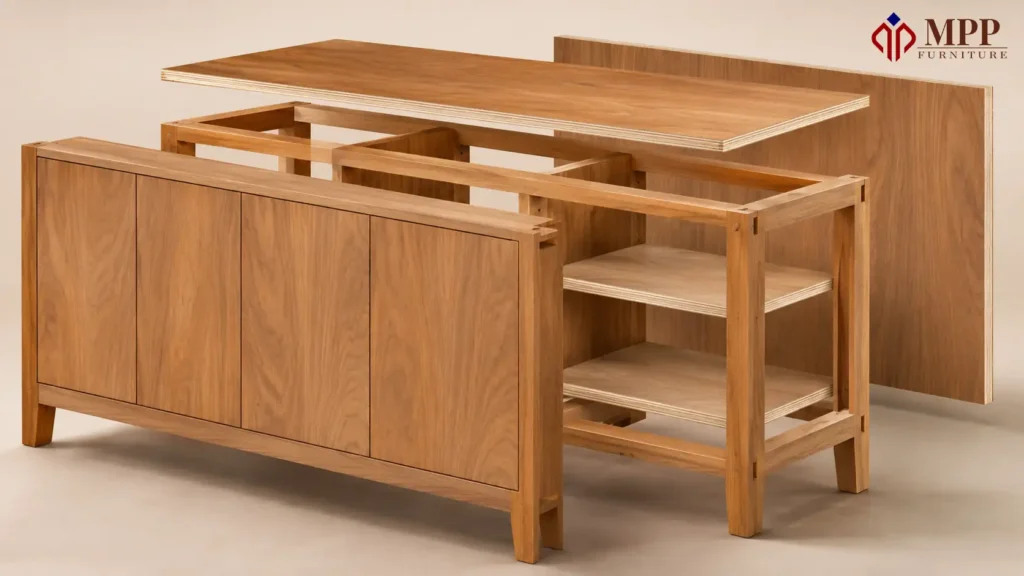
The solid wood vs veneer comparison is not about real versus artificial wood. Natural decorative veneer is a thin layer of genuine wood bonded to a substrate, such as plywood or MDF, while solid wood consists of timber throughout the component.
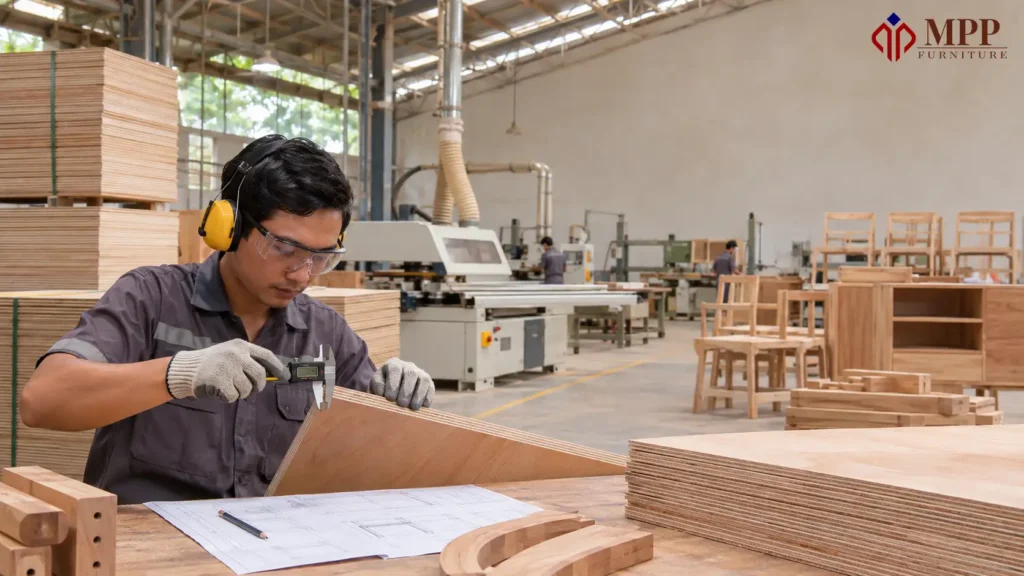
In our cabinet production at MPP Furniture, we typically use solid wood for the frame and veneered plywood for cabinet tops, back panels, and internal shelves. Material combinations vary with the buyer's design and construction requirements.
| Cabinet Component | Material Options | Selection Considerations |
| Top panels | Solid wood or veneered plywood | Surface wear, width, and edge profile |
| Door fronts | Veneered panels or frame-and-panel construction | Grain continuity and stability |
| Drawer fronts | Solid wood or veneered panels | Grain pattern and machining |
| Carcass and side panels | Veneered plywood or suitable engineered panels | Rigidity and appearance |
| Shelves | Solid wood or suitable engineered panels | Load, thickness, and span |
| Back panels | Plywood or suitable engineered panels | Rigidity and attachment |
| Legs and frame | Solid wood or suitable engineered construction | Load transfer and joinery |
| Edges | Solid wood lipping or suitable edge banding | Profile and impact resistance |
Unlike choosing between solid teak and teak veneer side tables, cabinets require more component-level decisions. Confirm dimensions, loads, hardware, and intended use with your manufacturer.
How Can Buyers Combine Materials to Meet Target Prices Without Changing the Design?
Set your target buying price and identify the features your target market values, such as proportions, decorative profiles, and grain appearance. Agree which features must stay unchanged.
For example, a sideboard with a solid wood frame and shaped details could use decorative veneered panels for its broad surfaces. This combination may reduce solid timber consumption while maintaining the intended design, subject to construction review and sample approval.
Selected veneers, complex matching, substrates, and finishing can increase costs. To reduce furniture costs without changing the collection design, compare revised samples and finished-product quotations at matching quantities and commercial terms.
How Do Veneer Specifications Affect Cabinet Design and Collection Consistency?
Veneer Species, Cut, and Grain Matching
The appearance of wood veneer furniture depends on species, grade, slicing method, and grain arrangement. As explained by the Architectural Woodwork Institute, plain slicing generally produces cathedral-shaped patterns, while quarter and rift slicing can produce more linear grain, depending on the species.
For wood veneer grain matching, book matching, slip matching, and random matching create mirrored, repeated, and more varied grain arrangements, respectively. Book-matched leaves can also reflect light differently, creating alternating light and dark tones known as the barber pole effect. Specify your preferred grain direction and whether sequence matching is required across adjacent doors and drawers.
Finish Matching Across Cabinet SKUs and Repeat Orders
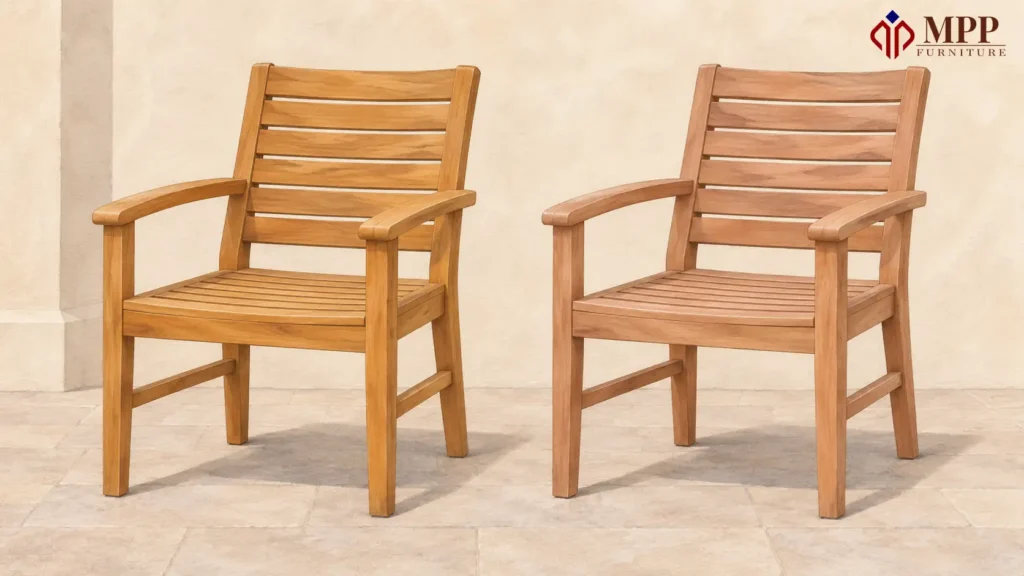
During sampling, we sometimes find differences in finish color between solid wood and decorative veneer because their natural characteristics and surface responses differ. Our finishing team adjusts the color on each material so they look coordinated when assembled into one product. Once approved by the buyer, the result becomes a reference for our production and QC teams.
This is particularly important when developing a complete indoor furniture collection. Approve a shared visual direction across related SKUs, including color range, sheen, and grain character, rather than expecting identical natural grain on every cabinet.
How Do Solid Wood and Veneered Panels Affect Cabinet Construction Stability?
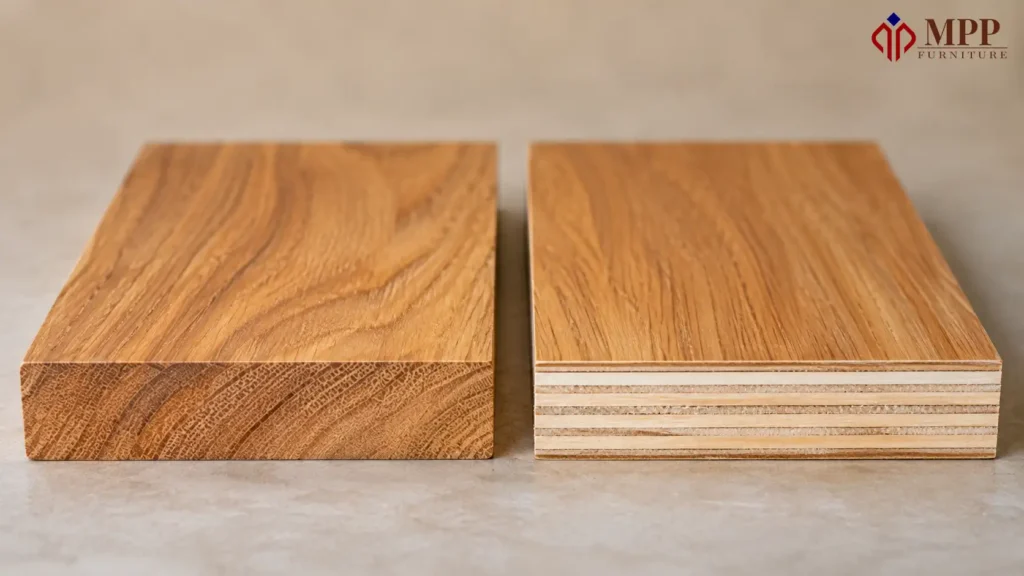
According to the USDA's Wood Handbook, changes in moisture content influence wood properties and performance. Wide solid wood panels can shrink or swell across the grain, increasing the risk of warping or cracking when construction restricts natural movement.
Veneered plywood can offer better dimensional stability than wide solid wood panels because of its cross-layered construction. However, unsuitable substrates, unbalanced panel construction, or uneven moisture exposure can still cause warping.
Veneer delamination can occur when bonding quality or adhesive suitability is inadequate. The Timber Veneer Association of Australia treats substrate performance and veneer bond durability as separate considerations, so buyers should evaluate both rather than judging quality by the visible veneer alone.
What Material Specifications Should Buyers Approve Before Cabinet Production?
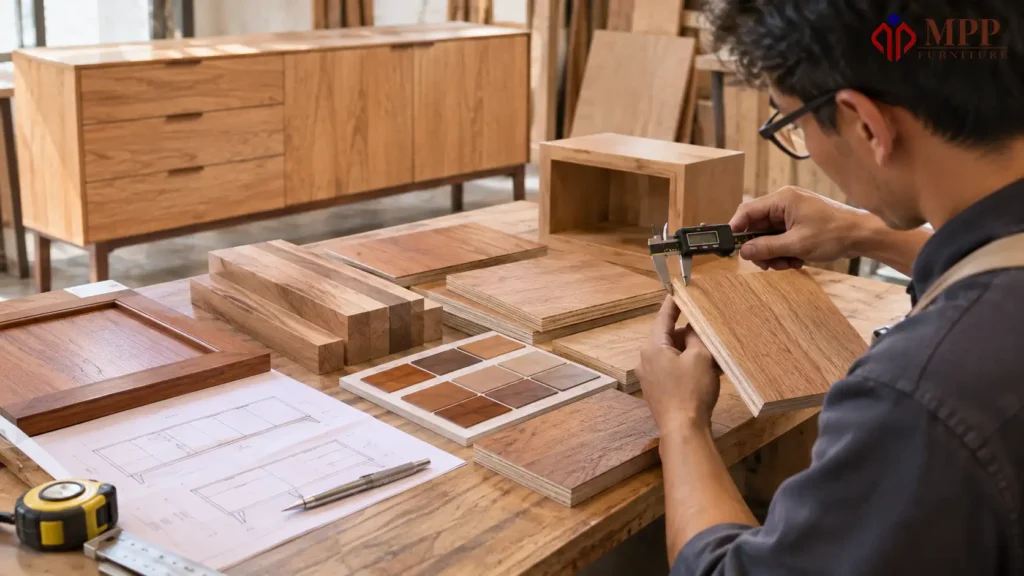
A cabinet material specification should connect the approved design with the materials and construction intended for bulk production. Before placing an order, agree on the following information with your manufacturer:
- Solid wood: species, grade, moisture requirements, and component allocation.
- Decorative veneer: species, cut, grade, thickness, matching method, and grain direction.
- Panel construction: substrate, thickness, backing material, bonding requirements, and edge treatment.
- Visual approval: finish color range, sheen, texture, and acceptable natural variation.
- Construction approval: dimensions, joinery, shelf loads, hardware fitting, and functional checks.
- Production reference: approved drawings, bill of materials, physical samples, and material-change approval.
At MPP Furniture, our purchasing and production teams check incoming plywood and MDF against buyer-approved specifications, including material types, panel thickness, and available supplier purchase records. For US-bound furniture, buyers should also review applicable TSCA Title VI compliance requirements.
For repeat orders, when a new veneer batch differs in appearance from the previous one, we compare it with the approved sample and request renewed buyer approval when necessary. This helps us maintain the agreed visual character while accounting for natural material variation.
Final Thoughts: Choose the Right Material for Each Cabinet Component
Neither solid wood nor decorative veneer is automatically the better choice for an entire cabinet. The right combination depends on component function, design character, target buying price, and construction requirements.
By approving materials, grain arrangements, finishes, and construction together, buyers have a clearer basis for maintaining quality and consistency across their cabinet collections.
Develop Your Cabinet Collection with the Right Material Specifications
Share your cabinet drawings, design references, target buying prices, and collection requirements with MPP Furniture.
Through our free consultation, free product development, and custom manufacturing services, we help you evaluate material combinations that align with your design, target price, and quality requirements before committing to production.
FAQs: Solid Wood and Decorative Veneer for Cabinet Collections
1. How should retailers describe cabinets made from solid wood and decorative veneer?
Retailers should identify the materials used in each component, such as solid wood frames and veneered plywood tops, rather than describing the entire cabinet as solid wood.
2. Are veneered cabinets lighter than solid wood cabinets?
Not necessarily. Finished cabinet weight depends on wood density, substrate type, panel thickness, dimensions, and hardware. Request actual product weights when estimating handling and shipping costs.
3. Can decorative veneer be used on curved cabinet fronts?
Yes. Decorative veneer can be applied to curved surfaces, provided the veneer type, substrate, bending radius, and bonding method are suitable for the intended shape.
4. Should retailers order spare veneered cabinet doors and drawer fronts?
Ordering spare components from the initial production batch can help retailers manage after-sales replacements and reduce the risk of visible differences when replacement parts are needed later.
5. Can damaged decorative veneer on cabinets be repaired?
Minor surface scratches may be repaired through finish touch-ups. Deeper damage may require veneer patching or component replacement. Excessive sanding should be avoided because it can expose the underlying substrate.

A versatile content creator with a strong foundation in product photography and videography, and a comprehensive brand strategy. Capable of creating engaging content to connect consumers and producers, web analytics, and engaging visual content to drive interest and growth for a product or brand.
0 Comments