When evaluating a furniture factory in Indonesia, you need a lead-time estimate for your complete order, not just a general production duration. As you compare Indonesian furniture manufacturers, check what each estimate covers before using it to plan container loading.
MPP publishes a typical 45–60 day production range for certain orders, but that range should not automatically be interpreted as 45–60 days from deposit receipt to container loading. The actual timeline depends on the order, its specifications, production readiness, and the starting and completion points stated in the quotation.
This guide therefore uses a separate measurement: from the date MPP receives your deposit until all agreed goods have been loaded into the container. It shows how specifications, production milestones, inspections, packing, and SKU coordination affect that timeline and how you can check whether your proposed loading date still holds.
When Does Your Furniture Lead Time Start and End?
Before comparing lead-time estimates, first establish exactly what the quoted number measures.
For this guide, we measure the deposit-to-loading period from the date MPP receives your deposit until all goods agreed for the container have been loaded. This gives the buyer a clear starting and ending point for reviewing an actual order timeline. For this guide, deposit receipt is the starting point used to explain the timeline. Your actual quotation may use a different starting event, so confirm the start and completion points stated for your order.
For a 40HQ container order quoted within MPP's 45–60 day production range, treat that range as order-dependent rather than as a fixed deposit-to-loading duration for every order. Confirm the starting event stated in the quotation, whether the estimate uses calendar or working days, and which production or shipment milestone marks completion.
Keep the order confirmation date, deposit receipt date, production start date, packing completion date, container loading date, and vessel departure date separate. A deposit may already have been received while a drawing, finish, packaging specification, or another buyer approval is still pending.
For planning beyond container loading to stock availability, see our guide to timing furniture imports from Indonesia.
What Order Details Are Needed to Estimate Your Lead Time?
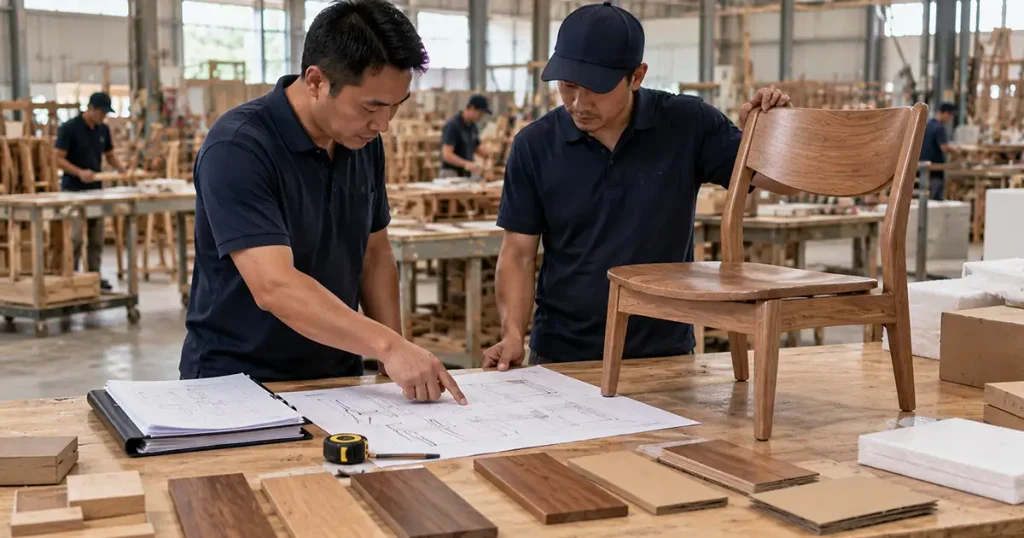
A useful estimate starts with the actual order rather than a standard number of production days.
Provide each SKU or product code, quantity, material, finish, drawing or sample approval status, and packaging requirements. Include any buyer-side inspection requirements, your requested loading date, and which products must travel together in the same container.
At MPP, every order follows written specifications for materials, dimensions, finishes, and packaging. Production scheduling considers capacity, material availability, labour, finishing requirements, and inspection. Before relying on the proposed loading date, check which specification version and production slot support the estimate.
Your requested loading date remains a target until the order has been reviewed against those requirements. Unfinished approvals should therefore have clear decision deadlines. A late finish approval, drawing revision, material change, or packaging change can affect the production schedule even when the deposit has already been received.
Follow the Production Milestones That Lead to Container Loading
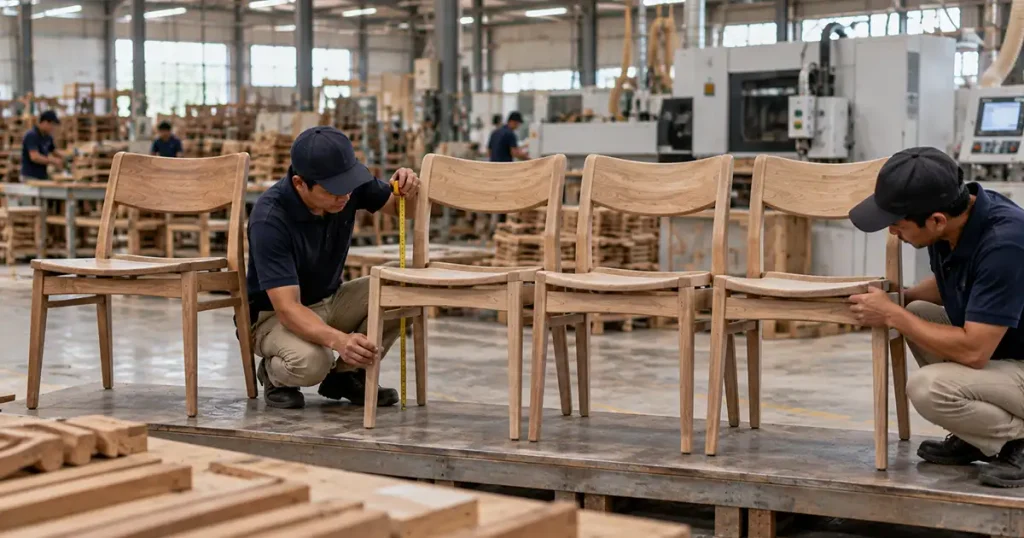
The main furniture manufacturing process runs through:
Material preparation → machining → assembly → sanding → finishing → quality control (QC) → packing → container loading.
These milestones tell you more about the status of an order than one general production percentage.
At MPP, CNC machines help produce consistent components, while skilled craftspeople handle assembly and other work that requires manual accuracy. In our chair checks, for example, several early units can be compared side by side for differences in profile, seat height, and joint position. The approved sample remains the reference so that early differences can be corrected before they continue across the batch.
Do not divide a 45–60 day estimate equally across every manufacturing stage. Some activities can overlap, while others depend on completion or approval of earlier work. Instead, request completion targets for the milestones relevant to your order and check whether correction and reinspection time are included in the schedule.
How Mixed-SKU Orders Affect the Overall Timeline

When several SKUs must travel in the same container, the fastest SKU does not determine when the container can be loaded.
Suppose chairs are already packed while tables and sideboards are still undergoing finishing or QC. If all three products belong to the same planned container, the order is not ready for complete loading simply because the chairs are finished.
You therefore need to know when every SKU required for that load can clear QC and packing. For more about coordinating products across a collection, see our complete indoor dining collection guide.
Consider this fictional example:
| SKU / Quantity | QC Clearance Forecast | Packing Completion Forecast |
|---|---|---|
| Chairs / 48 | 8 July | 10 July |
| Tables / 12 | 10 July | 13 July |
| Sideboards / 8 | 13 July | 15 July |
Assume MPP receives the deposit on 6 May, packing of the final SKU finishes on 15 July, and container loading is completed on 17 July.
In this illustration, the deposit-to-loading period is 72 elapsed calendar days. This example is fictional and should not be treated as an MPP quotation, production benchmark, or indication that the 45–60 day production range applies from deposit receipt to container loading.
For an actual order, use the manufacturer-reviewed schedule and the day-count method agreed for that specific order. Do not simply add the production duration of individual SKUs because several manufacturing activities may run in parallel.
Read Production Updates by Milestone, Not Just Percentage
A report saying an order is “70% completed” does not necessarily tell you whether your container loading date is still achievable.
Seventy percent assembled and 70% packed represent very different positions in the manufacturing timeline. One still has sanding, finishing, QC, correction, and packing ahead; the other is much closer to cargo readiness.
A more useful production update shows quantities and expected dates for milestones such as machining, assembly, finishing, QC clearance, and packing. Compare planned dates with actual progress and identify which unfinished SKU or process could affect the complete order.
Using the fictional example above, moving sideboard packing from 15 July to 16 July would not necessarily prevent loading on 17 July. However, if sideboard packing moves to 18 July, the complete order can no longer support the original 17 July loading date. In that situation, request a revised whole-order forecast rather than automatically adding one day to every remaining activity.
What Must Be Complete Before Container Loading?
Confirm QC, Corrections, and Packing Are Complete
Production completion alone should not be treated as confirmation that an order is ready to load.
At MPP, inspections take place during production, followed by a final product check before packing. Some European buyers also use their own QC teams alongside MPP's internal checks. When buyer-side inspection is required, its timing should be included in the schedule before relying on the proposed loading date.
Before loading, confirm QC clearance, completed corrections, packed quantities, labels, required hardware, and packaging verification. If an issue found during final inspection requires correction and rechecking, that work needs to be completed before the affected quantity can be considered ready.
For more detail on how products are checked, see our furniture quality control guide.
Separate Cargo Readiness, Container Loading, and Vessel Departure

These three milestones should not be used interchangeably.
Cargo readiness means the goods are available at the agreed location and have reached the required readiness condition. Container loading means the agreed goods have actually been placed into the container. Vessel departure occurs later in the logistics process.
Flexport's definition of Cargo Ready Date describes it as the date when cargo is expected to be available at the supplier or another named location. Cargo availability therefore does not by itself confirm that all goods have already been loaded into the container.
Confirm who arranges the container, the planned loading date, and whether any condition still prevents cargo release. Once loading takes place, request confirmation that all agreed goods have been loaded.
For the measurement used in this guide:
Deposit received → Completed container loading
is the period being reviewed.
Vessel departure is outside this deposit-to-loading measurement. The current article makes this distinction explicitly.
For the wider logistics process after production, see our furniture shipment guide.
Final Decision: What Should You Ask Before Accepting a Lead-Time Estimate?
Before accepting a furniture lead-time estimate from an Indonesian furniture manufacturer, confirm five things:
- Which event starts the quoted lead time, and which milestone ends it?
- Does the quotation use calendar days or working days?
- Which SKUs, quantities, and approved specifications must be completed for the planned load?
- Does the schedule account for approvals, QC, corrections, packing, and loading arrangements?
- What conditions would require the factory to issue a revised estimate?
A useful furniture lead time comes from an order-specific schedule, not from applying one standard number of days to every order.
MPP's published or quoted production range can provide an initial planning reference, but the actual schedule depends on your SKU mix, quantities, specifications, approval status, material readiness, production slot, QC requirements, packing, and loading arrangements.
Most importantly, do not assume that “45–60 days” automatically means “45–60 days from deposit received to container loading.” Confirm what the quotation actually measures.
Once the starting and ending points are defined, use actual production milestones to check whether the complete order continues to support your target loading date.
Discuss Your Furniture Production Timeline With MPP
Share your SKU list, quantities, specification and approval status, packaging needs, and target loading date with MPP. We offer free consultation to discuss your dining or bedroom production requirements. Bring unfinished decisions into the timeline and quotation discussion before treating the loading estimate as agreed.
FAQ: About Furniture Production Lead Times
1. How do you estimate furniture lead time from deposit to loading?
For the deposit-to-loading measurement used in this guide, start from the date the manufacturer receives the deposit and end when loading of all agreed goods is complete. Use the agreed calendar-day or working-day method and review the dates against each SKU’s production milestones.
2. Does paying the deposit mean production starts immediately?
Not necessarily. Deposit receipt starts the deposit-to-loading measurement used in this guide, but the production-start date should be confirmed separately. Check the production slot, material availability, and outstanding approvals before relying on the schedule.
3. Can the lead-time estimate change after deposit receipt?
Yes. Specification changes, late approvals, corrections, or additional work can affect the forecast. When conditions change, request revised milestone dates and a revised loading forecast with the reason for the change.
4. Does completed packing mean the container has been loaded?
No. Packing completion and container loading are separate milestones. This guide's deposit-to-loading period ends when all goods agreed for the container have been loaded, not when packing finishes, the vessel departs, or the goods reach your warehouse.
5. Can one unfinished SKU delay container loading for the whole order?
Yes, when that SKU must travel with the rest of the order and cannot be ready before the planned loading date. Check when its remaining production, inspection, correction, and packing will finish, then confirm whether the complete order still supports the loading target.

A versatile content creator with a strong foundation in product photography and videography, and a comprehensive brand strategy. Capable of creating engaging content to connect consumers and producers, web analytics, and engaging visual content to drive interest and growth for a product or brand.



0 Comments