Retailers can receive three different prices for the same furniture drawing. When a wood furniture manufacturer quotes different woods, the challenge is knowing what actually changed.
This guide helps you compare teak, mahogany, and sungkai quotations against the same requirements, then choose an option that fits your collection and target retail price.
You will review material grades, production work, finishes, and costs per SKU before preparing a clearer request for an Indonesian Furniture Supplier.
Why the Same Furniture Design Gets Different Wood Quotations
Furniture manufacturing costs include timber, usable yield, machining, finishing, labor, and factory overhead. A lower quotation does not automatically mean lower quality.
For teak wood furniture and mahogany or sungkai alternatives, request the same drawing revision and quantity from one factory first. Ask the manufacturer to list material, construction, finish, packing, or commercial changes separately.
Compare Wood Grade, Moisture Content, and Cutting Yield
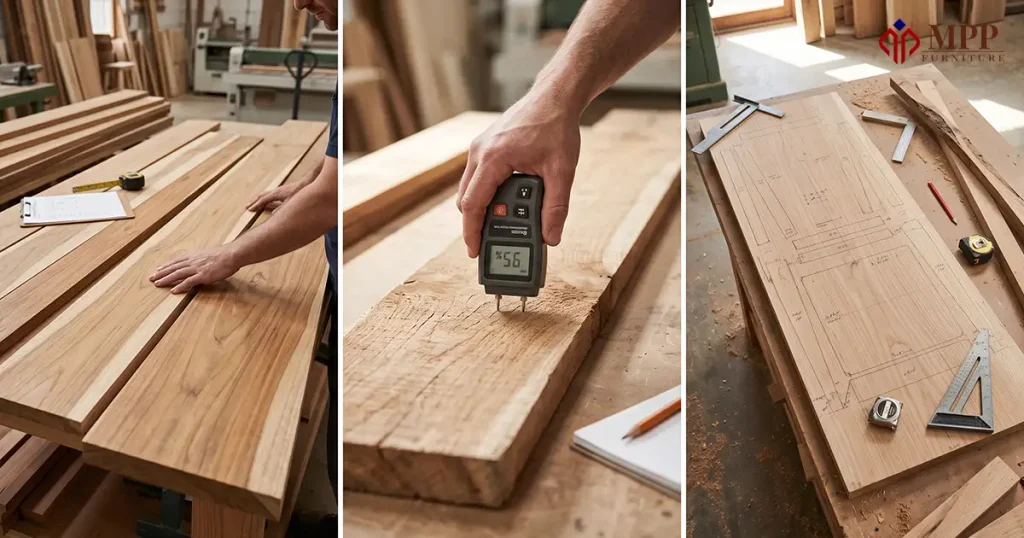
Check Grade, Moisture Content, and Available Timber Sizes
For solid wood furniture, define species, grade, permitted sapwood or defects, color variation, and visible-part requirements. Match available timber sizes to the component list, especially for wide tops, long rails, and legs.
The USDA Wood Handbook explains that wood moisture responds to its service environment. Agree the moisture target and checking method for the intended use instead of accepting an unexplained “export standard.”
Compare Cutting Yield and Production Allowances
Cutting yield is the share of purchased timber that becomes usable components. Ask how component size, defects, offcuts, machining losses, and available timber dimensions affect the material allowance; a lower timber rate can still produce a similar unit quotation.
Review Joinery, Component Thickness, and Engineering Adjustments
For custom wood furniture, confirm joints, thicknesses, supports, hardware connections, and movement allowances against the same function and stability requirements. Price proposed changes separately from a simple wood substitution.
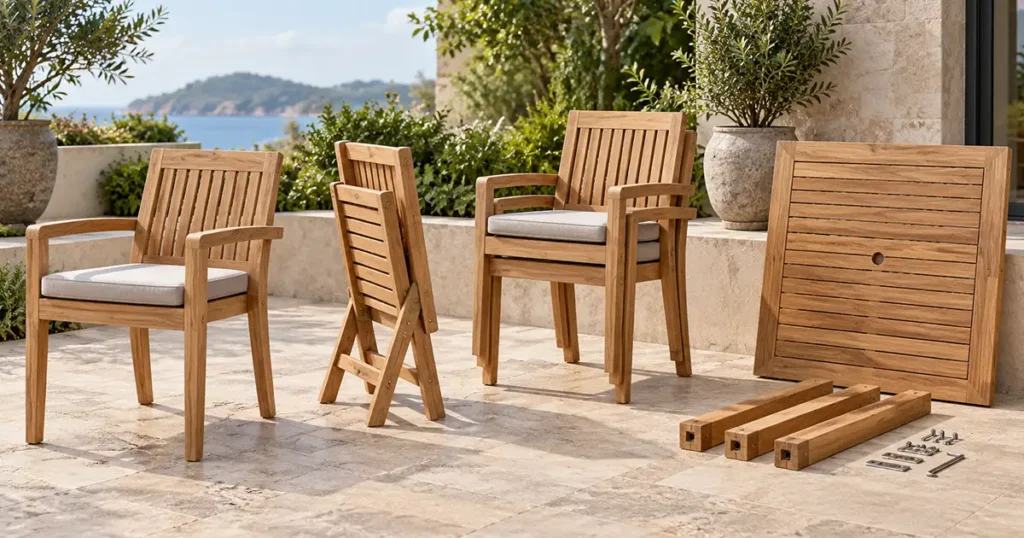
A South African buyer asked us to make a sampled chair stackable before a planned bulk order. We repositioned supports beneath the seat to prevent stacking interference while keeping strength as a design priority; our teak garden furniture construction guide documents that development.
Compare Finished Samples, Not Just Finish Names
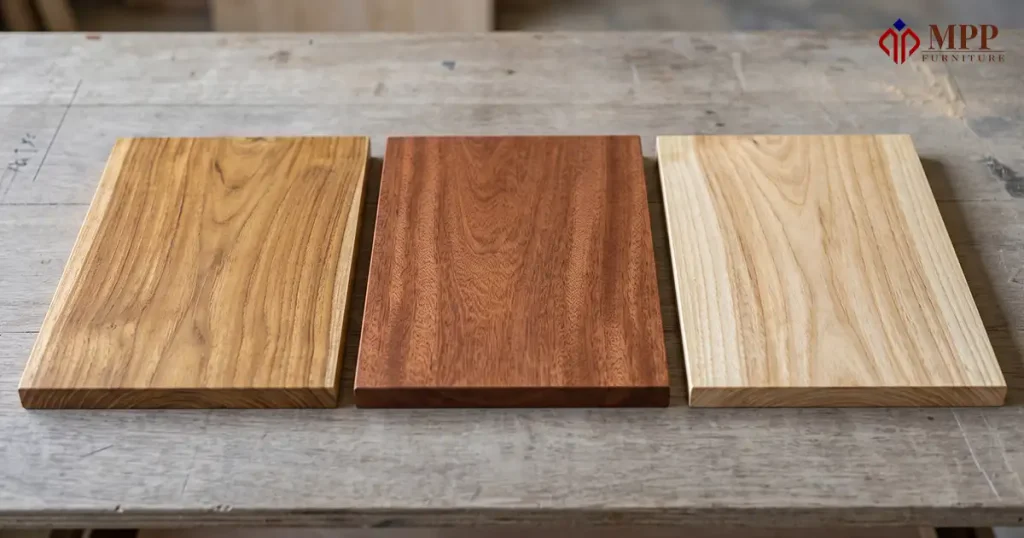
Compare finished teak, mahogany, and sungkai samples for color range, grain visibility, texture, and sheen instead of relying on a finish name. Ask which sanding, filling, color adjustment, and coating steps are included for each option.
Approve a sample reference and acceptable variation before bulk production, then price any added preparation or revision work.
Normalize Hardware, Packing, MOQ, Sampling, and Quotation Terms
Ask your wood furniture supplier to confirm hardware, export packing, minimum order quantity, mixed-SKU conditions, sampling, revisions, and sample credits. Our manufacturer quotation guide covers the wider comparison process. Also record currency, validity, Incoterms basis, and exclusions.
Request carton dimensions, packed cubic meters, and gross weight. If carton size and count stay the same, changing the wood species does not by itself change packed CBM.
Teak vs Mahogany vs Sungkai: Compare Costs per SKU
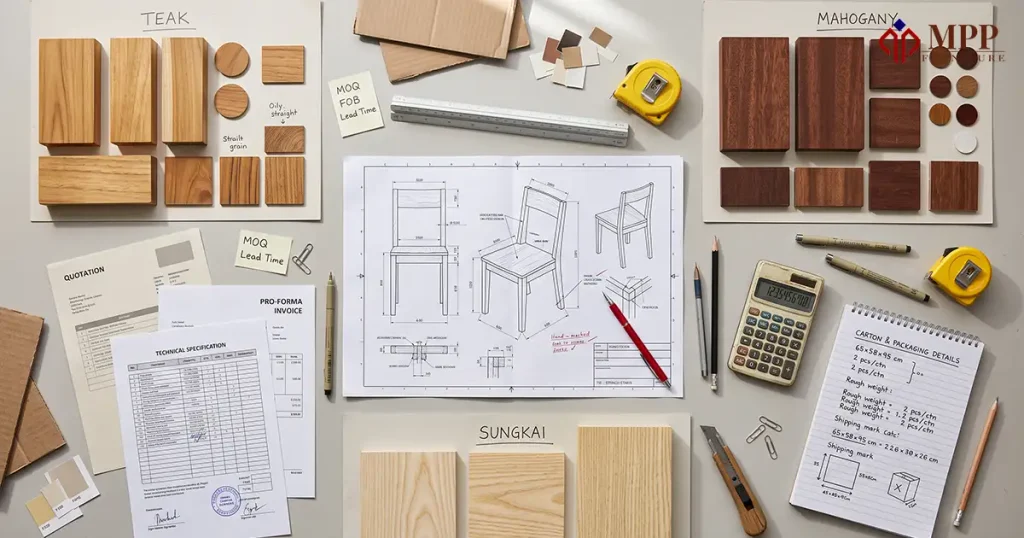
Changing the wood can lower a quotation, but the saving should come from a revised quote, not an assumption. In July 2026, we worked with an Australian buyer who initially requested teak for an indoor dining chair collection; after reviewing the target retail price, finish direction, and preference for a lighter natural look, we discussed sungkai and developed a new sample before the revised direction was approved.
The case does not publish quotation values, so it should not be used as a percentage-saving benchmark. It shows why material choice should be reviewed against price position, appearance, and an approved sample.
| Cost Comparison | Teak | Mahogany | Sungkai |
|---|---|---|---|
| Material specification | Teak spec and grade | Mahogany spec and grade | Sungkai spec and grade |
| Finish reference | Approved teak sample | Approved mahogany sample | Approved sungkai sample |
| Proposed engineering change | Record deviations | Record deviations | Record deviations |
| Quoted unit price | Dated quote | Dated quote | Dated quote |
| Excluded costs | List exclusions | List exclusions | List exclusions |
| Development allocation | Non-credited sample/revision cost | Same allocation method | Same allocation method |
| Packed CBM / weight | Measured CBM and weight | Measured CBM and weight | Measured CBM and weight |
| First-order cost | Quote + exclusions + development | Same basis | Same basis |
| Repeat-order cost | Remove non-repeat charges | Same basis | Same basis |
Comparable unit cost = quoted unit price + required excluded costs + allocated non-recoverable development costs.
Use the same calculation method across all three columns. Mark unconfirmed costs as pending, not zero, and separate first-order from repeat-order costs.
Match the Material to Your Collection and Target Retail Price
Your lowest quoted option is not automatically the best commercial fit. Compare the complete cost with your target retail price, margin plan, approved appearance, and the role the SKU plays in the collection.
Our Australian dining-chair case followed this logic: the discussion moved from teak to sungkai after reviewing retail price and the desired lighter natural direction. The buyer preferred the sungkai direction after sampling.
Our mahogany dining furniture and retail assortment guide also explains why retailers should judge material choice against the role it plays in the assortment, rather than replacing a proven range without a clear commercial reason.
Send a Clear RFQ Before Approving a Material Option
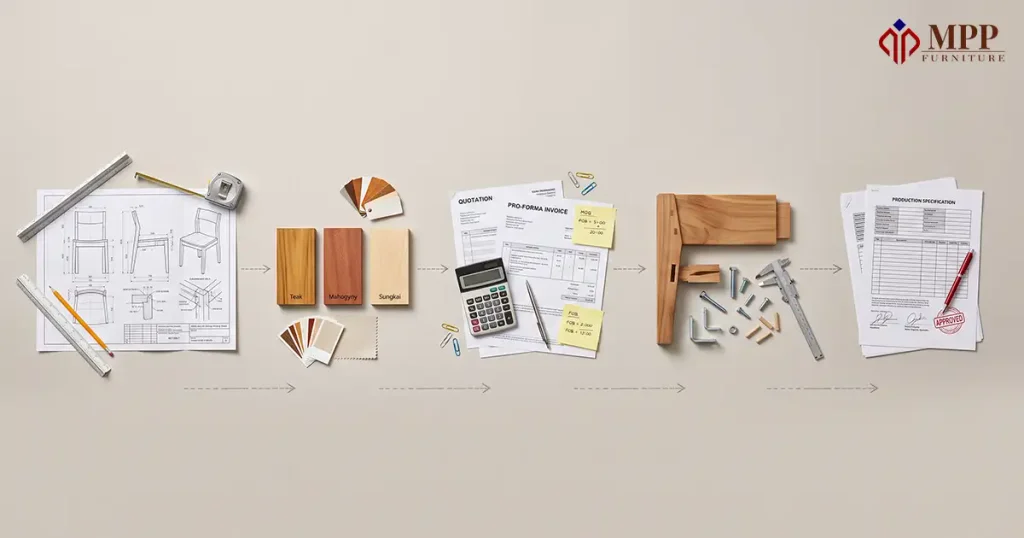
Your request for quotation should include the drawing revision, SKU quantities, target market, intended use, material requirements, finish references, hardware, packing, delivery terms, target retail price, and purchasing budget. Identify fixed requirements and alternatives open for review.
Compare baseline quotations first, review proposed changes next, and approve the final drawing and sample before production. Request revised pricing whenever the approved sample changes the quoted material, construction, finish, or packing.
Final Thoughts: Choose the Right Specification, Not Just the Cheapest Wood
Choose a wood furniture manufacturer that can explain and reproduce your approved specification. Compare teak, mahogany, and sungkai by complete SKU cost and collection fit, not wood names alone.
Discuss Your Furniture Material Options with MPP
Send your drawings, quantities, target market, finishes, and target prices to sales@mppfurniture.com. We offer free consultation and product development, subject to terms, with custom and private-label manufacturing. Our in-house team combines skilled craftsmanship, precision machinery, and production-stage quality checks.
FAQ: Teak, Mahogany, and Sungkai Furniture Costs
1. Which costs less for the same furniture design: teak, mahogany, or sungkai?
You need matched quotations to establish the lowest-cost option, not a fixed wood ranking. Compare the same product requirements, quantity, finish, and delivery basis, then add required exclusions.
2. Why can lower-priced timber produce a similar furniture quotation?
Lower usable yield, extra machining, or additional finishing can absorb the timber saving. Ask what material and production allowances the quotation includes before comparing finished-unit costs.
3. Can all three woods use the same drawing and finish specification?
Use the same requirements as a starting point, but ask the manufacturer to identify exceptions. Approve construction and finishing changes through drawings and samples before treating the offers as equivalent.
4. What moisture content should buyers specify for export furniture?
Specify a moisture target suited to the intended service conditions, with an agreed measurement method. One percentage does not cover every destination, product, and environment.
5. What should an RFQ include to compare all three materials?
Include the drawing revision, SKU quantities, target market, intended use, material requirements, finish references, hardware, packing, delivery terms, and budget. Require a clear list of exclusions and proposed substitutions.

A versatile content creator with a strong foundation in product photography and videography, and a comprehensive brand strategy. Capable of creating engaging content to connect consumers and producers, web analytics, and engaging visual content to drive interest and growth for a product or brand.


0 Comments