A dining table might look perfect in a catalog, but a slight dimensional miscalculation can quickly become a costly retail headache. Correcting a cramped seating layout after a bulk mahogany order reaches production easily destroys profit margins. Finalizing the right dimensions before issuing a purchase order is the most critical step in a successful sourcing program.
This mahogany dining table size guide provides a practical blueprint for avoiding those costly sizing mistakes. We will explore standard size-to-seating ratios, detail the production impacts of custom sizing, and share strategies for building a balanced retail assortment. Read on to discover how to engineer tables that actually fit your customers and your business model.
Why Table Size Planning Matters More for Mahogany Than Lighter Woods
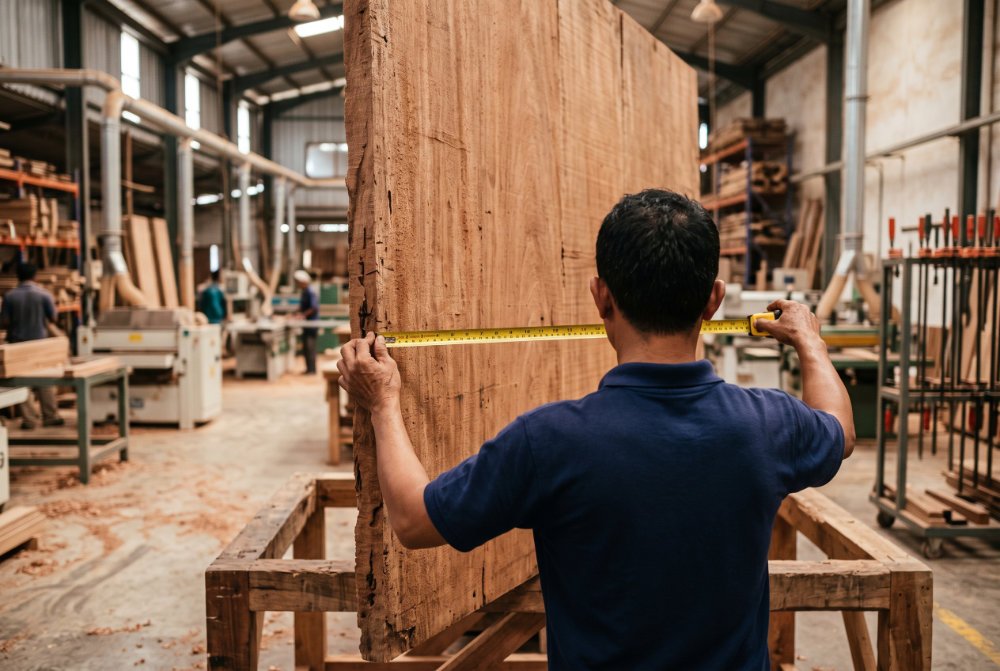
Mahogany dining tables are usually positioned as higher-value products, so incorrect sizing can affect more than customer comfort. An oversized table can increase material use, packing volume, freight space, and showroom footprint, while an undersized table may fail to deliver the seating capacity promised on the product label.
Large solid-wood tops also need thoughtful board selection, grain matching, and construction planning. Mahogany performs well in large horizontal surfaces when properly dried and manufactured, but increasing the tabletop dimensions still changes material yield and how the top should be built.
For a deeper explanation of why mahogany performs well in large indoor furniture pieces, read ideal furniture applications for mahogany wood.
For retailers buying in volume, this matters even more. One sizing mistake repeated across dozens of tables can create excess inventory, customer complaints, or a collection that is harder to merchandise than expected.
Industry data indicates that furniture return rates can reach 22.7%, with size mismatches being a primary driver. For heavy items like solid mahogany dining tables, the reverse logistics of a single return can quickly exceed the product's profit margin. Preventing these costly returns starts with strict dimensional planning before your bulk order ever reaches the production floor.
Standard Size-to-Seating Ratios for Dining Tables
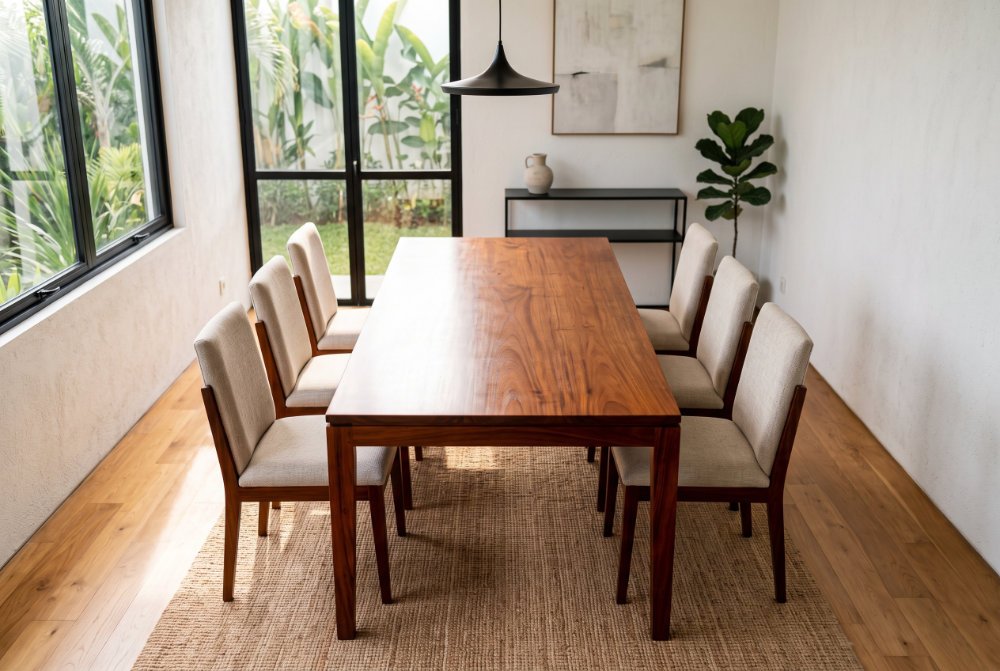
A practical planning rule is to allow around 55 to 60 cm of table edge per person for everyday dining. This is only a starting point because chair width, table legs, bases, and apron construction can reduce the usable seating area.
| Seating Capacity | Typical Rectangular Planning Range | Common Retail Role |
| 4 seats | 120-140 x 80-90 cm | Compact homes and smaller dining rooms |
| 6 seats | 160-180 x 90-100 cm | Standard family dining |
| 8 seats | 200-240 x 95-110 cm | Larger homes, hospitality, and project use |
These ranges are planning references rather than fixed production rules. Your final specification should be checked against the chair model, base construction, and target market before sampling.
Dining tables are often the anchor of a broader mahogany assortment for retailers. To help buyers build cohesive, multi-room collections, the MPP factory regularly produces complementary pieces like 2-3 seater mahogany sofas. For more context on how these categories blend seamlessly, read about the mahogany furniture pieces that retailers should import from Indonesia.
4-Seater Dimensions and Typical Use Cases
A rectangular 4-seater commonly starts around 120 cm long, with 130 to 140 cm giving customers a little more elbow room. A width of about 80 to 90 cm provides enough center space for plates, serving dishes, or décor without making the table feel too deep.
For retailers, this size works well for apartments, smaller houses, breakfast areas, and compact dining collections. It can also serve as a lower-entry-price mahogany table for customers who want solid wood without committing to a large dining set.
6-Seater Dimensions and Typical Use Cases
A 6-seater is often the safest core size for a retail assortment. Lengths around 160 to 180 cm usually give three practical seating positions on each long side, while a 90 to 100 cm width keeps proportions balanced.
This format suits standard family dining and works across a wide range of residential floor plans. If your chairs have broad upholstered seats or arms, choose the upper end of the length range rather than squeezing six chairs around a smaller top.
8-Seater and Extendable Options for Hospitality or Large-Format Retail
For eight people, retailers can start planning around 200 to 240 cm in length. Wider chairs, formal dining styles, or hospitality specifications may call for extra length, especially when comfortable spacing matters more than maximum seat count.
Extendable tables can give buyers more flexibility because the table stays smaller for everyday use but grows for gatherings. They also add more production variables, such as leaf storage, rails, locks, alignment, and stability, so the extension system should be specified before sampling.
What Changes When You Move to Custom Sizing
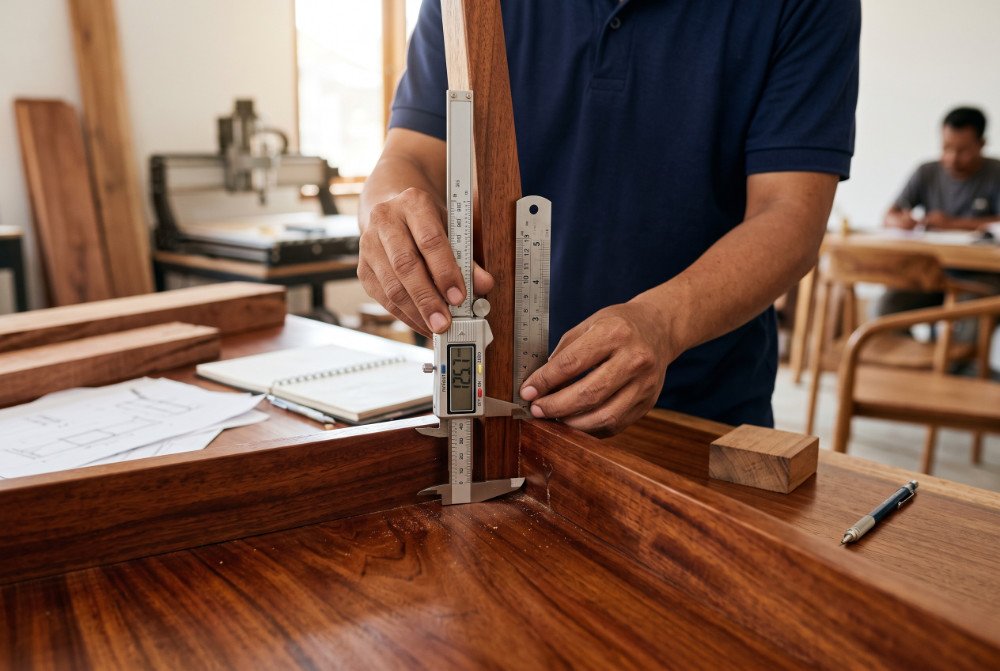
Custom dining table sizing gives retailers more control, but different lengths or widths can affect cutting plans, joinery, and packaging. Because custom dimensions directly impact your Minimum Order Quantity (MOQ) and lead time, the MPP factory team actively helps buyers calculate and optimize their MOQs. This collaborative approach ensures your custom program remains profitable without overstretching your inventory budget.
Extendable or leaf-based tables need even more coordination. Before approving the sample, define the closed size, extended size, number of leaves, leaf dimensions, storage method, and the number of seats expected in each configuration.
Chair dimensions should be developed together with the table rather than treated as a separate purchase. To reduce the risk of costly sizing errors, the MPP factory team cross-checks table dimensions alongside chair models, base construction, apron depth, and leg positions before entering the sampling stage. This proactive step guarantees that your promised seating capacity actually translates into a comfortable dining experience.
If you want to compare table and chair formats before setting custom specifications, explore our dining room collection. MPP's dining range includes coordinated tables and seating that can be developed around different dimensions, finishes, and collection directions.
Building a Balanced Size Assortment for Your Store
A strong dining assortment does not need ten different table sizes. It needs enough variation to cover different customer situations without spreading inventory too thin.
A simple 4, 6, and 8-seat structure gives retailers a clear good-better-bigger progression. From there, finishes, chair styles, and extendable options can create variety without multiplying table dimensions unnecessarily.
Covering Compact Spaces with 4-Seater Options
Use the 4-seater as the compact option for customers with limited floor space. It works well in urban markets, first homes, apartments, and smaller dining zones.
Retailers can also use this size to introduce mahogany at a more accessible ticket level. A smaller table still shows the grain, finish, and handcrafted details that make mahogany appealing without requiring the floor space of a larger set.
Covering Standard Family Dining with 6-Seater Options
The 6-seater can act as the center of the assortment because it fits the broadest residential use case. It gives enough capacity for everyday family dining while remaining manageable for most dining rooms.
If you are deciding where to put more stock depth, this is often the size worth discussing first with your sales team. Review your customer profile, average room size, chair width, and selling price before deciding the final quantity. Explore how solid mahogany versus veneer construction actually affects price and durability for this core assortment.
Covering Hospitality or Project Buyers with 8-Seater and Extendable Options
The hospitality segment's growing demand for premium, luxurious furnishings is actively driving market growth as hotels aim to elevate guest experiences. Stocking well-proportioned 8-seater mahogany tables perfectly positions your catalog to capture these lucrative B2B project bids.
Large 8-seat and extendable tables suit customers who often entertain, hospitality spaces, villas, restaurants, and project buyers. They can also function as statement pieces in larger showrooms where a strong visual anchor helps present the rest of the dining collection.
Final Thoughts: Key Takeaways Before You Finalize Your Size Assortment
Mahogany's higher product value makes dimensional planning worth getting right before bulk production. A 4, 6, and 8-seat structure gives retailers a practical starting point, but chair width, table legs, apron clearance, and extension systems can change how many people actually sit comfortably.
Standard sizes are useful for repeatable retail programs, while custom sizing gives you more control for specific markets or projects. Custom dimensions can also change production planning, so discuss them before the sample stage rather than after the purchase order is finalized.
Preparing a bulk mahogany order requires careful coordination between standard sizing, custom dimensions, and your overall retail strategy. Navigating these production variables is much easier when you collaborate directly with experienced furniture manufacturers in Indonesia.
Supported by over 20 years of manufacturing expertise and full in-house R&D, MPP Furniture helps retailers engineer reliable Indonesian mahogany furniture that is perfectly proportioned, consistently finished, and fully production-ready.
Frequently Asked Questions About Mahogany Table Sizing
1. How much seating space should I calculate per person?
As a general baseline, allow 55 to 60 cm of table edge per person. However, you must always factor in the width of your specific dining chairs and table legs to ensure a truly comfortable fit.
2. What is the safest table size to anchor my retail assortment?
A 6-seater (typically 160-180 cm long) is the most versatile core size. It perfectly fits standard family dining needs and suits the broadest range of residential floor plans.
3. Will requesting custom table sizes affect my order lead time?
Yes. Custom dimensions often require changes to cutting plans, jigs, and packaging. This customization typically impacts both your Minimum Order Quantity (MOQ) and production lead time.
4. Should I order dining tables and chairs separately?
It is highly recommended to develop them together. Table height, apron depth, and leg placement must coordinate directly with seat height and armrests to guarantee proper knee clearance.
Ready to Build Your Exclusive Dining Collection?
To start planning your next dining program, explore MPP's dining room furniture collections or contact us to discuss custom, private-label, or OEM mahogany table development.

I am a Web Designer, Technical SEO Specialist, and writer with 6+ years of experience in website optimization and search visibility. For more than a year, I have supported MPP Furniture’s growth, and I am currently expanding my role as an author to help B2B furniture buyers make more informed business decisions through informative, practical, and impactful articles.
0 Comments