Choosing an OEM furniture partner is not as simple as comparing catalogs and prices. The manufacturer you select will directly affect your product quality, delivery performance, customer complaints, and ultimately, how buyers perceive your brand.
This guide will help you assess an Indonesian OEM mahogany furniture manufacturer based on real production capability, material knowledge, customization support, and quality control. It will also help you avoid suppliers that make attractive promises but fail to repeat the approved standard during bulk production.
You will learn where mahogany actually works outdoors, what solid proof to request from a factory, which critical questions to ask, and how to kick off a custom project smoothly. The ultimate goal is to help you secure a manufacturing partner capable of supporting both your very first order and your future collections.
Why Choosing the Right OEM Mahogany Outdoor Furniture Manufacturer Partner Matters
The manufacturer you choose directly represents your company's name. Since the supplier is responsible for bringing your vision to reality through physical production, any drop in quality, whether in construction, color, or finish, reflects directly on you. When a product fails the approved standard, your customers will hold your brand accountable, not the factory.
Mahogany outdoor furniture requires careful planning because moisture, sunlight, and temperature fluctuations can drastically affect the wood and its protective finish. A single beautiful sample is meaningless if the factory cannot maintain the same materials and processes across hundreds of units.
The right partner should proactively review your design, point out potential production risks, and suggest practical adjustments before sampling even begins. This proactive approach reduces post-shipment disputes, delays, replacement costs, and frustrating corrections.
A reliable manufacturer also invests in your long-term growth. Instead of treating each order as a standalone transaction, the factory should learn your specific brand standards and help you build highly repeatable collections.
Confirm Whether Mahogany Fits the Intended Outdoor Setting
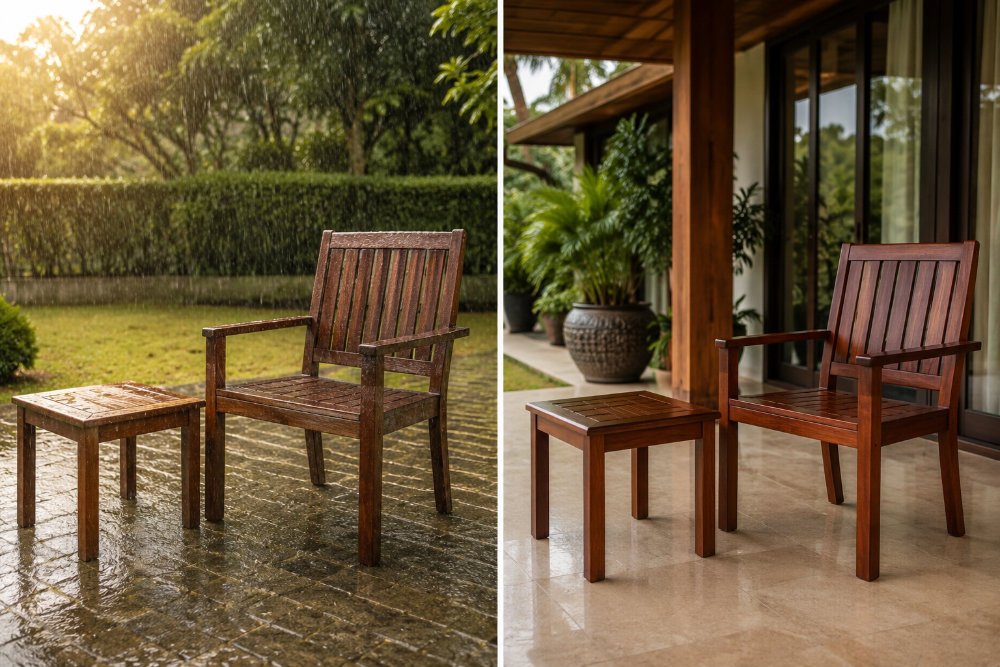
Full Outdoor, Covered Outdoor, and Semi-Outdoor Use
Mahogany thrives in covered outdoor and semi-outdoor environments rather than locations exposed to constant, beating rain and harsh sunlight. Direct UV exposure can rapidly fade its rich color, while uncontrolled moisture will inevitably degrade the wood and coating over time.
Covered terraces, hotel verandas, enclosed patios, and protected dining areas are the most suitable applications for this elegant wood. For fully exposed poolside or garden setups, teak usually offers lower maintenance and superior natural weather resistance.
Why Exposure Level Changes Product Specifications
Exposure conditions dictate moisture targets, component thickness, joint design, water drainage, and coating systems. As a technical baseline, research on wood moisture behavior shows that outdoor wood naturally stabilizes at an equilibrium moisture content (EMC) of 12-18%, whereas indoor wood stabilizes between 8-14%.
If the factory fails to dry the mahogany to this specific threshold, the wood will aggressively shrink or swell as it adapts to its new climate, leading to cracked joints or warped surfaces. This is exactly why a capable manufacturer will always ask where the furniture will be used, not just what it should look like.
When Teak May Be a Better Alternative
Mahogany is an excellent choice when buyers want smooth shaping, custom details, and a refined finish in protected areas. However, teak may be the smarter option if the product will face open rain, direct sunlight, and minimal maintenance.
This does not make one material universally better than the other. It simply means the chosen material must align with the environmental setting, expected service life, project budget, and the end-user's maintenance plan.
What to Look for in an Indonesian OEM Mahogany Furniture Manufacturer
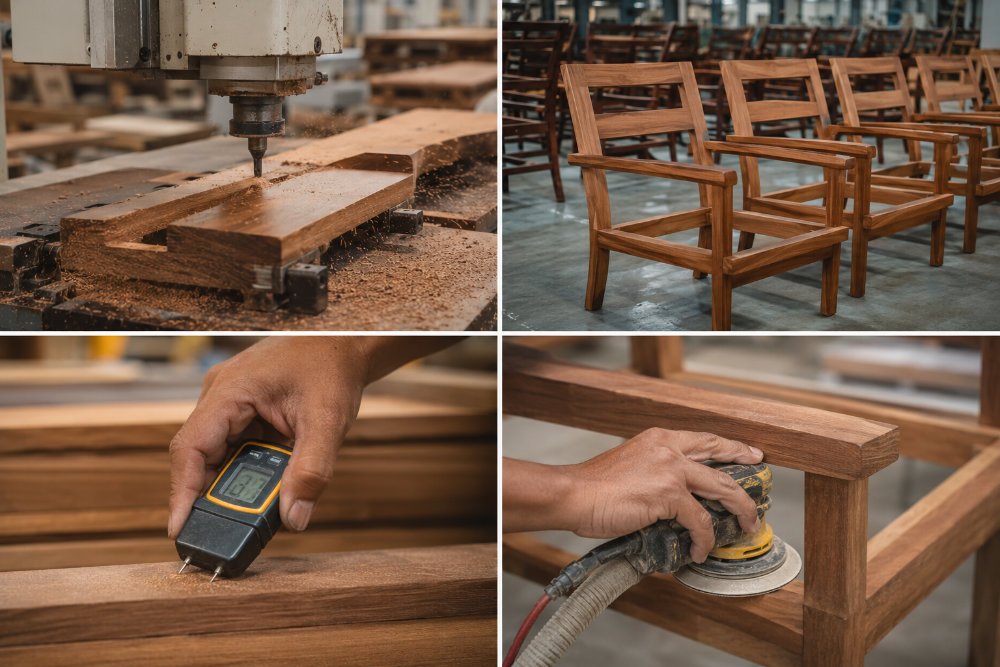
Proven Experience with Mahogany Outdoor Products
Ask for concrete examples of mahogany products manufactured specifically for outdoor or semi-outdoor use. Request details regarding the placement, destination market, finishing systems used, order volume, and whether the buyer returned for repeat orders.
Experience must be backed by evidence, not just polished catalog images. Production floor photos, detailed inspection records, finished physical samples, and past project portfolios provide a much clearer picture of how the factory handles similar work.
Product Development and Customization Capabilities
MPP Furniture supports this phase by offering free consultations, product development assistance, and exclusive custom design services tailored for B2B buyers. Drawing from practical industry experience, this consultation phase also addresses hidden manufacturing risks. One common pitfall is when rushed factories skip crucial anti-insect timber treatments, causing insect damage that only appears months after shipment.
A reliable manufacturer must demonstrate that production deadlines do not override these essential preparation procedures. Ultimately, these services allow buyers to mitigate such risks early in the development process. This ensures your idea can be produced safely and consistently before committing to a massive bulk order.
Manufacturing Capacity and In-House Control
Always ask which production stages are actually handled inside the factory walls. Kiln drying, machining, assembly, sanding, finishing, packing, and final inspection are far easier to control when the primary manufacturer has direct, uncompromised oversight.
For example, MPP Furniture operates a fully in-house production system within a 16,000 m² facility in Cirebon, Indonesia. By maintaining 100% direct control from initial timber preparation to final container loading, the production seamlessly blends precision machining with artisan finishing.
This strict oversight backed by over 20 years of manufacturing experience resulted in a highly controlled defect rate of just 0.54% in 2024. For B2B buyers, this translates to consistent batch-to-batch quality and reliable scalability for both indoor and semi-outdoor mahogany collections.
Quality Control Systems
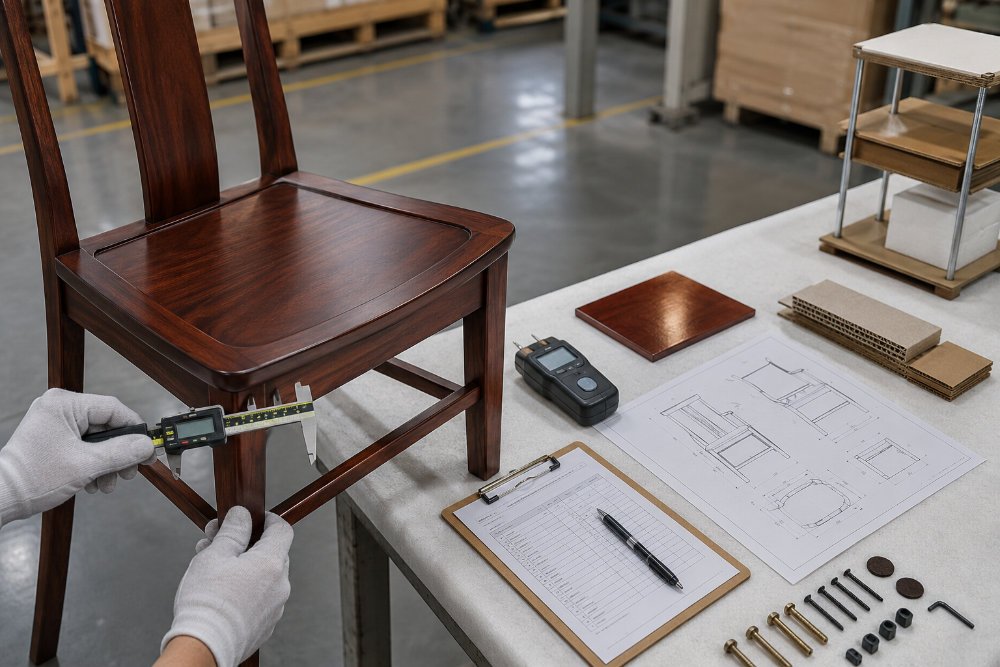
Quality control is an ongoing process that should take place throughout every stage of production, not just a quick glance before container loading. Buyers should look for documented material checks, routine moisture readings, dimension verifications, joinery inspections, coating reviews, packaging drop tests, and comprehensive final inspection reports.
The factory should also clearly explain their protocol when a product fails inspection. A transparent correction process is a much better indicator of reliability than a supplier who claims that defects simply "never happen."
Material Sourcing and Traceability
Confirm exactly which mahogany species will be used, trace where it comes from, and request insight from your Indonesian furniture supplier on how they record and manage each batch. Proper drying techniques and strict grading heavily dictate the wood's stability, finishing results, and overall product consistency.
Buyers should also mandate legal wood certifications and export documentation applicable to their destination market. This protects your supply chain integrity and minimizes friction during customs clearance.
Questions to Ask Before Selecting an OEM Manufacturer
Can You Match Our Brand Standards?
Provide exhaustive requirements detailing dimensions, finish colors, sheen levels, ergonomic comfort, hardware specifications, labeling, and packaging. Ask the factory exactly how each specific requirement will be recorded, monitored, and checked during the production run.
What Is Your Sampling and Approval Process?
A highly practical process includes a thorough design review, material confirmation, prototype production, finish approval, necessary revisions, and ultimately, a signed "golden sample." This golden sample must remain the absolute reference point for all subsequent bulk production.
What Are Your MOQ, Lead Time, and Payment Terms?
Ask what specific factors influence their Minimum Order Quantity (MOQ) and production schedule. Product complexity, highly customized finishes, raw material availability, complex packaging, and mixed-item collections can significantly alter both the final cost and the production timeline.
How Do You Control Production Timelines?
The manufacturer should provide a realistic, transparent schedule outlining production stages and committed update dates. Ask how delays are communicated and what corrective actions are taken when a specific production stage falls behind schedule.
What Export Experience Can You Prove?
Investigate the factory's primary export markets, loading protocols, packaging standards, document preparation, and their experience accommodating third-party quality inspections. An experienced Indonesian furniture supplier should be able to articulate the entire process seamlessly, from order confirmation straight through to container sealing.
Warning Signs When Evaluating OEM Furniture Manufacturers
Limited product portfolio or export experience
Exercise caution when a supplier enthusiastically accepts every design without once discussing outdoor exposure, structural construction, or material limitations. A responsible manufacturer acts as a consultant and may challenge parts of your brief because they know certain ideas need technical adjustments before they can be produced safely and consistently.
Unclear production processes
A production process that cannot be explained clearly is a glaring warning sign. If the supplier cannot demonstrate how their wood is dried, how samples are officially approved, or how defects are systematically recorded, your product quality will likely depend too much on the mood of individual workers rather than standardized factory protocols.
Inconsistent communication
Erratic communication introduces massive risk. If a factory is sluggish to respond or sidesteps direct technical questions, it is a major red flag for a long-term partnership. Important details must always be locked down in technical drawings, specification sheets, signed finish samples, and written production records to avoid costly misunderstandings.
Lack of quality assurance documentation
Quality control is a science backed by data. If the factory cannot produce moisture readings, precise dimension checks, or finalized inspection reports, their quality control is likely superficial at best. Again, a clear, documented correction process is far more trustworthy than a supplier claiming perfection.
Unrealistic pricing or delivery promises
Rock-bottom prices or unusually aggressive delivery promises demand scrutiny. While everyone loves a good deal, those savings quickly evaporate when lower material grades, skipped finishing steps, flimsy packaging, or rushed inspections inevitably lead to damage claims, replacements, and unhappy end-users.
Why Indonesia Is a Strong Base for OEM Mahogany Furniture
Indonesia boasts a centuries-old woodworking tradition now supported by highly skilled craftsmen and modern furniture machinery. This powerful combination allows manufacturers to produce solid wood furniture featuring intricate carving, smoothly shaped components, complex joinery, and highly varied finish applications.
Indonesia is also a prime hub for custom product development. Instead of relying solely on generic standard catalogs, buyers can freely create market-specific sizing, launch private-label collections, develop mixed-material products, and design exclusive pieces.
The true value lies not just in competitive labor costs. It comes from the perfect balance of artisanal craftsmanship, production flexibility, deep wood knowledge, and extensive experience serving demanding export markets.
For more background on the material and how to source it effectively, read this comprehensive Indonesian mahogany furniture buyer's guide.
How to Start Working with an OEM Furniture Manufacturer
Begin by drafting a robust product brief covering dimensions, intended placement, target demographic, estimated order volume, preferred finish, hardware requirements, packaging needs, and target price. The more granular your brief is, the more accurate and useful the factory's technical feedback will be.
Next, request a prototype sample and evaluate it beyond its surface appearance. Rigorously test the ergonomic comfort, verify exact dimensions, inspect joint accuracy, assess the coating and color consistency, check the hardware functionality, and review the packaging durability.
Once the sample is fully approved, cement the relationship by confirming the technical drawings, bill of materials, finish standards, acceptable tolerances, inspection checkpoints, and production schedules in writing. These written records ensure both sides are steering by the exact same compass.
Treat your first order as the crucial foundation of a long-term partnership. Dependable Indonesian mahogany furniture manufacturers will effortlessly support your repeat orders, streamline new product development, and accelerate your collection planning as your brand scales.
Final Checklist for Choosing an Indonesian OEM Mahogany Furniture Manufacturer
- Choose a manufacturer that deeply understands exactly where mahogany can be deployed outdoors and is transparent about its natural limitations.
- Ensure the factory can empirically prove its ability to properly dry wood, engineer samples, control finishing environments, inspect production, and flawlessly prepare export shipments.
- Do not select a partner based on price alone. Weigh their technical knowledge, communication clarity, production oversight, customization flexibility, and their proven ability to repeat the approved golden sample.
- A strong OEM relationship should eliminate uncertainty and make product development an exciting, seamless process.
- MPP Furniture supports buyers from the initial consultation and custom design phase straight through to bulk production, rigorous quality checks, secure packing, and final delivery.
FAQs About Indonesian OEM Mahogany Furniture
1. Is mahogany suitable for outdoor furniture?
Mahogany is highly suitable for covered outdoor and semi-outdoor furniture provided it is properly dried, constructed, sealed, and maintained. It is generally less suitable for environments with constant rain and direct, harsh sunlight.
2. What should buyers check before choosing an OEM furniture factory?
Buyers must thoroughly review the factory's material knowledge, sample development process, in-house production control, quality assurance records, actual manufacturing capacity, export track record, and communication standards.
3. How can bulk production match the approved sample?
Consistency is maintained by strictly utilizing a signed golden sample, approved technical drawings, physical finish references, detailed material specifications, defined tolerance limits, and a written, comprehensive inspection checklist.
4. What is a warning sign when reviewing an OEM manufacturer?
A major red flag is a factory that enthusiastically accepts every design concept without pausing to discuss material limits, construction risks, finishing constraints, or actual production feasibility.
5. Should price be the main factor when choosing an OEM partner?
No. An artificially lower upfront price often creates significantly higher backend costs when it inevitably leads to manufacturing defects, production delays, costly replacements, and severely damaged customer trust.
Ready to Build Your Custom Mahogany Furniture Line?
To start planning your next mahogany outdoor or semi-outdoor collection, explore MPP's manufacturing capabilities or contact us to discuss custom, private-label, or OEM development.

I am a Web Designer, Technical SEO Specialist, and writer with 6+ years of experience in website optimization and search visibility. For more than a year, I have supported MPP Furniture’s growth, and I am currently expanding my role as an author to help B2B furniture buyers make more informed business decisions through informative, practical, and impactful articles.
0 Comments