Two quotations for solid mahogany bedroom furniture can look almost identical at first. They may show a similar design, the same wood species, and close overall dimensions, yet the unit prices can still be very different.
The good news is that most quotation gaps can be explained once you know what to compare. Whether you are working with a new factory or an experienced Indonesian furniture supplier, understanding how costing is built makes it easier to judge which offer fits your target cost, margin, and retail market.
This guide explains how product specifications, component sizes, timber selection, finishing, order quantity, and supplier assumptions affect the final quotation. It will also help you compare two offers based on commercial fit, not price alone.
First, Check Whether Both Quotations Use the Same Product Specifications
A fair comparison starts with the same drawing and specification sheet. Product photos do not show internal construction, drawer materials, hardware grade, finish steps, packaging method, or service scope.
Check whether both suppliers are quoting the same item list, dimensions, materials, finish, hardware, packaging, quantity, Incoterm, and development work. One quote may include sample support or stronger export packaging, while the other may list those costs separately.
MPP experienced this when reviewing a project inquiry from a buyer in the Maldives. The products looked similar, but changes in dimensions and finishing requirements created a clear difference in material use and final pricing.
Use a checklist for ordering Indonesian bedroom furniture to confirm that both quotations are based on the same assumptions before comparing unit prices.
How Product Dimensions Change Mahogany Material Requirements
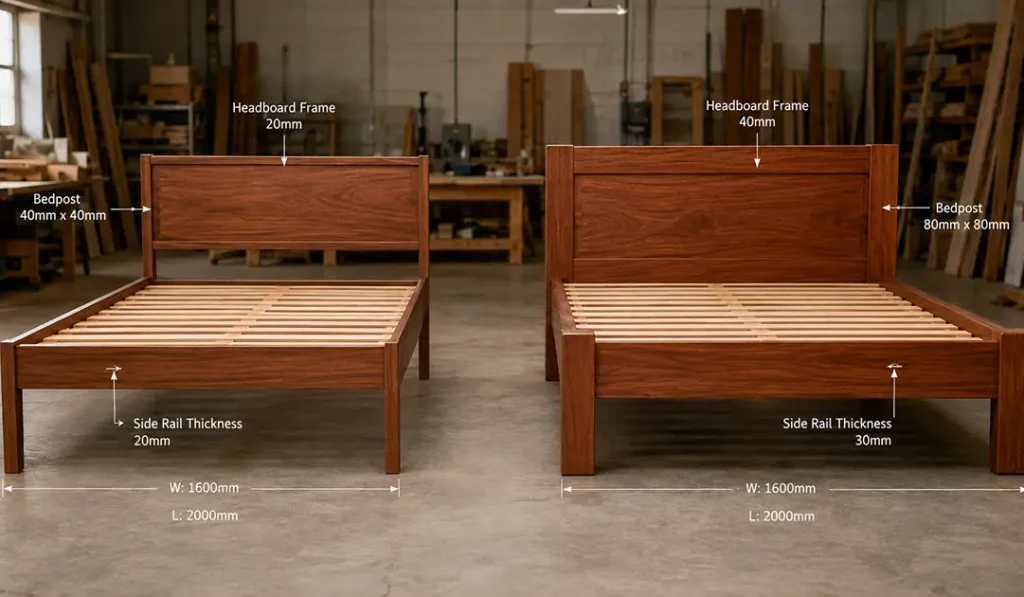
Overall dimensions affect the amount of solid mahogany required for a product. A wider bed, deeper dresser, or taller wardrobe usually needs more material, but the full cost impact depends on how each part is designed.
The outside size also affects machining, sanding, assembly, handling, packing, and shipping weight. This means a small dimensional change can influence more than timber volume alone.
Overall Dimensions and Component Dimensions Are Not the Same
Two beds may have the same width and length but use different post sizes, side rails, headboard frames, panels, and support parts. Supplier A may use lighter sections, while Supplier B may quote thicker parts for a heavier look or different structural target.
Equal outside dimensions do not prove equal material usage. Buyers should ask for component dimensions when the price gap is large.
Why Component Thickness Can Create a Major Price Difference
Component thickness directly affects material volume and production work. Thicker bedposts, side rails, top panels, frames, and drawer parts may need larger timber sections, more machining, and more sanding.
Accessories can also raise the quotation. In MPP’s experience, requests for premium drawer runners, additional components, special hardware, or a specific accessory color can create a noticeable price increase.
A higher specification is not automatically better for every collection. The right choice depends on the target customer, selling price, product position, and expected sales volume.
How Timber Grade and Usable Yield Affect the Quotation
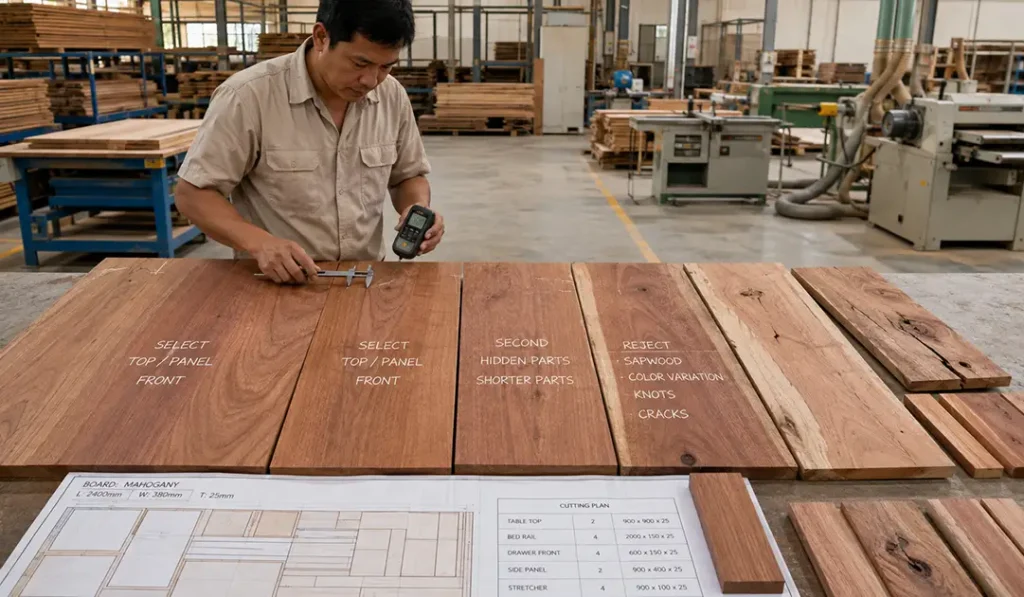
The phrase “solid mahogany” does not explain every material rule behind a quotation. Suppliers may use different standards for color variation, sapwood, visible marks, grain matching, moisture content, and accepted quality for visible surfaces.
Usable yield is the share of purchased timber that can become accepted furniture components. Long, wide, thick, or color-matched parts often require stricter selection, so fewer sections of each board may be suitable.
Research from the USDA Forest Service shows that component dimensions, quantities, and cutting requirements can influence lumber yield. The study focuses on rough-mill production, so it supports the general production principle rather than a fixed formula for mahogany furniture.
As an Indonesian mahogany furniture manufacturer, MPP reviews drawings, component dimensions, timber requirements, finishing needs, and production feasibility before estimating material usage. This helps explain why two suppliers using the same wood species may still produce different quotations.
Why MOQ and Production Quantity Change the Unit Price
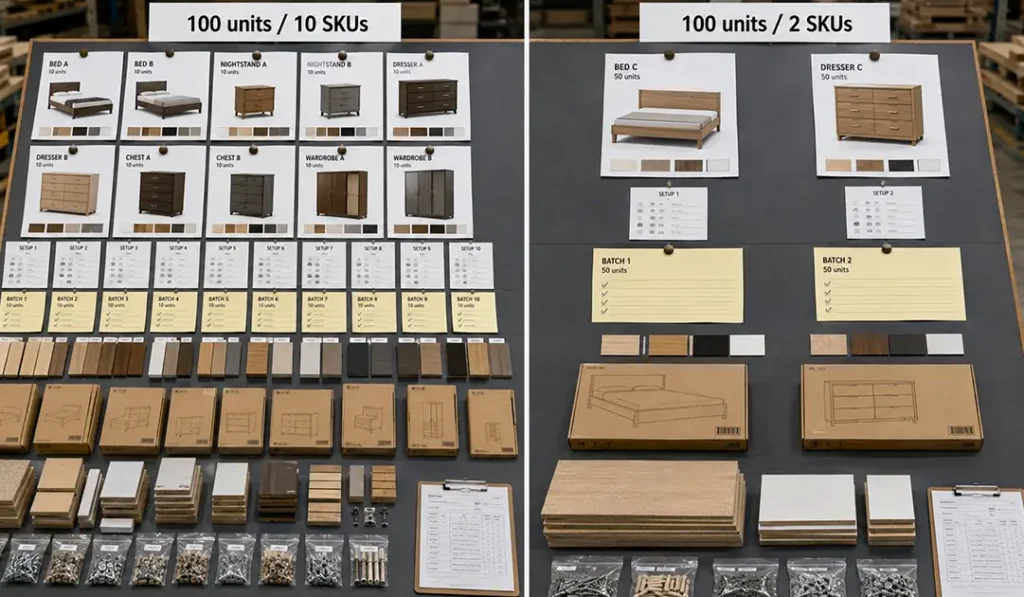
MOQ and total order quantity are related, but they are not the same. A supplier may apply minimum quantities by SKU, size, finish, color, or design.
MOQ Is Not the Same as Total Order Quantity
An order of 100 units across ten SKUs gives the factory only ten units per SKU. Another 100-unit order across two SKUs gives 50 units per SKU and can support a more efficient production run.
SKU Mix Can Affect Production Efficiency
Each design may need separate cutting preparation, machine setup, finishing work, inspection points, and packaging preparation. These activities are spread across fewer pieces when the quantity per SKU is low.
MPP has handled cases where retailers requested premium products but ordered only a small quantity per SKU. The unit price became higher because premium details still required full setup and careful production, even though each design had limited volume.
The ETH Zurich production cost model explains how setup costs can be distributed across a batch. Buyers should therefore compare quotations using the same total quantity and the same SKU allocation.
MPP’s guide to planning a mixed bedroom furniture collection provides more context for retailers working with several coordinated products.
Compare Each Quote Against Your Target Price and Retail Market
A quotation should be tested against your business model. Start with the target FOB price, then add freight, duties, handling, warehousing, and other expenses that form the landed cost.
Compare that figure with your planned wholesale or retail price and expected margin. A heavier product with detailed finishing may fit a premium collection but may be difficult to sell in an entry-level range.
When a Higher Mahogany Furniture Quote May Be Justified
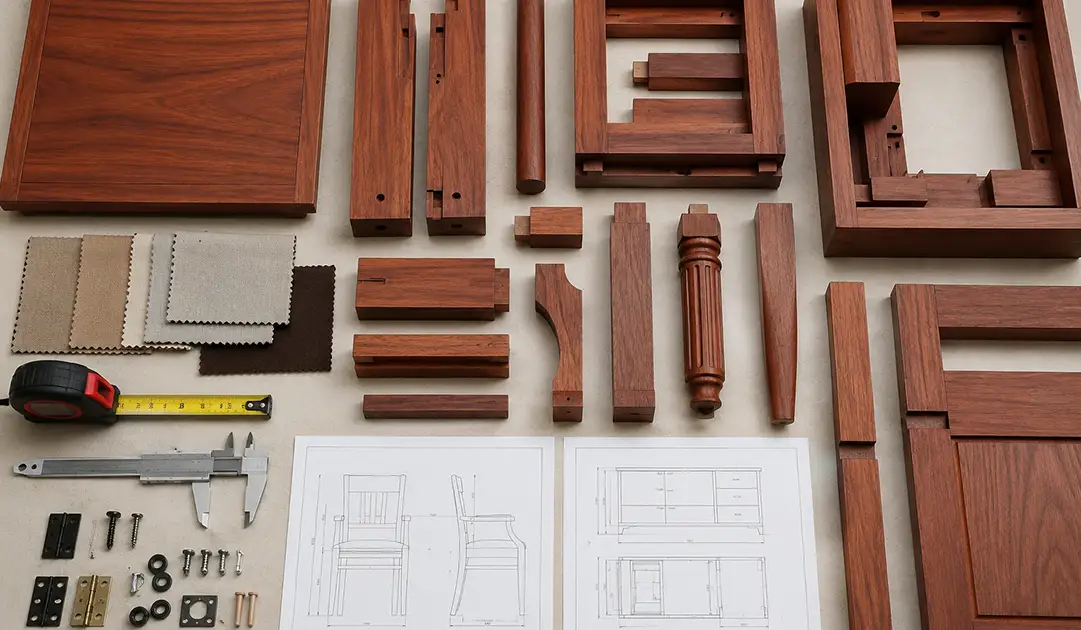
A higher quote may reflect thicker components, tighter timber selection, better hardware, additional finishing stages, stronger export packaging, or a smaller production run. It may also include development, sampling, testing, or more detailed quality checks.
Ask the supplier to identify which specifications and services create the difference. The added cost is reasonable only when those elements support the product’s intended use and retail position.
When the Lowest Quote May Not Be the Best Commercial Choice
A low quote may be suitable when the specification is clear and fits the intended market. It needs further review when dimensions, internal materials, finish steps, hardware, packaging, or exclusions are not stated.
Ask whether the supplier has used material substitutions, simpler construction, or different service assumptions. The purpose is not to reject the lowest quote, but to confirm what is included before making a decision.
Use This Framework to Compare Two Solid Mahogany Bedroom Furniture Quotes
Before choosing a supplier, compare both offers through the same technical and commercial framework.
| Review area | What to check |
| Product | Same dimensions, construction, materials, finish, and packaging |
| Cost | Clear explanation of the main price drivers |
| Market | Specification fits the intended retail customer |
| Margin | Landed cost supports the planned selling price |
| Quantity | Correct MOQ and quantity per SKU |
| Repeat orders | Design and finish can be reproduced consistently |
| Support | Supplier can review and revise the costing |
| Risk | Exclusions and substitutions are stated clearly |
From MPP’s quotation review experience, the information most often missing is the requested material, target price, and complete product dimensions. Without these details, suppliers may use assumptions that do not match the buyer’s commercial plan.
Choose the Supplier That Fits Your Costing and Market
Two solid mahogany bedroom furniture quotations may represent different specifications, production plans, and service scopes. For that reason, the unit price should be reviewed together with the technical details behind it.
Choose the supplier that can explain its costing, work within your commercial requirements, and reproduce the product consistently for future orders. Clear communication at the quotation stage can reduce purchasing risk and support better planning for sampling and production.
When the first offer is above budget, a specification review may reveal practical options before the quotation is rejected. This creates a natural next step toward value engineering, product development, or purchase discussion.
Compare Your Solid Mahogany Bedroom Furniture Quote with MPP Furniture
Send MPP your comparative quotation, product drawing, specification sheet, target FOB price, expected quantity, quantity per SKU, finish reference, and packaging requirement. MPP can review where the cost difference may come from and discuss possible changes before sampling or purchase discussion.
FAQ: About Solid Mahogany Bedroom Furniture Quotes
1. Why can two solid mahogany bedroom furniture quotes be very different?
They may use different dimensions, component thicknesses, timber standards, finishes, packaging, quantities, or included services.
2. What should buyers compare in a mahogany furniture quotation?
Compare drawings, dimensions, construction, material rules, hardware, finish, packaging, quantity per SKU, trade terms, and service scope.
3. Is MOQ the same as total order quantity?
No. MOQ may apply to each SKU, finish, size, or design, while total order quantity counts all pieces in the order.
4. Does thicker solid mahogany always mean better furniture?
No. Component thickness should match the design, structural needs, target price, and retail position.
5. Can a manufacturer revise a design to meet a target price?
Yes. The supplier can review material combinations, component sizes, hardware, finish, packaging, and quantity to move closer to the target cost.

A versatile content creator with a strong foundation in product photography and videography, and a comprehensive brand strategy. Capable of creating engaging content to connect consumers and producers, web analytics, and engaging visual content to drive interest and growth for a product or brand.

0 Comments