Many retailers compare patio outdoor furniture by price first. That makes sense because margin matters. But for outdoor furniture, the wood choice can decide whether the product performs well after months of sun, rain, humidity, storage, and daily use.
A low unit price can look attractive in a quotation. But if the wood cracks, warps, fades, grows mold, stains cushions, or needs too much maintenance, the real cost shows up after the product reaches your customer.
This article explains why choosing the wrong wood for patio furniture can cost retailers more than the price difference. It also shows what to check before ordering from an Indonesian furniture manufacturer.
Why Wood Choice Is a Business Decision, Not Just a Product Detail
Choosing the right wood for patio outdoor furniture is not only about appearance. It is about maintaining customer trust, because the material used will affect how long the product performs in real outdoor conditions.
Your customer does not see the factory behind the product. They see your brand name, catalog, product promise, and after-sales service. So when a chair starts to crack, a table fades too quickly, or a sofa feels unstable, they may blame your store first.
From a manufacturer’s point of view, wood selection should consider the product’s use, target market, climate, finishing system, and expected maintenance. This matters because patio furniture must handle sunlight, humidity, rain exposure, cleaning, and daily use.
In practice, a cheaper wood choice can become expensive when it damages the customer experience. Once the product is sold, the customer usually connects every defect with the buyer’s brand, not with the factory behind it. That is why wood selection should be treated with the same seriousness as supplier selection, because the wrong Indonesian furniture manufacturer can create quality issues that affect trust, repeat orders, and long-term business reputation.
How the Wrong Wood Raises Hidden Costs After Shipment
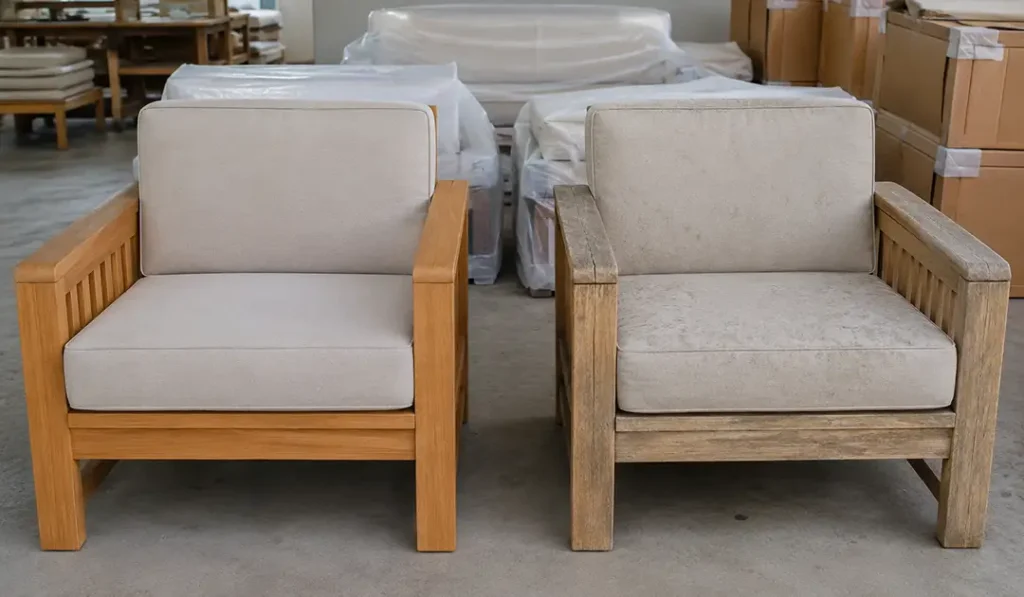
Poor wood selection often becomes visible only after shipment. Once the container arrives, the products are already in the buyer's warehouse, and the selling season has started. If the furniture starts to crack, warp, fade, or feel unstable, the buyer must handle the complaints, replacements, refunds, and extra customer service work.
This is why price comparison alone can be misleading. A lower FOB price does not always mean a lower total business cost, especially when the product needs to perform outdoors. Buyers also need to consider material quality, specifications, production consistency, and after-shipment risks. These factors are part of the real cost of furniture sourcing from Indonesia, not just the number written in the quotation.
For patio furniture, the risk is higher because the product is exposed to temperature fluctuations, humidity, direct sunlight, rain, cleaning, and daily use. That is why retailers need the right wood selection and proper production handling, not only a low production cost that may put customer trust at risk.
What Makes Wood Suitable for Patio Outdoor Furniture
A suitable wood for patio outdoor furniture is not chosen by species alone. The material must match the climate, target price, finishing system, and customer expectations. A wood that looks good indoors may be used outdoors, but it will not always perform the same when exposed to direct sunlight, rain, and daily weather changes.
Retailers should check three things before choosing wood: stability, drying control, and finishing compatibility. Stable wood helps reduce cracking, bending, and loose joints. Proper drying helps prevent shrinkage after shipment, while the right finishing system helps the surface handle moisture, sunlight, and regular cleaning.
In short, the right wood is the one that fits the product, market, climate, and customer promise. A dining table, lounge chair, sunbed, and sofa frame do not face the same pressure, so each product needs material evaluation before production starts.
Teak, Sungkai, and Mahogany: What Retailers Should Know
Many buyers ask, “What is the best wood for patio furniture?” The direct answer is: teak is often one of the strongest choices for patio outdoor furniture because it has strong durability, natural oil content, easier maintenance, and a premium look. This is especially true when the wood grade, drying process, finishing system, and frame construction are properly controlled.
From MPP’s production experience, sungkai and mahogany may still be considered for covered patio or semi-outdoor use when the finishing system is properly selected. In one discussion with a coating supplier, we reviewed whether sungkai and mahogany could be used with outdoor-grade color protection. Based on the lab test result, the coating showed stable color performance for around one year without a strong contrast change. However, for full outdoor exposure, teak remains the safer and more proven option, especially for collections such as outdoor rope and Indonesian teak patio furniture that need to combine durability, comfort, and premium visual appeal.
The safer question is not, “Which wood is cheapest?” It is, “Which wood fits my product promise, customer climate, care expectation, and retail price point?” This helps retailers choose wood based on product performance, not only production cost.
Why Finishing and Construction Matter as Much as Wood Species
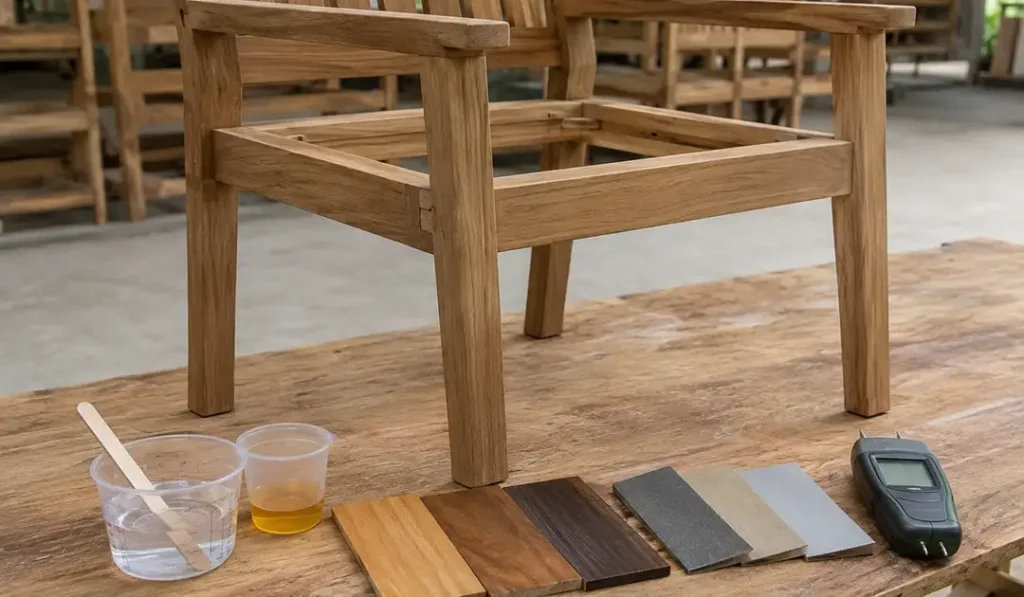
Choosing the right wood is important, but wood species alone do not guarantee reliable patio outdoor furniture. Strong wood can still crack, warp, or move if the drying process is poor. A good design can also fail if the joints are loose, the glue application is weak, or the finishing is not fully cured before packing.
From MPP’s production experience, bulk quality depends on details that are not always visible in catalog photos. Moisture content should be controlled before production, mortise and tenon joints must fit properly, epoxy glue must be applied according to the standard procedure, and finishing needs enough curing time before final handling.
This is why MPP treats finishing and construction as part of the product standard, not only the final look. The process is handled in-house from wood preparation, assembly, sanding, finishing, inspection, and packing, so the approved sample can be followed more consistently in bulk production.
For retailers and importers, this matters because patio furniture is judged after months of sun, humidity, storage, shipping, and daily use. As explained in MPP’s patio furniture manufacturer guide, buyers should evaluate the production process behind the product, not only the photos, samples, or price, because poor finishing and weak construction can lead to defects, complaints, returns, and margin pressure.
How Indonesian Furniture Manufacturers Help Reduce Material Risk
A reliable Indonesian furniture manufacturer can help retailers reduce material risk before bulk production starts. For patio furniture, the right decision is not only about choosing teak, mahogany, or sungkai. It is also about matching the material with the design, finishing system, construction, target market, and expected outdoor use.
This matters because material mistakes are harder to fix after production begins. A manufacturer should help buyers review the wood species and grade, outdoor exposure, climate, finishing system, construction detail, packaging method, and customer care instructions before confirming the order.
MPP Furniture works as a B2B wooden and rattan furniture manufacturer in Indonesia, serving retailers, importers, wholesalers, project-based businesses, interior designers, and contractors worldwide. Through custom furniture, private label, OEM support, free consultation, free product development, in-house production, and quality control at each stage, MPP helps buyers make better material decisions before bulk production.
At MPP, wooden and rattan furniture is handcrafted with attention to detail, supported by machinery and production control. The goal is not just to produce furniture, but to help retailers build outdoor collections that are consistent, durable, and ready to sell with confidence.
What Retailers Should Ask Before Ordering Patio Outdoor Furniture
Before ordering Indonesian patio furniture, the buyer should ask practical questions about the wood and production process. Start with the material: what wood species and grade will be used, and will the same material be used in bulk production as in the approved sample?
Next, ask about drying, finishing, construction, and production control.
- Has the wood been prepared for outdoor use?
- Is the finishing system suitable for sunlight, humidity, rain exposure, and cleaning?
- Are the joints built for repeated use?
- Is the product made in-house, and who checks the quality at each stage?
Buyers should also ask about packaging and care instructions. Good packaging helps protect the product during export and storage, while clear care guidance helps reduce customer complaints. These questions help buyers compare manufacturers beyond price and protect margin, trust, and future orders.
Conclusion
Choosing the right wood for patio outdoor furniture is not only a production decision. It is a business decision that affects customer trust, product lifespan, margin, and repeat orders. A cheaper wood option may reduce cost at the start, but it can create bigger problems later if the product cracks, fades, warps, or fails in real outdoor use.
For retailers, the better approach is to evaluate the wood, finishing, construction, packaging, and care guidance before confirming an order. This helps you choose furniture that matches your market, climate, price point, and customer promise.
In short, the right material protects more than the furniture. It protects your store's reputation. Work with a manufacturer that understands outdoor product performance, so your next patio collection is ready to sell with more confidence.
Build Patio Outdoor Furniture with the Right Wood
Work with MPP Furniture to review the right wood, finishing, and construction before starting your next patio outdoor furniture collection.
FAQs: About Choosing Wood for Patio Outdoor Furniture
1. What is the best wood for patio outdoor furniture?
Teak is often one of the best choices for premium patio outdoor furniture because it has strong durability, natural oil content, easier maintenance, and a premium look. But the best wood still depends on the climate, product design, finishing system, construction, and customer expectations.
2.Why can cheap patio furniture cost retailers more later?
Cheap patio furniture can cost more later when poor wood selection causes cracking, warping, fading, complaints, replacements, refunds, or lost repeat orders. A lower production cost does not always mean a lower total business cost.
3. Can sungkai and mahogany be used for patio furniture?
Sungkai and mahogany can be used for indoor, covered patio, or semi-outdoor furniture, depending on treatment, construction, and finishing. Retailers should not assume they can handle full outdoor exposure with only a simple finishing layer.
4. What should retailers check before ordering patio outdoor furniture?
Retailers should check the wood species, wood grade, drying process, finishing system, construction strength, packaging method, and care instructions. These details help reduce complaints and protect customer trust.
5. Why is the manufacturer important when choosing outdoor wood furniture?
A manufacturer affects how the wood is selected, dried, finished, constructed, packed, and inspected. A reliable manufacturer helps reduce material risk before bulk production, so retailers can sell outdoor collections with more confidence.

A versatile content creator with a strong foundation in product photography and videography, and a comprehensive brand strategy. Capable of creating engaging content to connect consumers and producers, web analytics, and engaging visual content to drive interest and growth for a product or brand.

0 Comments