Mahogany living room furniture does not look outdated because of the wood itself. Its appearance comes from silhouette, frame volume, proportion, negative space, finish direction, cushion scale, and material contrast.
For retailers, importers, wholesalers, and product developers, this matters before sample approval. A sofa may look balanced alone but feel too dark or dense within the full set. Working with a Mahogany Furniture Supplier Indonesia helps buyers review these points before sampling and bulk production.
The goal is to keep mahogany’s warmth while controlling visual weight across the collection.
Mahogany Is Not the Problem: Visual Weight Is
Visual weight describes how heavy or dense a product appears, not how much it weighs. Dark wood has more presence than pale wood, but color is only one part of the result.
Mahogany feels too heavy when several dense features appear together. Thick arms, broad aprons, closed side panels, low solid bases, deep cushions, carved details, and a dark glossy finish can all add mass. One choice may work well, but several competing choices can make the product feel formal or dated.
Modern mahogany furniture usually has a clearer hierarchy. A sofa can have a substantial frame with slimmer arms and visible floor clearance. A coffee table can use a thick top with an open base. A cabinet can keep a broad front while using raised legs or recessed panels.
Mahogany offers good workability, grain character, and stability. Its visual weight depends more on design and finish than on the wood alone, as discussed in this mahogany furniture investment guide.
| Modern direction | Too-heavy direction |
|---|---|
| Controlled frame thicknes | Thick arms, rails, and bases |
| Visible floor clearance | Low closed plinth |
| Selected details | Ornament across many surfaces |
| Visible grain | Dark reflective coating |
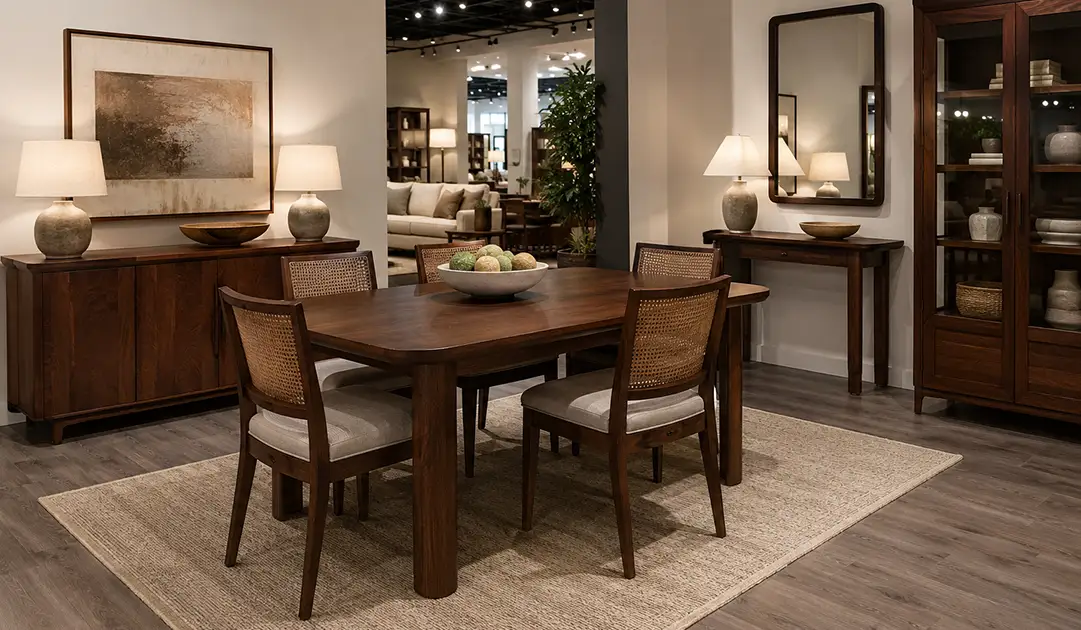
How Silhouette and Proportion Shape Mahogany Furniture Design

Silhouette is the first shape buyers and customers notice. Before checking joinery or finish codes, they read whether a product looks open, compact, low, soft, or block-like.
A modern silhouette does not mean every frame must be thin. Mahogany can support strong forms, but the arms, back, base, cushions, and decorative details should not all compete. On a sofa, wide arms combined with deep cushions, a high back, and a thick base can make the product feel crowded.
In June 2026, MPP Furniture worked with a furniture retailer from France that submitted sofa photos and dimensions based on online references. The first sample looked close to the image, but its full-scale proportion and sitting experience felt less balanced. MPP recommended revising the seat height, seat depth, and back support before approval.
The case shows why buyers should review front and side views together. Seat depth, cushion volume, frame thickness, and base height affect comfort and visual weight. The same rule applies to tables and storage, where a thick top, deep apron, or solid base can add too much mass.

How Negative Space Makes Contemporary Mahogany Furniture Feel Lighter
Negative space is the open area below, beside, or inside a furniture frame. It separates solid parts and gives the eye room to rest.
For dark wood living room furniture, open space can change the whole impression. A raised sofa base reveals more floor. Open chair sides separate the arms, legs, and cushions. A coffee table with spaced legs feels less dense than a box base, even when both use similar amounts of mahogany.
A cabinet on visible legs often feels lighter than one built onto a full plinth, while open shelves can break up a wide front.
The frame should remain strong. Contemporary mahogany furniture works when solid wood shows craftsmanship while selected areas remain open. During drawing review, buyers can compare solid and open areas instead of saying “make it lighter.”
Finish Direction Can Make Mahogany Feel Warm or Too Dark
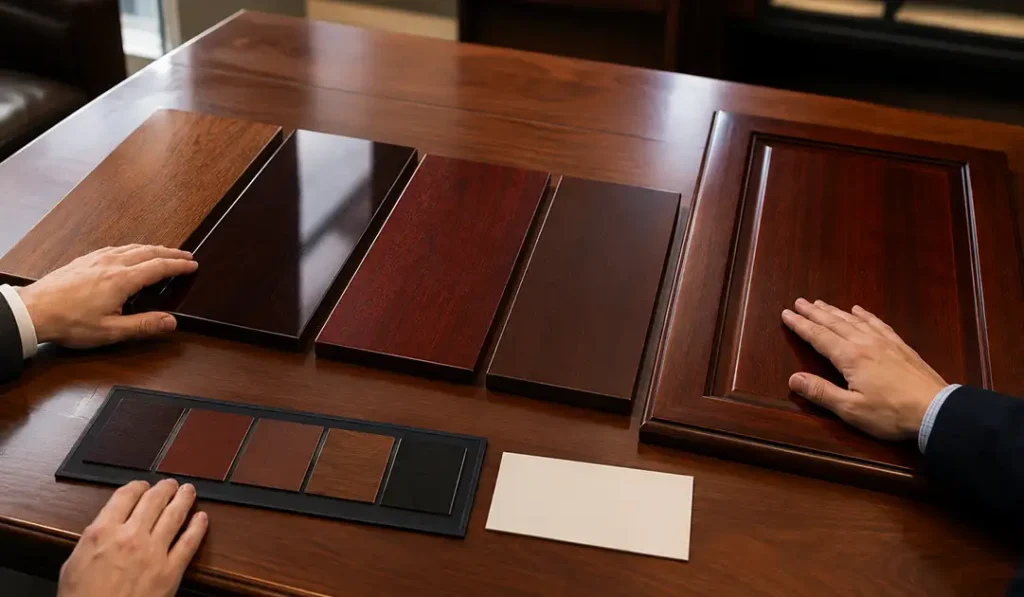
Finishing changes how mahogany appears across tabletops, cabinet doors, sofa rails, and chair arms. A dark stain may hide the grain, while a glossy topcoat can make broad surfaces feel denser. Matte or satin finishes often keep the grain visible and reduce strong reflection.
This is not a general mahogany finish guide. The buyer’s concern here is whether color depth and sheen make the product appear denser than intended.
MPP Furniture handled this issue with a furniture retailer from the United States that requested a warm mahogany direction. The retailer sent a color reference, but “warm mahogany” still allowed different interpretations of brown depth, red tone, and sheen. MPP prepared a physical finish swatch, and the approved sample became the reference for bulk production.
This gave production and quality control one shared standard and reduced the risk of inconsistent color across several SKUs.
Check Color Depth, Sheen, and Grain Visibility
Review physical swatches under daylight and indoor showroom lighting. Screen images can shift red, brown, and black tones, so digital approval alone may not show the final result.
Check whether the stain is too red, dark, or flat. Then review the sheen and grain. A dark glossy arm can appear heavier than the same part in satin, while a coating that hides the grain may make mahogany look painted.
Test the tone on more than one surface size. A balanced swatch may appear darker on a wide cabinet door or coffee-table top.
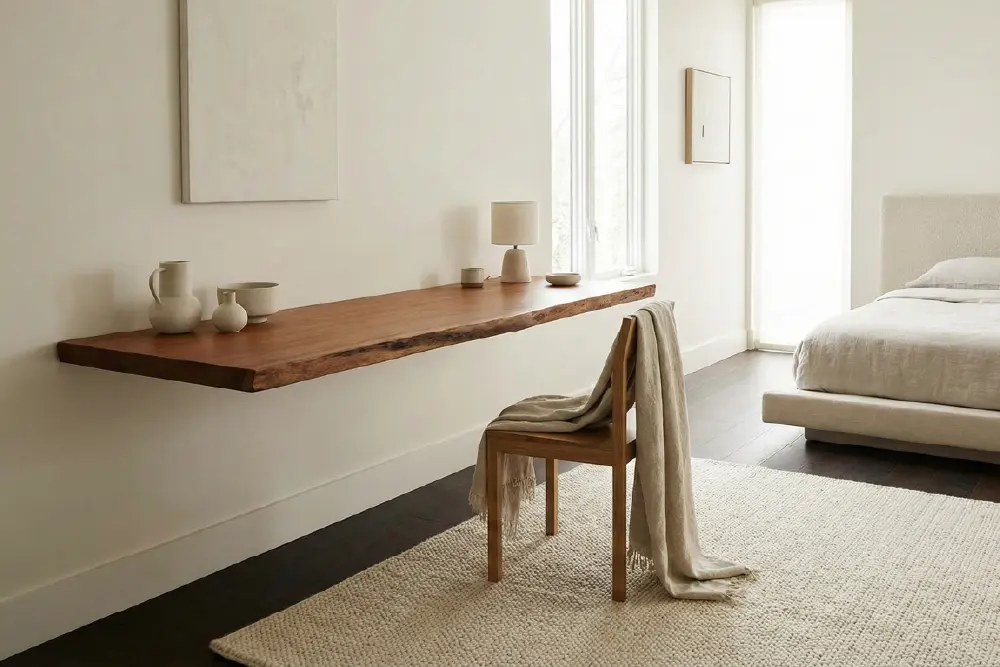
Use Material Contrast to Balance Dark Wood Living Room Furniture
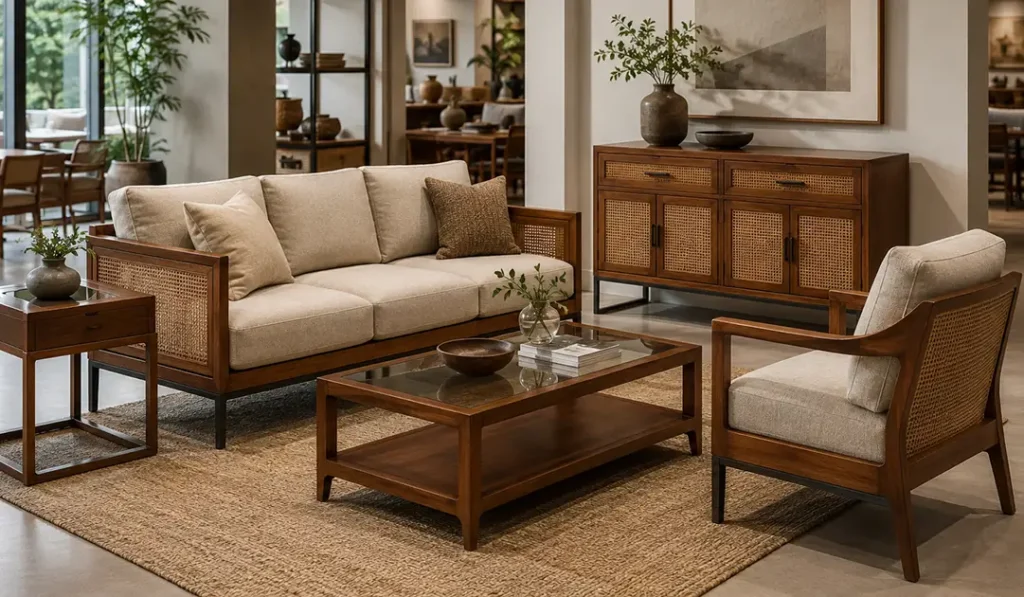
Material contrast helps dark wood living room furniture feel more balanced by reducing the amount of solid dark surface visible across the collection. Warm-neutral fabric can soften a sofa or lounge chair frame, while rattan adds open woven areas to chair backs, cabinet doors, or side panels. Glass can make tables feel lighter, and metal works best as a small accent.
In June 2026, a furniture retailer from Australia approached MPP Furniture with a living room collection using wood, rattan, and aluminum accents. The products still needed one shared direction, so MPP reviewed the wood tone, rattan texture, aluminum finish, and cushion color before sampling.
Wood became the main material, while rattan and aluminum supported the collection. This helped the sofa, chairs, tables, and storage pieces feel connected without repeating the same visual weight across every SKU.
Dark wood can still feel current when paired with softer materials and controlled contrast. Architectural Digest’s discussion of modern Neo Deco design supports this approach.

Distribute Visual Weight Across a Mahogany Living Room Collection
A product can look balanced on its own but still make the full collection feel too heavy. This often happens when the same dark finish, thick frame, and closed base are repeated across every SKU.
The sofa usually becomes the visual anchor because it has the largest volume. The lounge chair, tables, and storage pieces should relate to it, but they do not need to carry the same mass. Some items can feel more solid, while others add open space or lighter materials.
Review the full collection in one front-view lineup, then check the side views. Compare frame thickness, finish depth, cushion volume, leg profiles, and visible floor area to see where the collection starts to feel too dense.
Repeat selected details, such as a leg shape, edge profile, or finish tone, instead of copying every design element. Buyers can also review MPP’s indonesian living room range to see how seating, tables, and storage can work as one product family.
Mahogany Visual Weight Sample Review
| Review area | Buyer question |
|---|---|
| Silhouette | Can the main shape be read in seconds? |
| Frame volume | Are the arms, rails, legs, and base balanced? |
| Negative space | Is enough open area visible? |
| Finish | Are color depth, sheen, and grain controlled? |
| Material contrast | Do supporting materials add visual relief? |
| Collection fit | Does the sample work with the other SKUs? |
Score each area from 1 to 5. This gives the buyer and manufacturer one shared method for identifying which design elements need revision before approval.
Turn Visual Feedback Into Clear Product Direction
“Make it more modern” is too broad. A clearer note might ask for slimmer arms, a thinner tabletop, more floor clearance, lower cushion volume, or a softer sheen.
“It looks too heavy” can become a production action, such as reducing closed panels, raising the base, widening leg spacing, or removing one decorative frame layer.
Clear comments reduce repeated sampling. As an Indonesian Furniture Manufacturer, MPP Furniture supports consultation, product development, and custom design from drawing to sample review.
Conclusion: Modern Mahogany Furniture Comes From Controlled Design Decisions
Mahogany living room furniture can feel modern, balanced, and retail-ready when its visual weight is controlled through frame volume, negative space, cushion scale, finish, and material contrast.
Before sample approval, buyers should review these elements across the full collection and give specific revision notes. This helps the manufacturer adjust the right design areas before bulk production.
Develop a Modern Mahogany Living Room Collection With MPP Furniture
Work with MPP Furniture to refine silhouette, proportion, finish, and material pairing before sample approval. Start with a free consultation for your custom mahogany collection.
Mahogany Living Room Furniture FAQs: What Buyers Should Check
1. Is mahogany living room furniture outdated?
No. Mahogany does not look outdated because of its dark color alone. It usually feels dated when thick frames, closed bases, excess decoration, full cushions, and dark glossy finishes are combined in one product.
2. What makes mahogany furniture look modern?
Modern mahogany furniture usually has a clear silhouette, controlled frame thickness, visible floor clearance, balanced cushions, readable grain, and selected material contrast. The aim is not to make every part thin, but to control how much visual weight each part carries.
3. Why does dark wood furniture look too heavy?
Dark wood furniture looks too heavy when broad wooden surfaces, thick arms, low bases, deep cushions, and limited open space appear together. Buyers should review the solid-to-open ratio instead of treating the wood color as the only cause
4. What finish works well for modern mahogany furniture?
Matte or satin finishes often work well because they reduce strong reflection and keep the mahogany grain visible. Buyers should approve the color depth, red-brown balance, and sheen on a physical swatch before bulk production.
5. What should buyers check before approving a mahogany furniture sample?
Buyers should check silhouette, frame volume, floor clearance, cushion balance, finish depth, grain visibility, material contrast, and fit with the full collection. At MPP Furniture, an approved sample is treated as a production reference, so dimensions, finishes, materials, and visual details should be recorded before bulk production.

A versatile content creator with a strong foundation in product photography and videography, and a comprehensive brand strategy. Capable of creating engaging content to connect consumers and producers, web analytics, and engaging visual content to drive interest and growth for a product or brand.


0 Comments