Retailers competing in the indoor furniture market often compare sourcing options based on FOB price because even a small cost difference can affect pricing and margin. But a lower factory price does not always mean better sourcing efficiency when packing volume and import costs are taken into account.
This is where Knock-Down (KD) furniture becomes relevant. By reducing packed volume, KD construction can fit more units into the same container than fully assembled furniture, although it may also require additional hardware and engineering.
The question is not just, “Which version has the lower unit price?” It is, “Which version gives the better total cost when the furniture reaches my market?” This article helps buyers assess when KD furniture can actually deliver a lower landed cost.
KD Furniture Can Be Competitive Even When FOB Cost Is Not Lower
KD furniture is designed to reduce packed volume by separating selected components before shipping and assembling them later at the destination. For wooden furniture, this requires more engineering because structural connections, such as the side frame, seat, backrest, or legs, must be designed to come apart without reducing stability after assembly.
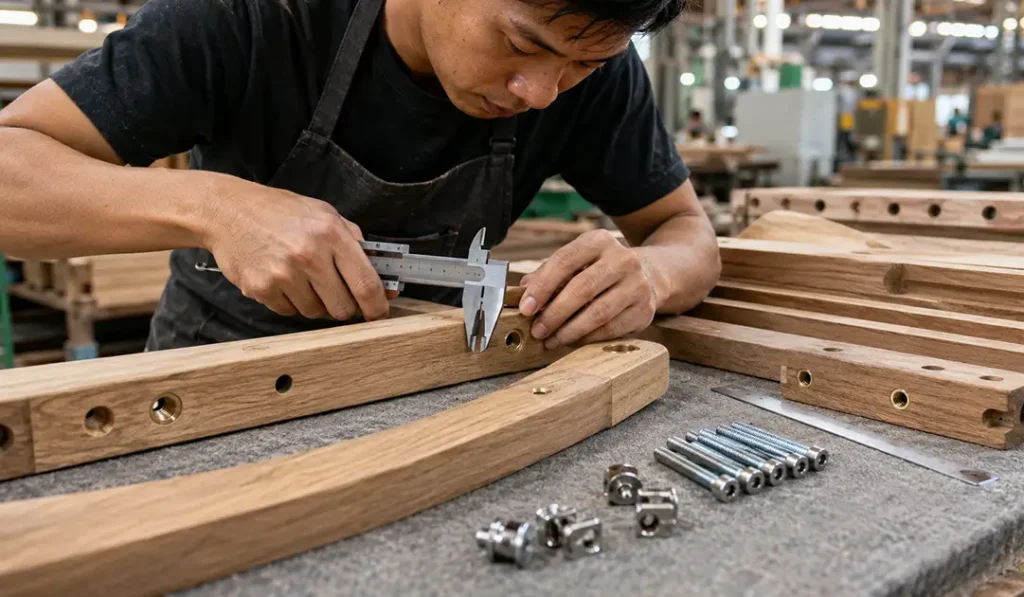
Once these components are separated, the manufacturer needs to consider drilling accuracy, hardware selection, connection points, and an easy-to-follow assembly process. This is where the role of an experienced Indonesian furniture manufacturer becomes important, because joint positions, machining accuracy, assembly sequence, and packing layout need to work as one system.
Because of these additional requirements, KD furniture does not always have a lower FOB unit cost than fully assembled furniture. Removable bolts, inserts, fittings, and extra machining can add cost compared with a construction that uses fewer detachable connection points.
But a slightly higher FOB price does not automatically mean a higher total cost. If KD construction allows more units to fit into the same container, the lower logistics cost per unit can offset the additional production cost.
How Compact Packing Lowers Import Cost per Sellable Unit
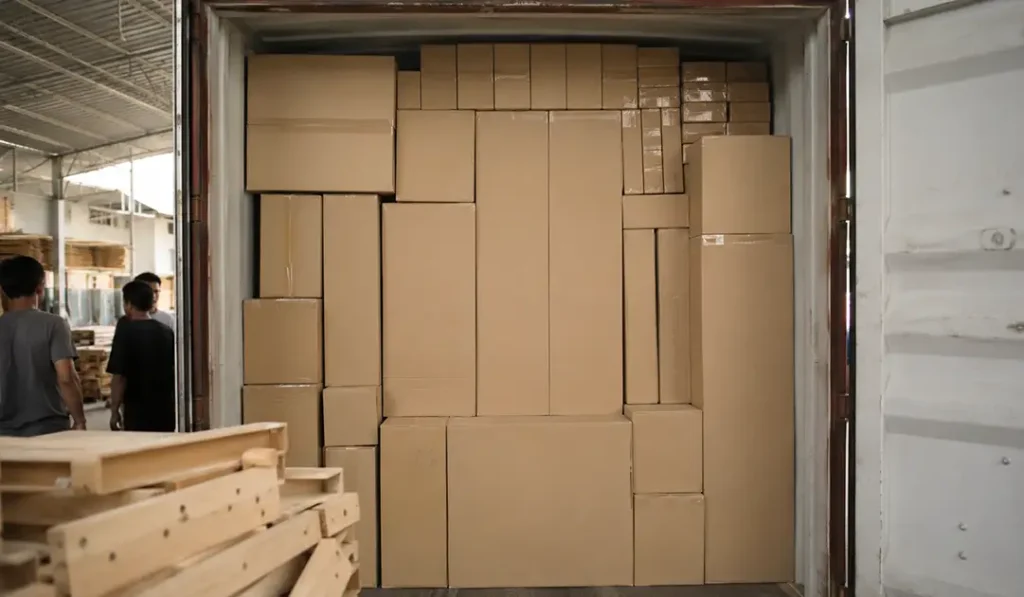
Packing efficiency matters because every carton takes up limited container space. Lower packed volume means more units can fit into the same shipment.
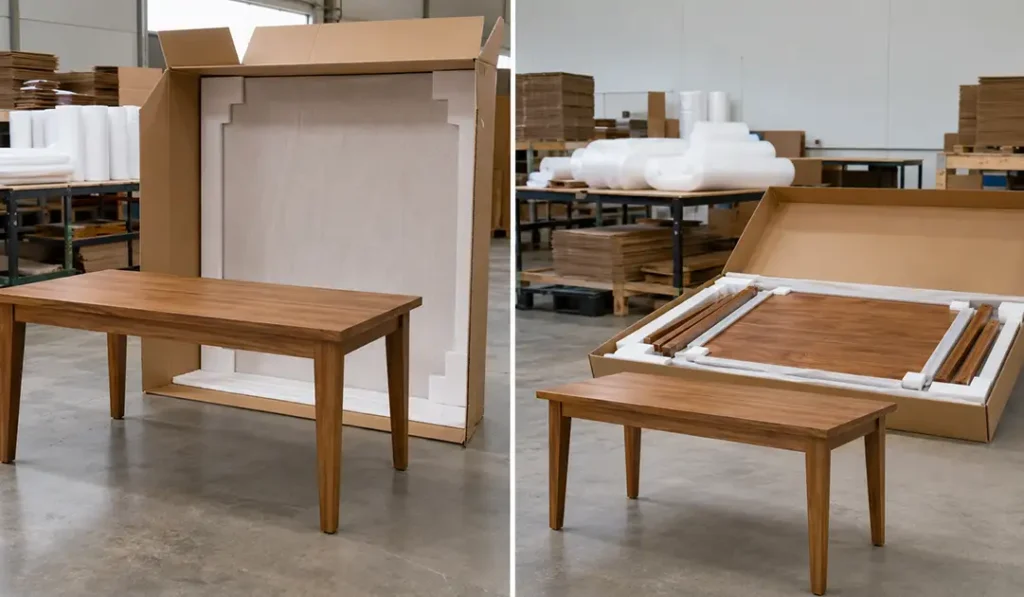
For example, a fully assembled dining table measuring 100 × 200 × 75 cm can occupy around 1.5 m³ of space, while a KD version may reduce the packed volume to around 0.7 m³ because the height of packaging is reduced from 75 to 35 cm. This allows the same container space to carry more sellable units.
In short, the relationship is:
Smaller packed dimensions → lower CBM per unit → more units per container → lower freight allocation per unit.
The actual CBM saving depends on the product model and construction. Dining chairs, tables, sofas, benches, and other indoor furniture can produce very different packing results.
Product dimensions also matter when estimating packing volume. Even closely related seating products may need different specifications and carton dimensions. For example, counter stools and bar stools should be treated as separate product specifications because changes in seat height, overall height, footrest position, and other dimensions can affect how each SKU is developed and packed.
From our experience loading export containers, KD products can also help use smaller spaces around the sides or remaining gaps inside the container. Benches are one example because their compact packing can sometimes be placed as filler between larger cartons, helping improve overall container utilization.
So the commercial value does not come from simply calling a product “KD Furniture.” It comes from how much packed volume the construction can actually reduce and how efficiently that space can be used during container loading.
How KD Construction Changes the Final Landed Cost
Landed cost is the total cost of bringing furniture from the factory to the buyer’s destination. It usually includes the FOB price, freight, insurance, import duty, and destination charges, so a lower factory price does not always result in a lower landed cost.
For example, compare the same furniture in fully assembled and KD construction:
| Cost Element | Fully Assembled | KD Furniture |
| FOB price per unit | $100 | $106 |
| Packed volume per unit | 1.5 m³ | 0.7 m³ |
| Freight allocation per unit | $30 | $16 |
| Other import costs | $15 | $15 |
| Estimated landed cost per unit | $145 | $137 |
The figures above are a simplified illustration. Actual landed cost depends on freight rates, destination, duty, packing dimensions, and other import charges.
In this example, the KD furniture costs $6 more at the factory, but the lower packed volume reduces freight allocation by $14 per unit.
After the other import costs are added, the KD version still reaches the destination at a lower landed cost. This is why retailers should compare landed cost per sellable unit, not FOB price alone.
The break-even question is:
Do the logistics savings per unit exceed the additional cost created by KD construction?
If the answer is yes, the higher-FOB product may still be the cheaper to import.
Why Lower Landed Cost Gives Retailers More Pricing and Margin Options
A saving of a few dollars per unit may look small, but the impact becomes much larger when the order reaches hundreds of units. This gives furniture retailers more room when setting selling prices, promotional discounts, and target margins.
For example, one of an occasional chair MPP’s product may fit only 200 units per container when fully assembled, whereas a KD version may allow around 400 units. If the lower landed cost creates a saving of $15 per unit, that can equal $6,000 across 400 units, which can be allocated to marketing, promotions, inventory, or used to support a more competitive selling price.
This matters for buyers building a repeatable indoor collection rather than making a one-time purchase. Better cost efficiency can give retailers more flexibility when planning future orders, pricing, and assortment.
When Is KD Furniture Actually Cost-Effective?
KD furniture is cost-effective when the reduction in packed volume is large enough to justify the additional engineering, hardware, and assembly requirements. For example, if a fully assembled side table uses 0.12 m³ while the KD version only reduces it to 0.10 m³, the saving is around 17%. In this case, the additional KD cost may not be worth the relatively small improvement in container space.
Cost-effectiveness should also be judged by how safely and reliably the product performs after assembly. If the manufacturer does not design the joints, hardware, and assembly points properly, the product may develop problems such as wobbling, misaligned parts, loose connections, or too many assembly steps.
These issues do more than create product complaints. They can make customers uncomfortable with the assembly process and reduce their trust in the retailer or private-label brand selling the product.
This is why choosing the right Indonesian furniture manufacturer matters in KD development. The manufacturer needs to balance packing efficiency with structural performance, assembly simplicity, and production consistency.
Sometimes the smartest KD decision is deciding not to make the product KD.
Why Develop Knock-Down Indoor Furniture with MPP Furniture
At MPP Furniture, KD development is viewed from both the product and commercial side. The product still needs to be strong, easy to assemble, and consistent in production, while the packing also needs to reduce CBM enough to create a meaningful cost advantage for the buyer.
CNC machinery supports the precision needed for KD furniture, especially for drilling positions, joint placement, and repeatable component dimensions. This helps each part fit correctly during assembly and reduces the risk of misalignment between production batches.
MPP also has experience developing and producing KD furniture for B2B buyers. That experience helps us consider practical details such as where components should be separated, how many assembly points are reasonable, which hardware is suitable, and how the product can be packed efficiently without making the assembly process difficult for the customer.
For retailers and importers, the goal is to develop KD furniture that performs reliably while improving the sourcing program's commercial efficiency.
Summary: Compare Landed Cost, Not FOB Price Alone
KD furniture can be a cost-effective option when the reduction in packed volume is large enough to offset the additional engineering, hardware, and assembly cost. For furniture retailers and importers, the better comparison is not FOB price alone, but the final landed cost per sellable unit.
Product safety also depends on how well the KD construction is designed, so choosing the right furniture manufacturer is an important part of reducing product risk.
If you are considering KD construction for your next indoor furniture from Indonesia, MPP Furniture can help review the product design, assembly method, structural considerations, and packing efficiency before moving into production.
Discuss Your Next Sourcing KD Indoor Furniture from Indonesia
The development team can review the design from both a product and packing perspective before you commit to bulk production.
FAQs: KD (Knock-Down) Furniture
1. Is KD furniture cheaper than fully assembled furniture?
Not always. KD furniture can have a higher FOB price because it may require additional hardware, machining, and engineering, but lower packed volume can reduce freight cost and result in a lower landed cost per unit.
2. Does KD furniture reduce shipping costs?
Yes, when KD construction significantly reduces packed CBM. A smaller packed volume allows more units to fit into the same container, which lowers freight allocation per unit.
3. Is KD furniture as strong as fully assembled furniture?
It can be. The strength of KD furniture depends on joint design, hardware selection, machining accuracy, and how the components are assembled. Poorly designed connections can cause wobbling, loose joints, or misalignment.
4. What types of furniture are suitable for KD construction?
Tables, dining chairs, benches, beds, and some sofas can be suitable for KD construction. The best candidates are products where separating components creates meaningful CBM savings without making the structure weaker or assembly too difficult.
5. When is KD furniture not cost-effective?
KD furniture may not be cost-effective when the reduction in packed volume is too small to offset the added hardware, engineering, and assembly requirements. In that case, fully assembled construction may provide better overall value.

Hi, I’m Salman, founder of MPP Furniture, an Indonesian furniture manufacturer serving global retailers and project-based clients.
I began my career in my family’s export-oriented furniture company, gaining hands-on experience in production, construction, finishing, material performance, and product development. With a clear understanding of how international buyers evaluate furniture quality and reliability, I founded MPP Furniture to deliver export-ready products with consistent standards.
Here, I share insights from the perspective of a furniture manufacturer working directly with production teams on the factory floor, focusing on manufacturing and supplier evaluation.
Connect on LinkedIn
0 Comments