Receiving a TSCA Title VI certificate or an E1 plywood report can reassure furniture buyers. But neither document automatically establishes compliance for furniture sold in the EU.
Under the EU REACH formaldehyde restriction, covered furniture must meet an emission limit of 0.062 mg/m³ under specified test conditions. Understanding your evidence helps identify compliance gaps before bulk production.
This guide explains which materials and reports to review, when changes require reassessment, and what to confirm with your manufacturer before ordering.
What Does EU REACH Entry 77 Require for Indoor Furniture?
Commission Regulation (EU) 2023/1464 limits emissions from covered furniture and wood-based articles to 0.062 mg/m³ under Appendix 14 test conditions for products placed on the EU market after 6 August 2026.
| Product category | Maximum emission limit |
| Furniture and wood-based articles | 0.062 mg/m³ |
| Other covered articles | 0.080 mg/m³ |
The 2026 EU formaldehyde limit applies to the whole furniture product, not just its panels. Under REACH Article 3(12), importing articles and supplying or making them available to third parties count as market placement; the purchase or production date does not determine applicability.
ECHA's Entry 77 restriction conditions list exemptions for articles with exclusively naturally occurring formaldehyde or releasers, articles used exclusively outdoors under foreseeable conditions, and exclusively professional or industrial articles without foreseeable public exposure, among others.
Which Indoor Furniture Materials Can Contribute to Formaldehyde Emissions?
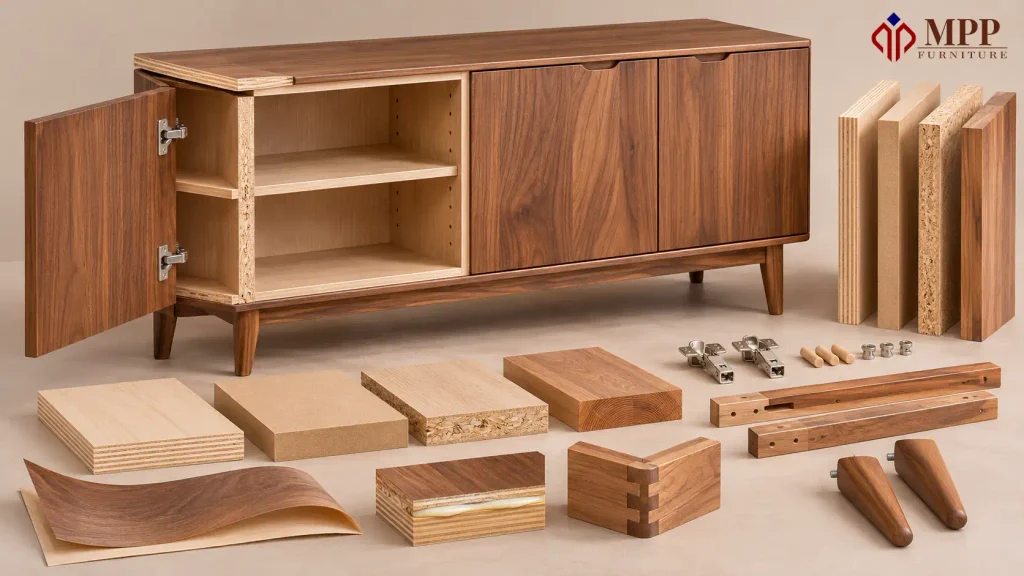
Formaldehyde emissions from furniture can come from composite wood and materials added during production. Formaldehyde in plywood, for example, can originate from resins bonding its veneer layers.
| Potential emission source | Furniture applications |
| Plywood | Drawer bottoms, cabinet backs |
| Medium-density fibreboard (MDF) and particleboard | Doors, shelves, tabletops |
| Veneer adhesives | Decorative panels |
| Assembly adhesives | Bonded joints |
| Paints and coatings | Finished surfaces |
| Foam and textiles | Upholstered seating |
Solid wood can release naturally occurring formaldehyde. Added adhesives and finishes must also be considered before claiming an exemption.
Ask your manufacturer which components arrive ready for assembly and which undergo further bonding, veneering, or finishing.
Does TSCA Title VI Certification Prove EU Formaldehyde Compliance?
No. TSCA Title VI certification supports compliance for regulated composite wood panels under US rules, but does not automatically establish compliance with REACH Entry 77.
These formaldehyde emission standards differ in scope and testing conditions.
| Requirement | Assessment scope | Emission limit |
| TSCA Title VI | Regulated composite wood panels | Varies by panel type |
| Formaldehyde emission class E1 | Wood-based panels | 0.124 mg/m³ (conventional EN 717-1 threshold) |
| REACH Entry 77 | Covered furniture and wood-based articles | 0.062 mg/m³ |
The EU furniture Ecolabel decision defines E1 by reference to EN 13986. Some E1 panels may emit below 0.062 mg/m³, but classification alone does not establish Entry 77 compliance. Review actual results and test conditions rather than relying on labels or unit conversions.
Our TSCA Title VI compliance guide for wooden furniture explains the separate US requirements.
What Formaldehyde Test Reports Should EU Furniture Importers Request?
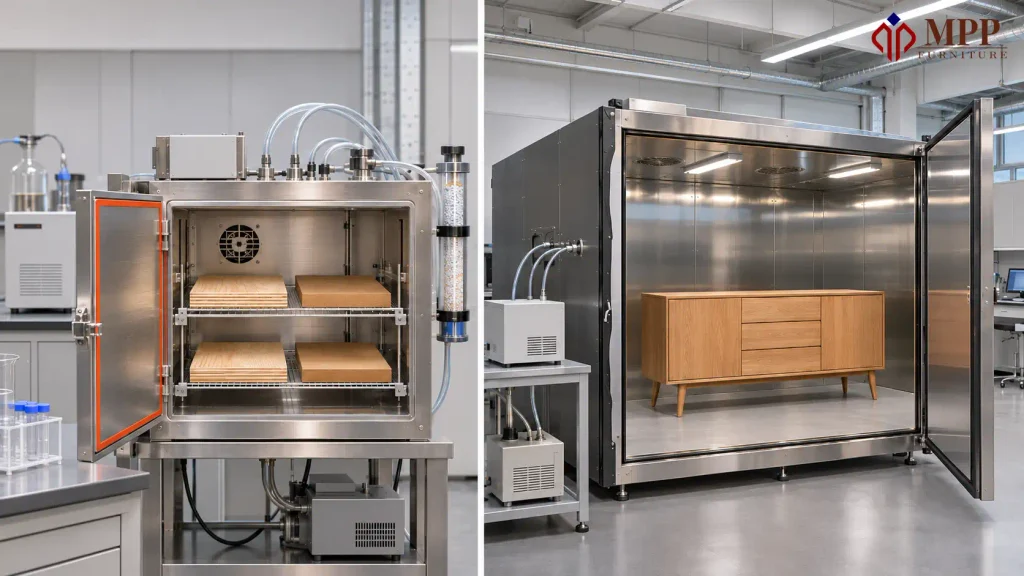
Request emission evidence representing the actual furniture, using component reports or assembled-product testing according to the manufacturing process.
Component Test Reports vs. Finished-Furniture Testing
ECHA's April 2025 measurement guidance, Section 3.3.1, allows assessment using individual component tests for simple assembly without additional formaldehyde-emitting materials. When assembly adds emitting adhesives, paints, or coatings, the guidance calls for testing assembled furniture. If full-product testing is not feasible, suitable representative parts may be tested, reflecting material types and proportions.
What to Check in a Formaldehyde Test Report
The Bureau Veritas REACH regulatory update refers to Appendix 14 chamber testing conditions. Before accepting a report, verify:
- Laboratory identity, competence, report number and date.
- Tested product or component, method, edition and sample preparation.
- Chamber temperature, humidity, loading factor and air exchange rate.
- Steady-state emission concentration and units.
- Scientifically valid correlation for non-reference conditions when reference-condition data are unavailable or unsuitable.
As with verifying EN 581 outdoor furniture test reports, the evidence must represent the product. Mechanical safety and chemical emission testing serve different purposes.
How Can Buyers Match Emission Evidence to Their Furniture Specifications?
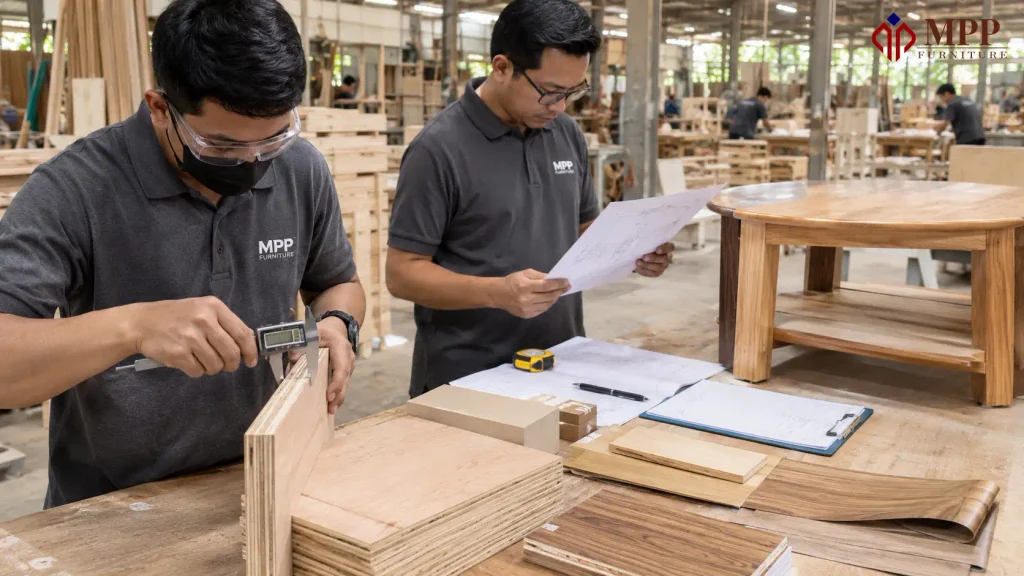
Match test specimens and production processes to your approved bill of materials (BOM), drawings, sample, and finishing specifications. Consider this illustrative coffee table:
| Approved specification | Available evidence | Potential evidence gap |
| Veneered MDF tabletop | Raw MDF report | Veneer adhesive and finished surface |
| Solid-wood legs | Timber specification | Added coatings |
| Assembly adhesive | Technical data sheet | Emissions after application |
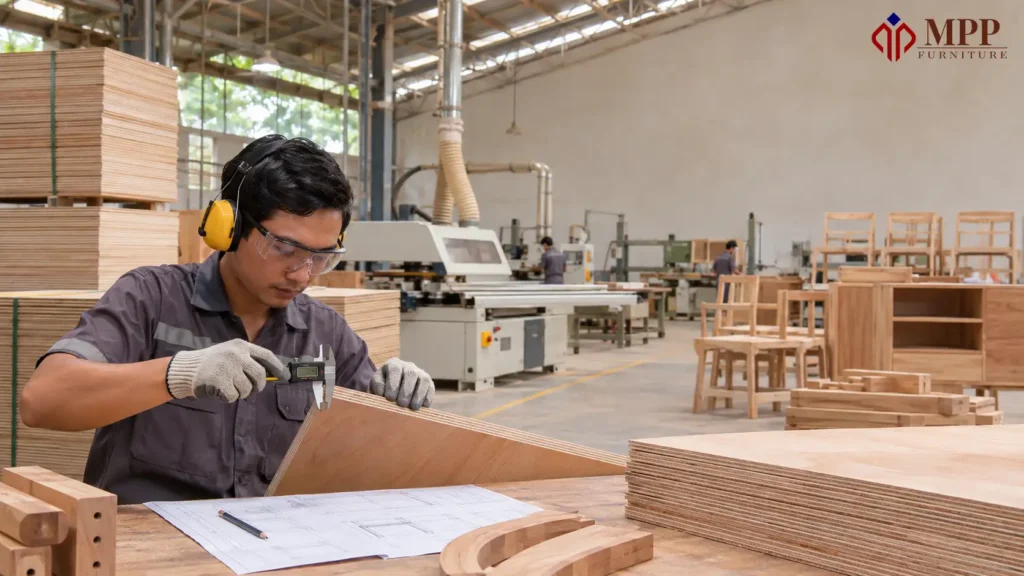
At MPP Furniture, an Indonesian furniture manufacturer, our purchasing and production teams check incoming plywood and MDF against buyer-approved specifications. We compare panel types, thicknesses, and available supplier purchase records, then clarify differences before using the materials.
These factory checks support consistency, not proof of emission compliance. Ask your compliance team whether the evidence covers processes applied after panels reach the factory.
When Should Material or Supplier Changes Trigger Another Compliance Review?

Review emission evidence when changes could affect emissions, such as a different plywood supplier, resin, veneer adhesive, or coating. Even material changes made to reduce furniture costs can affect report applicability.
At MPP Furniture, when a different material supplier is proposed after sample approval, we request supporting documents and share them with the buyer. Documentation matters when regulatory requirements apply, so the buyer can decide whether to accept the proposed supplier.
For EU orders, check whether evidence still represents the revised specification. Depending on the change, updated records, a technical assessment, or further testing may be needed.
What Should Importers Confirm Before Placing an Indoor Furniture Order?
When qualifying an Indonesian Furniture Supplier for bulk and repeat orders, agree on how approved materials and emission evidence will be maintained.
Before confirming your purchase order, review:
- Final BOM, specifications, and material sources.
- Emission reports and unresolved evidence gaps.
- Additional testing arrangements, costs, and lead times.
- Responsibilities for documentation and compliance assessment.
- Written approval procedures for material substitutions.
If evidence is pending, agree on conditional order terms and hold production release until agreed checks are resolved. Review the separate EU furniture packaging requirements as part of market preparation.
Final Thoughts: Verify Emission Evidence Before Confirming Your Order
REACH formaldehyde compliance requires more than panel certificates. Match emission evidence to approved materials and production processes, resolve gaps, and maintain specifications across bulk and repeat orders.
Regulatory Reference Note: Reviewed against Commission Regulation (EU) 2023/1464 and ECHA's April 2025 measurement guidance on 24 November 2026.
Discuss Your Indoor Furniture Material Requirements with MPP Furniture
Are you developing an indoor furniture collection for the EU market? Share your product drawings, material specifications, SKU list, and emission documentation requirements with MPP Furniture.
Through free consultation, product development, and in-house manufacturing, we can help review material options and available supplier records before production. Your compliance team and qualified laboratory can assess the applicable emission requirements.
FAQs: EU Formaldehyde Requirements for Furniture Importers
1. Is a REACH formaldehyde certificate mandatory for furniture?
No. REACH Entry 77 does not prescribe a mandatory third-party certificate, specific label, or new CE marking. Importers must demonstrate compliance with the applicable emission limit, although individual retailers may require additional certification as part of their supplier approval process.
2. How long does formaldehyde emission testing take?
Under Appendix 14 reference conditions, chamber testing must continue long enough to determine the steady-state emission concentration, with a maximum duration of 28 days. Allow additional time for sample preparation, shipping, laboratory scheduling, and report issuance when planning your furniture order.
3. Does the EU formaldehyde restriction apply to furniture already in stock?
Yes, if covered furniture is supplied or made available on the EU market after 6 August 2026, even if it was imported earlier. Holding older inventory does not automatically exempt it from the restriction when sold. Second-hand articles, however, are exempt under Entry 77.
4. What happens if furniture fails the EU formaldehyde emission test?
Non-compliant furniture cannot legally be placed on the EU market. Buyers should hold the affected products, investigate potential emission sources with their manufacturer, and review corrective actions and further testing before releasing the order.
5. Who Is Responsible for REACH Formaldehyde Compliance When Importing Furniture into the EU?
EU importers are responsible for verifying that the furniture they place on the EU market meets applicable REACH formaldehyde requirements. Overseas manufacturers support this process by providing material information, relevant emission evidence, and production records, while distributors and retailers must also meet their applicable legal obligations.

A versatile content creator with a strong foundation in product photography and videography, and a comprehensive brand strategy. Capable of creating engaging content to connect consumers and producers, web analytics, and engaging visual content to drive interest and growth for a product or brand.

0 Comments