If you import private-label furniture into the EU, protecting finishes and preventing transit damage are already part of your work. PPWR adds another question: can you show who is responsible for the packaging and what evidence supports it?
This guide explains who issues a PPWR declaration of conformity, what packaging bill of materials (BOM) to request, and which documents to verify before bulk production. It also shows how to review these records with an overseas furniture manufacturer.
We will cover legal roles, packaging component weights, compliance evidence, protective packing, and approval of later changes. Regulation (EU) 2025/40 has applied since 12 August 2026, but several detailed packaging design rules begin later.
Who Is Responsible for PPWR Compliance in Private-Label Furniture Imports?
The company physically packing furniture is not always the legal manufacturer under PPWR. A business that has packaging or packaged products made under its own name or trademark may hold that role, subject to specific exceptions.
Private-Label Brand Owner and EU Importer Responsibilities
You should identify who is the legal manufacturer and who places the imported packaging on the EU market. The legal manufacturer assesses conformity and draws up the EU declaration, while the importer verifies the assessment, supporting documents, packaging identification, and required contact details.
Packaging Suppliers and EPR Producers Have Different Roles
Physical packaging suppliers provide material information and supporting documents needed for conformity assessment. The extended producer responsibility (EPR) producer has separate registration, reporting, and waste-management financing obligations that depend on the Member State and how packaged goods are supplied or unpacked, as explained in the European Commission's PPWR guidance.
What Packaging Information Should Importers Request From Furniture Manufacturers?
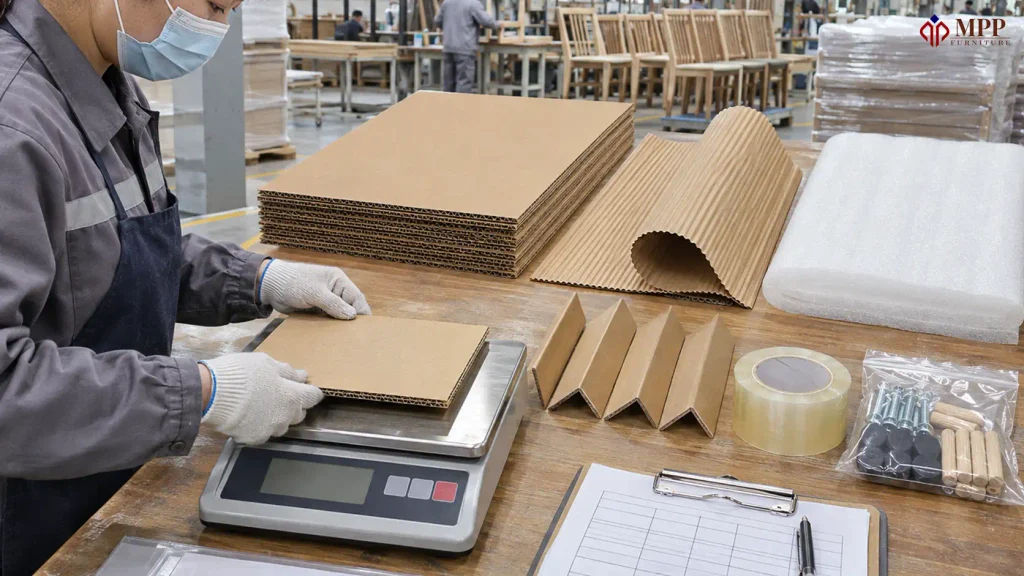
Request a packaging BOM for each SKU and approved packing version. Record carton board, corrugated sheets, protective foam, corner guards, wrapping, tape, and hardware bags, including their material specifications, quantities, supplier information, and weights.
| Record | What to verify |
| Materials and suppliers | Component name, material type, specification, supplier |
| Quantities and weights | Quantity and measured weight per component |
| Pack identification | SKU, carton dimensions, batch or packaging identifier, revision |
| Supporting records | Material statements, relevant reports, drawings, packing photographs |
In our factory, we record individual packaging-component weights, not just the overall packed weight. This provides a more useful reference when buyers compare materials or review a proposed change.
Our bedroom furniture packaging approval guide explains why trials should capture packed dimensions, hardware positions, carton count, and photographs. Keep those records linked to the approved BOM so buyers and production teams refer to the same version.
Which PPWR Compliance Documents Should Importers Verify?
A supplier statement can support PPWR compliance, but it is not automatically the EU Declaration of Conformity. The buyer should check which legal entity issued each record and which packaging version it covers.
Supplier Declaration vs. EU Declaration of Conformity
Under Articles 15 and 39, the legal manufacturer draws up the declaration after assessing the applicable requirements. The declaration follows Annex VIII; supporting material statements or test results do not replace it.
| Document | Purpose |
| Supplier declaration | Material details or supplier's supporting statement |
| EU Declaration of Conformity | Formal statement by the legal manufacturer |
| Technical documentation | Design, materials, assessments, and supporting records |
| Test evidence | Results for a specific requirement, where relevant |
Technical Documentation and Test Evidence
As of November 2026, the PPWR declaration covers applicable Article 5 substances-of-concern requirements, including the general combined 100 mg/kg limit for lead, cadmium, mercury, and hexavalent chromium. PFAS limits under Article 5 apply to food-contact packaging, not ordinary furniture cartons, as clarified by the European Commission's October 2026 guidance.
Manufacturers and importers have separate document-keeping duties under Regulation (EU) 2025/40. The standard retention period is five years after EU market placement for single-use packaging and ten years for reusable packaging.
How Can Furniture Packaging Meet PPWR Requirements Without Compromising Protection?

Retailers need packaging that limits waste without allowing chair legs, finished panels, cabinet corners, glass, or hardware to damage one another. Removing cushioning just to reduce material weight can create a different cost through claims and replacements.
Our published multi-packing furniture guide describes foam sheets against finishes, single-face corrugated paper, styrofoam, and rigid corner protection. It also documents using a smaller empty carton to limit movement inside a larger carton.
Article 10 introduces packaging minimisation requirements from 2030. Article 24 sets a future 50% maximum empty-space ratio for relevant grouped, transport, and e-commerce packaging, from 2030 or later depending on implementing measures; listed fillers such as foam count as empty space. Your packing review should test necessary protection and record the reasons for the approved design.
What Should Buyers Agree With Manufacturers Before Bulk Production?
Before bulk production, you and your manufacturer should agree on the approved packing method, material specifications, BOM version, carton layout, protection points, and packing photographs. Identify who approves changes and which records must be updated for each SKU.
Our team has made a real protective-packaging revision in furniture manufacturing. Buyer approval depends on the type of change, so the agreement should distinguish routine adjustments from changes that need fresh buyer sign-off.
Ask for written notice of substitutions that could affect material data, product protection, or the conformity assessment. As an Indonesian Furniture Manufacturer, we can help coordinate packaging specifications and factory records, while the responsible legal operator remains accountable for PPWR conformity.
Final Thoughts: Verify Packaging Compliance Before Production Starts
For EU private-label furniture importers, a suitable carton is only part of the decision. Confirm the legal roles, component-level packaging data, supporting documents, approved protection, and change-control process before bulk production.
Discuss Your EU Furniture Packaging Requirements With MPP
Share your SKU list, destination market, preferred packaging method, and available material records with MPP. Our team offers free consultation and product development support to discuss protective specifications and packing approvals; we do not issue PPWR certification or replace your legal compliance review.
FAQ: About EU PPWR Furniture Packaging
1. Who issues the PPWR declaration of conformity for private-label furniture packaging?
The legal manufacturer issues the EU Declaration of Conformity. For private-label goods, this may be the brand owner rather than the company that physically makes the carton or packs the furniture.
2. Is a supplier declaration enough for PPWR compliance?
No. A supplier declaration may support the legal manufacturer's assessment, but it does not replace the required EU Declaration of Conformity or supporting technical documentation.
3. Does the PPWR prohibit protective foam in furniture packaging?
No general PPWR rule bans all protective foam. However, its material composition and role in the packing design must be reviewed, and foam fillers count as empty space under future Article 24 calculations.
4. When should furniture packaging records be reviewed again?
Review them when packaging materials, component weights, suppliers, carton layouts, or product characteristics change. If the change could affect conformity, the responsible legal manufacturer must assess whether documentation or the declaration needs updating.
5. What Should EU Furniture Importers Check in a PPWR Declaration of Conformity?
Check the packaging identification, legal manufacturer’s details, applicable EU requirements, and authorised signature. The PPWR declaration of conformity should match the approved packaging version and be supported by technical documentation that can be provided to authorities when requested.

A versatile content creator with a strong foundation in product photography and videography, and a comprehensive brand strategy. Capable of creating engaging content to connect consumers and producers, web analytics, and engaging visual content to drive interest and growth for a product or brand.

0 Comments