Retail buyers often want enough variety to make a dining range feel complete, but every added model creates another purchasing and production commitment. A dining chair collection can look strong at launch and still become hard to manage when MOQ, stock depth, finishes, packaging, and repeat orders multiply.
This article explains why scalability matters before you expand a private-label range. You will see how to judge each SKU by its commercial role, protect collection consistency, and decide whether another model deserves a place in the assortment.
We will cover design language, SKU planning, shared standards, repeat-order readiness, and future SKU expansion. The goal is to grow when the business case is clear, without letting complexity grow faster than demand.
A Clear Commercial Role Makes the Collection Easier to Position
Retailers should be able to explain why each chair exists. One model may cover an entry price point, another a premium customer, while another may serve a functional need such as an armchair.
Before you approve another SKU, ask what gap it fills and whether an existing model already serves the same need. MPP's guide to indoor furniture retail profit margins shows why product appeal alone is not enough when cost, customer, and selling position do not line up.
In July 2026, an Australian buyer first requested Teak for an indoor dining chair collection. After reviewing retail price, finish direction, and the lighter natural look wanted, we discussed Sungkai, which the buyer preferred after sampling.
For private label dining chairs, the material should support the intended market position rather than force the collection into a specification that no longer fits its role. This also matches McKinsey's private-label guidance, which stresses clear product roles and disciplined assortment choices.
Consistent Design Builds a Recognizable Retail Identity
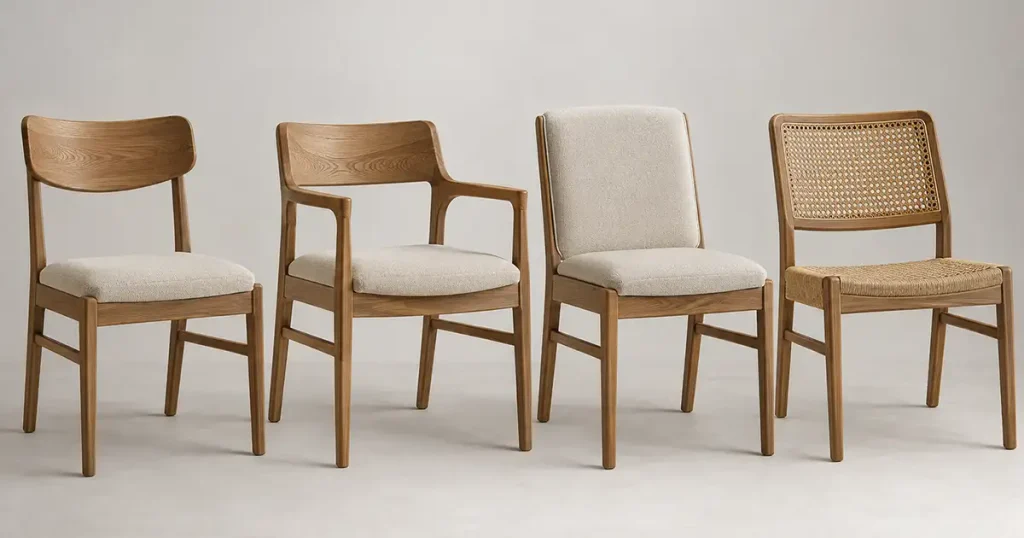
A dining chair collection does not need several chairs that look almost identical. It does need enough shared design language that buyers and end customers can see the models belong to the same family.
You can keep proportion, visual weight, material family, finish direction, or selected detailing consistent while changing arms, upholstery, woven panels, or seat treatment. Retailers planning a wider range can also review Indonesian Indoor Furniture Manufacturers to see how dining seating fits a broader indoor program.
In one MPP development, the wood finish and woven color looked suitable separately, but the wood appeared warmer once both were placed together on the chair. We adjusted the finish reference before sample approval.
SKU Complexity Changes the Economics of the Collection
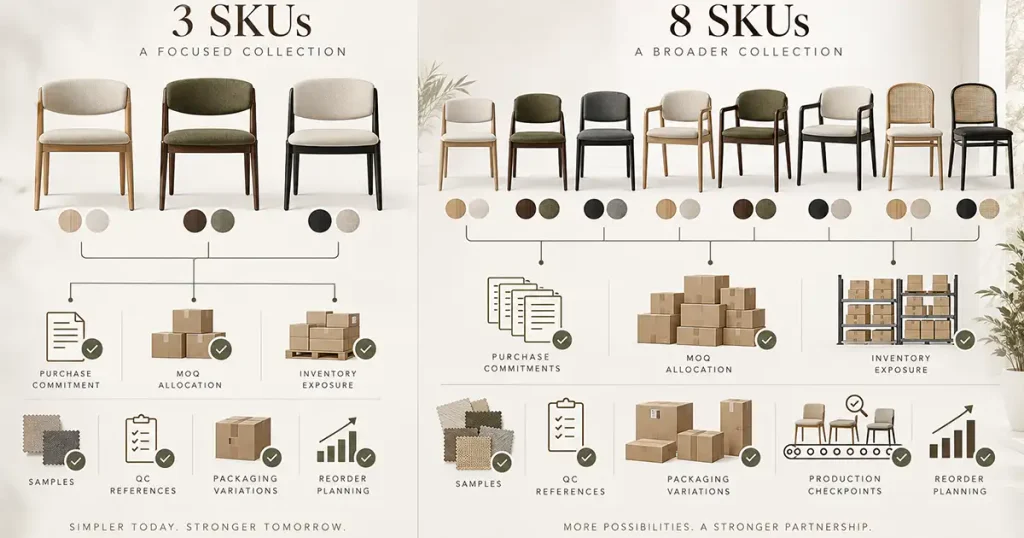
Every additional SKU changes more than the catalog. It can add another MOQ commitment, sample, technical reference, QC checkpoint, carton, forecast, and quantity that has to earn its place in inventory.
For your SKU planning, look at the full buying commitment rather than the design alone. If a new model needs its own material, finish, packaging, and production setup, its commercial reason should be stronger than a variation that reuses proven decisions.
A scalable dining chair collection should give buyers enough assortment choice without creating more stock and production complexity than the business can support. So SKU planning should answer one question early: what commercial job does this SKU perform that the current assortment cannot?
Shared Standards Protect the Product Promise Across Orders
Private label furniture becomes easier to manage when related SKUs share rules for material direction, construction, finish family, branding, labeling, and approvals. Dimensions, upholstery, or woven details can still change when the variation serves a clear purpose.
For custom dining chairs, shared standards reduce the need to reinterpret the product each time a new model or order is discussed. MPP's guide to custom dining chairs and private-label collection development covers approved samples, drawings, materials, finish references, packaging, and revision status.
We worked with a European retailer that had recurring joinery failures and wood cracking with a previous supplier. Our review found that moisture control, joinery tolerance, and wood movement had to be addressed together, and the revised approach stopped the recurring complaints reported in that case.
Repeat-Order Readiness Supports Better Replenishment Planning
A first order proves that a product can be made once. A stronger collection is one where approved dimensions, materials, finishes, labeling, packaging, and revision status can be reproduced when repeat orders are placed.
You should think about replenishment before stock becomes low. MPP's guide on order timing for furniture from Indonesia explains why repeat products can move toward production more directly once the PO and specifications are confirmed.
From our manufacturing experience, repeat production has sometimes been completed around seven days faster than the first run because the team already understood the difficult parts and production sequence. This is not a fixed timeline, but it shows why stable references can make repeat orders easier to plan.
Scalability Creates Room for Commercially Justified Expansion
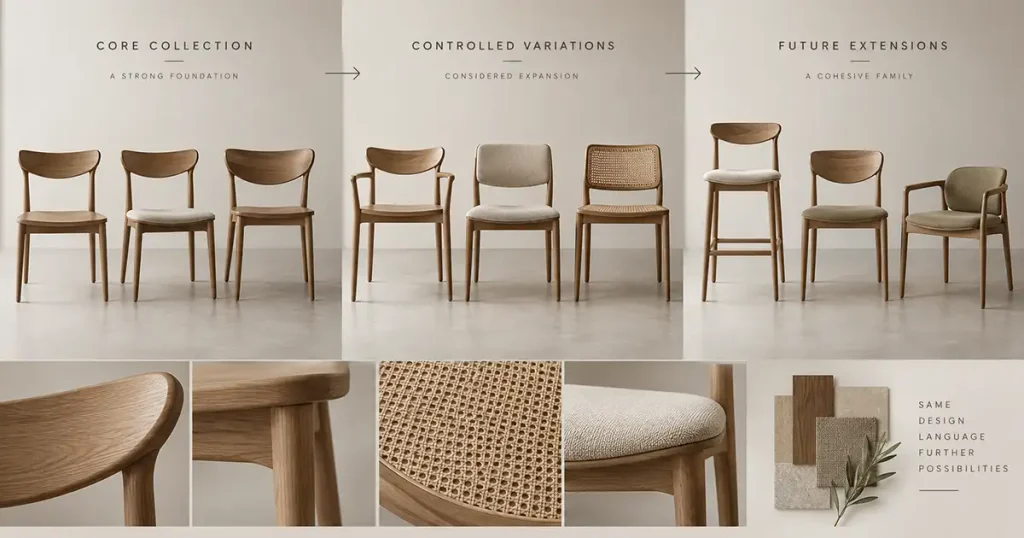
A new dining chair SKU should be added because the assortment needs it, not because the factory can make another design. Ask whether it serves a new customer, price point, function, material direction, or merchandising gap.
Then compare that opportunity with its MOQ, stock depth, sampling, QC, packaging, and purchasing attention. If demand is unclear, holding the idea until the current range provides stronger sales data or buyer feedback can be the better choice.
In one MPP project with a Swedish retailer, the process moved from controlled samples to 38 pieces across multiple collections without recurring defects in the reported case. This shows why buyers should expand after initial references and production controls have been proven.
The manufacturer also has to support growth across several products. MPP's article on dining room furniture manufacturer collection capability explains why materials, finishes, approvals, schedules, QC, packaging, and shipment need to stay controlled as the range grows.
Final Decision: Is the Collection Ready to Support Long-Term Growth?
A dining chair collection is more prepared for growth when every SKU has a clear role, the models share a family language, stock exposure is understood, and approved standards can be repeated. Expansion should follow a real assortment gap and a production system that can support the extra work.
For private label furniture buyers sourcing from Indonesian Furniture Manufacturers, the factory question should go beyond whether one chair can be made. Ask whether the manufacturer can reproduce approved decisions across repeat orders while supporting controlled development of new products.
In short, scalability means controlled expansion. The aim is not to build the biggest range, but to create a collection that can be reordered, adjusted, and expanded without losing commercial logic or product identity.
Discuss the Commercial Direction of Your Dining Chair Collection
If you are planning custom dining chairs or private label dining chairs, share your target market, retail position, proposed core SKUs, quantities, finish direction, and expected reorder pattern with MPP Furniture. We can review the collection through consultation, product development, in-house production, and QC.
FAQ: Scalable Private-Label Dining Chair Collections
1. Why does scalability matter for a retail dining chair collection?
Every added SKU creates more stock, purchasing, production, and replenishment work. Scalability gives retailers room to grow while keeping each SKU commercially justified and repeatable.
2. How does MOQ per SKU affect dining chair assortment planning?
MOQ sets the buying commitment for each model. A new SKU should justify that commitment through a clear customer, price, function, or assortment role.
3. What should remain consistent across a private-label dining chair collection?
Related chairs should share a recognizable design direction, material logic, finish family, approval method, and brand standards.
4. When should a retailer add another dining chair SKU?
Add it when it fills a real assortment gap and expected demand supports the extra MOQ, stock, development, and production work.
5. What should a furniture manufacturer prove before a retailer expands the collection?
The manufacturer should show that approved specifications can be repeated across several SKUs. Buyers should review material consistency, finish control, revisions, QC, packaging, and production planning.

A versatile content creator with a strong foundation in product photography and videography, and a comprehensive brand strategy. Capable of creating engaging content to connect consumers and producers, web analytics, and engaging visual content to drive interest and growth for a product or brand.

0 Comments