An approved sample can look right and still leave one major question unanswered: can the same chair be reproduced across dozens or hundreds of units? For retail buyers, small differences in frame geometry, rattan attachment, weaving, comfort, or finish become easier to notice when several chairs sit side by side.
This guide will help you judge whether wood and rattan dining chairs are ready to move from sample approval into bulk production. You will learn what to inspect, why it matters, and when a difference should be corrected before the full run continues.
We will review the approved sample, wooden frame, rattan attachment, weaving, comfort, natural variation, early production units, and production documentation. By the end, you should be able to decide: Production Ready, Correction Required, or Not Ready for Bulk Production.
Start With the Approved Sample as the Production Benchmark
The final approved sample should become the physical production reference. You should lock the dimensions, frame shape, wood species, finish reference, rattan material, weave pattern, attachment details, and agreed comfort level, then record any later revision.
In our product development work, we use the approved sample as a working reference for construction, dimensions, finish, woven details, and workmanship. If material selection is not final yet, review How to Choose the Right Solid Wood and Rattan Combination for Indoor Dining Chairs before moving into production.
When you work with an Indonesian Furniture Manufacturer, the useful question after approval is no longer only “Can you make it?” but “Can you repeat it consistently?”
Check the Wooden Frame Geometry and Stability
Retail buyers should inspect the finished frame as a complete structure. Check leg positions and angles, seat-frame alignment, backrest geometry, symmetry, joint locations, seat height, overall silhouette, and whether the chair rocks on a flat surface.
In our production, we have seen CNC-machined components follow the approved profile but change slightly after sanding or fitting. Because of this, we check the chair shape again after assembly instead of relying only on component measurements; the related method is explained in How to Keep Curved Sungkai Dining Chairs Consistent in Bulk Production.
ISO 7173:2023 can support strength and durability testing for seating, but it does not replace factory checks for geometry, appearance, or workmanship.
Inspect How the Rattan Is Attached to the Wooden Frame
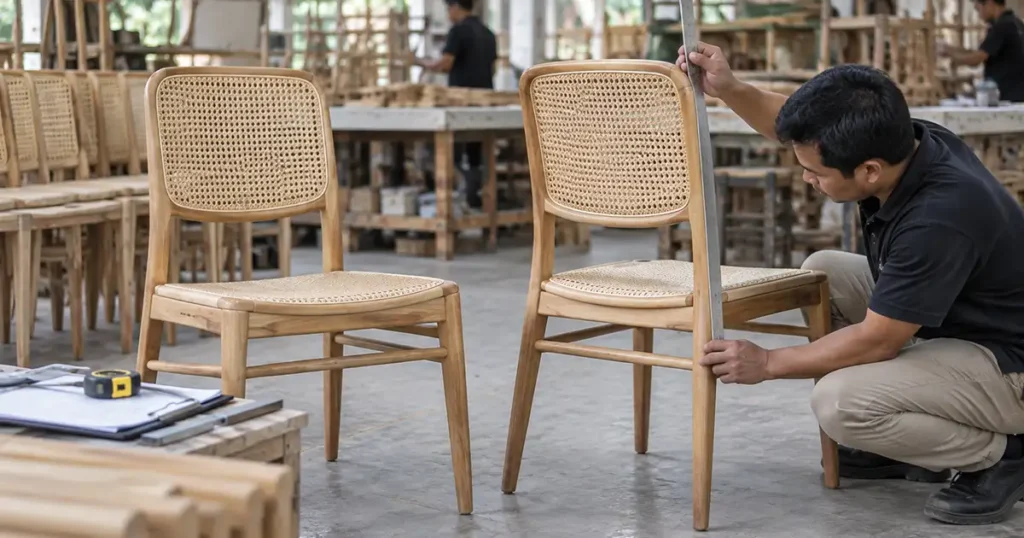
The attachment area deserves close attention because this is where wood and woven rattan become one construction system. Compare attachment positions with the approved sample and check for uneven gaps, loose sections, uneven edges, or positions that shift between units.
You should also check how the woven section sits inside or against the frame because a small attachment change can affect tension and visual balance. Buyers developing related indoor products can review the Indonesian Indoor Furniture Manufacturer category for broader collection context.
Check Weaving Tension, Spacing, and Pattern Consistency
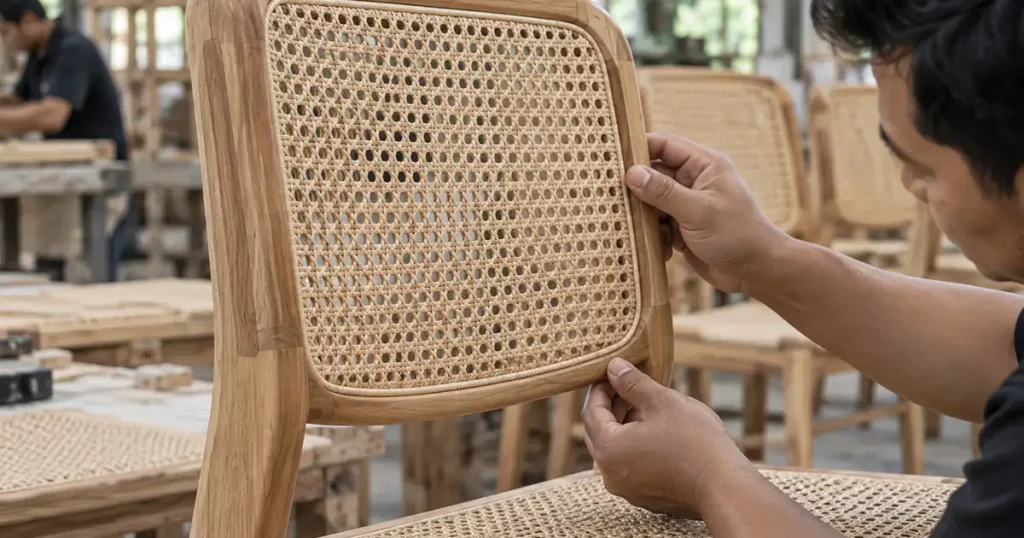
Handwoven rattan should not be expected to look mathematically identical across every chair. The production target is controlled workmanship that stays within the approved visual and functional reference.
Inspect tension, spacing between strands, pattern alignment, strand appearance, and the start and end points of the weave. If several rattan dining chairs show the same loose area, spacing change, or pattern shift, the issue is no longer just normal handwork variation.
Evaluate Seat and Backrest Support, Not Just Appearance
A chair can look close to the approved sample but feel different when someone sits on it. Buyers should recheck seat height, seat depth, backrest angle, woven tension, and support during early production.
Small changes in geometry combined with tighter or looser weaving can change comfort even when the chair still looks acceptable. For indoor dining chairs, the production unit should repeat the approved sitting experience as well as the approved shape.
Define Acceptable Variation in Wood Finish and Rattan Appearance
Natural wood and rattan will vary, so buyers should agree on an acceptable range for wood tone, grain, rattan tone, weave appearance, and chair-to-chair contrast before the main batch moves forward.
In one MPP product development, the wood finish and woven color looked suitable separately, but the wood appeared warmer once both were combined on the actual chair. We adjusted the finish reference before sample approval, which is why we review the pair as one finished composition.
Once approved, use that combination as the visual acceptance reference rather than reopening material selection during production. For deeper guidance, see How to Match Wood Finish and Rattan Tone for a Cohesive Indoor Dining Chair Collection.
Check Early Production Units Before the Full Batch Continues
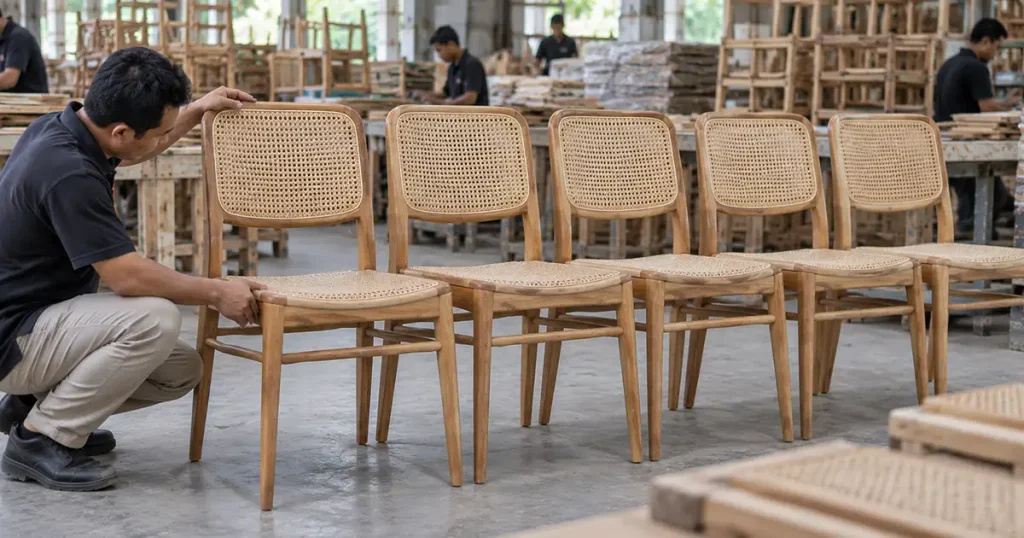
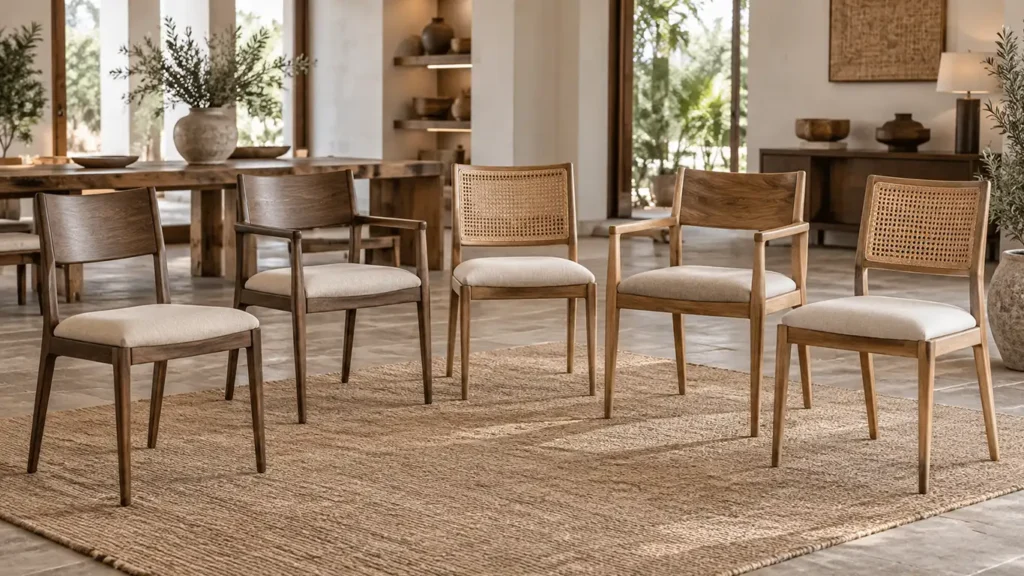
One good early production chair does not prove repeatability. Compare several units with the approved sample for silhouette, seat height, backrest angle, leg position, joint placement, rattan attachment, weaving, finish, and overall balance.
In our production checks, we compare several early chairs side by side because differences in profile, seat height, joint position, or silhouette are easier to spot this way than on one chair alone.
Correct Repeated Differences Early
A single unusual chair may be one workmanship issue, but the same difference across several units can point to a production pattern. Correct repeated changes in weave spacing, attachment position, joint location, finish range, seat height, or frame angle before they spread through the order.
Why Custom Wood Furniture Quality Drops After the First Batch explains how undocumented standards and production changes can create differences when volume increases, so early correction can reduce rework later.
Turn the Approved Sample Into a Clear QC and Production Specification
The approved sample becomes more useful when its important details are written into a production and QC specification. Record dimensions, geometry reference points, wood species, finish, rattan material, weave pattern, spacing expectations, attachment details, comfort reference, accepted natural variation, inspection points, and approved revisions.
The physical sample shows what the chair should look and feel like, while the written specification tells the production team what must stay controlled. It also gives buyers a clearer reference for future repeat orders.
Final Decision: Is the Chair Ready for Bulk Production?
A chair is Production Ready when several early units follow the approved construction, geometry, attachment, weaving, comfort, finish, and accepted natural variation. It is Correction Required when the design is acceptable but a repeated deviation still needs to be fixed.
It is Not Ready for Bulk Production when important construction, comfort, or visual requirements cannot yet be repeated across several units. Continuing at that point may only multiply the same problem across a larger order.
A good approved sample proves the chair can be made once. Production readiness means the manufacturer can reproduce its construction, comfort, and visual standard consistently across the order.
Planning a Wood and Rattan Dining Chair for Bulk Production?
If you already have a chair concept, drawing, approved sample, or collection direction, MPP Furniture can help review the construction, sample reference, and production requirements before bulk manufacturing begins. We support retailers, importers, wholesalers, and private-label brands with free consultation, free product development, custom design support, in-house production, and quality control at each stage, while you remain in control of the final approval.
FAQ: Wood and Rattan Dining Chair Construction
1. Is an approved sample enough before starting bulk production?
No. Buyers should inspect several early production units against the approved sample before the full batch continues.
2. What should buyers inspect in wood and rattan dining chair construction?
Check frame geometry, stability, rattan attachment, weaving tension and spacing, seat and backrest support, finish range, and chair-to-chair consistency.
3. How can buyers check whether rattan weaving is consistent?
Compare several units with the approved sample. Look at tension, spacing, pattern alignment, edge treatment, and the overall woven appearance.
4. How much natural variation is acceptable?
There is no universal visual range because wood and rattan are natural materials. Buyer and manufacturer should agree on an acceptable range before production begins.
5. What makes a wood and rattan dining chair ready for bulk production?
It is ready when the manufacturer can repeat the approved construction, comfort, attachment, weaving, appearance, and agreed natural variation across several early production units.

A versatile content creator with a strong foundation in product photography and videography, and a comprehensive brand strategy. Capable of creating engaging content to connect consumers and producers, web analytics, and engaging visual content to drive interest and growth for a product or brand.

0 Comments