Curved Sungkai dining chairs can look simple in a showroom, but they are harder to repeat in bulk than chairs built mostly from straight parts. A small change in a backrest curve, rear-leg profile, or seat-frame shape may seem minor on one chair, but it becomes easy to notice when many chairs are placed side by side.
For buyers, the goal is not just to approve a good sample. Working with an Indonesian furniture supplier that understands controlled machining, assembly, sanding, and inspection can help maintain the approved chair geometry when the design moves into bulk production.
This article explains where curved geometry usually appears, why Sungkai needs controlled production, how CNC supPhotorealistic close-up of CNC woodworking production in an Indonesian furniture factory. A CNC machine is machining a curved Sungkai wood dining chair component, such as a rear leg or curved backrest part. Show the shaped wooden component securely positioned during machining, with realistic sawdust, tooling, light-colored Sungkai wood grain, and other matching chair components nearby. The visual should explain controlled machining and repeat production, not futuristic automation. Skilled furniture production environment, documentary photography, horizontal composition, realistic proportions, no text, no brand logos.ports repeatability, and what buyers should review before approving bulk production. The focus is practical: CNC is useful, but it is one part of the production system, not a guarantee by itself.
Why Curved Dining Chair Components Are Difficult to Repeat
Straight components are easier to compare because length, width, thickness, and angle can be checked from simple reference points. Curved parts add more variables, such as radius, contour, transition points, and how one shaped part meets another.
The challenge becomes greater in bulk production because small differences repeat across the order. A rear leg can be only slightly different from the approved profile, but several chairs with that same difference can make a dining set look uneven.
Curved-chair consistency is also an assembly issue, not only a machining issue. A curved component can be correct by itself but still produce a different chair silhouette if joint positions, spacing, or assembly angles change.
Where Curved Components Commonly Appear on Dining Chairs
Curved Backrests and Rear Legs
Curved backrests and rear legs often define the visual identity of a dining chair. When these parts are not repeated closely, differences can show in the back angle, side profile, or the relationship between the left and right sides.
This becomes easier to notice when several seating pieces are displayed together. MPP's related article on Sungkai wood and leather counter stools also shows why uneven leg angles, frame geometry, or sanding become more visible across multiple units.
Curved Seat Frames and Armrests
Seat frames, side rails, and armrests can also include shaped geometry. These components may need to follow the approved curve while still meeting joints, upholstery lines, and neighboring parts in the correct position.
The buyer should look at the whole chair, not only the individual component. A curved armrest may match the drawing, but the final chair can still feel inconsistent if the front and rear connection points are not repeated in the same way.
Why Curved Sungkai Components Need Controlled Production
Sungkai is workable and suitable for many indoor furniture programs, but it is still a natural material. Material condition, moisture level, grain direction, and component preparation can affect how a part behaves before and after machining.
This is why controlled production begins before the wood reaches the CNC machine. MPP's article on Sungkai wood furniture for price-sensitive retail markets also explains that drying, machining, joint design, sanding, finishing, and quality checks all influence production consistency.
CNC can follow a programmed cutting path, but it cannot correct poor material preparation by itself. For curved Sungkai parts, the production team still needs clear references for dimensions, machining allowance, and the final approved profile.
How CNC Improves Curve Repeatability in Bulk Production
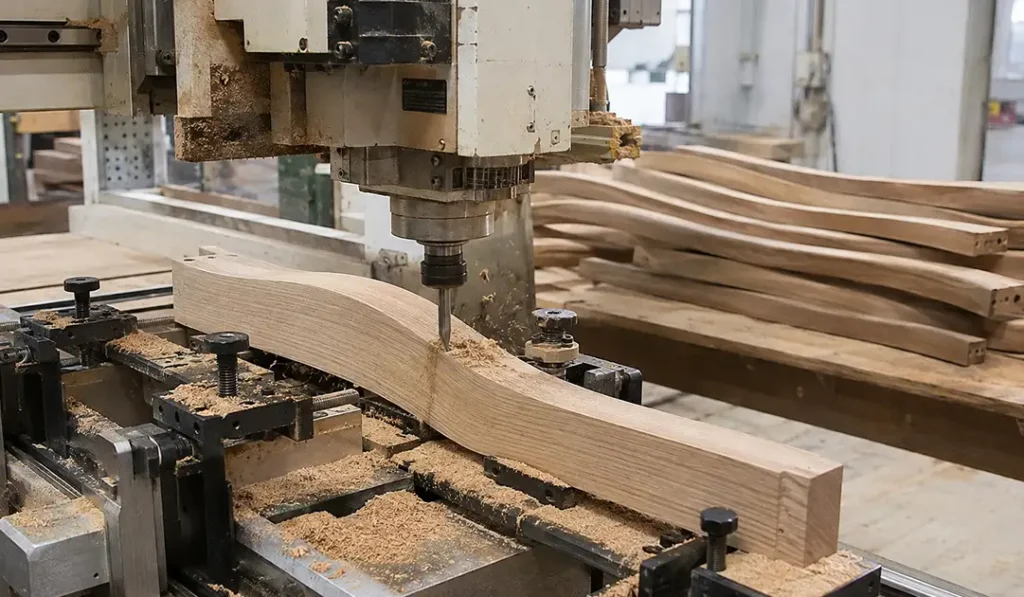
CNC helps the factory reproduce the same programmed geometry across multiple components. This is useful for shaped chair parts because the machine can follow a defined cutting path instead of depending only on manual shaping from one piece to the next.
The SCM reference on CNC machining centers for chair and desk components describes these systems as being designed for complex-shaped elements in curved or solid wood, with accuracy and stable machining as part of their production purpose.
In practice, the process may follow this logic: approved drawing or master sample, machining program, test component, comparison, production run, and dimensional inspection. This gives the factory a repeatable production reference when the same dining chair design needs to be made in larger quantities or reordered later.
Why CNC Alone Does Not Guarantee a Consistent Dining Chair
A CNC machine can reproduce component geometry, but the finished chair still depends on what happens before and after machining. Tool condition, component positioning, fixtures, joint preparation, sanding, assembly pressure, and inspection can all affect the final result.
In MPP Furniture's production, one of the most common challenges is small profile changes after sanding and fitting. A CNC-machined component may already follow the approved shape, but excessive sanding in one area or a slight change in joint position during fitting can make finished chairs look different from one another.
Because of this, MPP does not only compare components after machining. The team also checks the shape again after sanding and assembly, when small production differences are more likely to affect the final chair profile.
What Furniture Buyers Should Check Before Approving Bulk Production
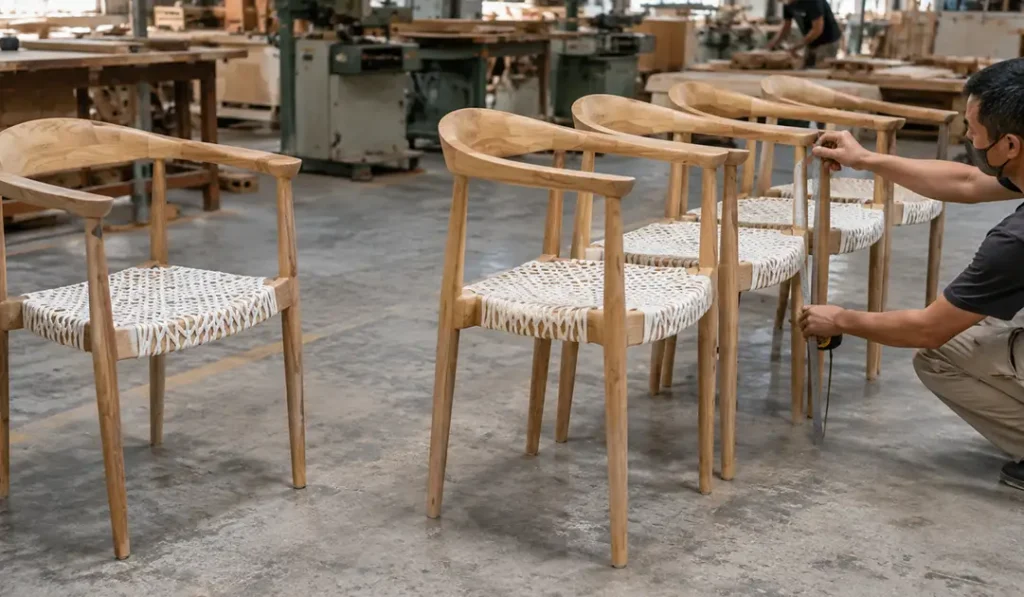
Start with one agreed production reference. The approved technical drawing, dimensions, curve details, and master sample should all point to the same final version before bulk work begins.
MPP's guide on how to create a technical brief for a custom furniture manufacturer recommends defining dimensions, materials, functional details, and approved revisions before production. This gives both buyer and manufacturer one clear reference for sampling and later comparison.
In MPP Furniture's production, consistency is not judged from one finished chair. Several early-production units are compared side by side with the approved sample to review the backrest profile, rear-leg angle, seat height, joint position, and overall silhouette.
If a visible difference appears or a measurement falls outside the approved reference, the production team makes corrections before the larger run continues. This helps catch repeated variation early instead of discovering it after a larger quantity has already been completed.
Why Controlled CNC Production Matters When Sourcing Curved Dining Chairs from MPP Furniture
For buyers sourcing custom dining room furniture, the real question is not only whether a supplier can make one curved chair. The better question is whether the supplier has a production method that can repeat the approved geometry across the order.
MPP combines controlled machining with skilled handwork in fitting, sanding, assembly, finishing, and final inspection. This approach supports custom Indonesian dining room furniture programs where buyers need design flexibility, careful detailing, and repeat production.
MPP can review drawings, develop samples, and discuss a suitable production route for curved Sungkai dining chairs before bulk production starts. For buyers, this changes the sourcing conversation from “Can you make it?” to “How will you repeat it?”
What Buyers Should Remember About Curved Sungkai Dining Chair Production
Curved Sungkai dining chairs need more production control than straight-frame designs because the factory must repeat profiles, radii, dimensions, and component relationships across many units. CNC helps with that repeatability, but consistent results still depend on material preparation, setup, assembly, sanding, and inspection.
For furniture buyers, the most useful question is simple: how will the approved sample be reproduced across the full order? The answer should describe the production process, not just the machine.
Planning a Curved Sungkai Dining Chair for Bulk Production?
If you are developing a curved Sungkai dining chair, share your drawing, reference image, dimensions, expected order quantity, and target market with MPP Furniture. Our team can review the design, discuss the production method, and support sample development before you commit to bulk production.
MPP also provides free consultation and new product development for custom and private-label furniture programs. The aim is to identify production requirements early, so both sides have the same reference before manufacturing begins.
FAQ: About Curved Sungkai Dining Chair Production
1. Can CNC make every curved dining chair exactly identical?
No. CNC can repeat programmed component geometry, but wood condition, sanding, joint preparation, assembly, and other production steps can still affect the finished chair.
2. Which dining chair components can be produced with CNC?
Depending on the design, CNC can be used for shaped backrests, rear legs, seat-frame components, armrests, rails, and other parts with defined geometry. The production method should be selected based on the component design rather than assuming every curved part needs CNC.
3. Why are curved chair components harder to produce in bulk?
Curved components require the factory to repeat profiles, radii, dimensions, transition points, and connection positions across many pieces. A small difference can become much more visible when several finished chairs are placed together.
4. Is an approved dining chair sample enough for bulk production?
No. An approved sample defines the target, but drawings, production references, machining controls, assembly checks, and inspection standards are also needed to reproduce that result across a bulk order.
5. What should buyers ask a curved dining chair manufacturer?
Ask how the factory records approved geometry, produces the curved components, controls assembly, checks early production pieces, and compares finished chairs with the approved sample. These questions show more about repeat-production capability than simply asking whether the factory owns a CNC machine.
A versatile content creator with a strong foundation in product photography and videography, and a comprehensive brand strategy. Capable of creating engaging content to connect consumers and producers, web analytics, and engaging visual content to drive interest and growth for a product or brand.
0 Comments