When your solid mahogany headboard sample has been approved, the next question is whether the manufacturer can reproduce that approved headboard consistently when production moves into a bulk order.
Without checking this first, differences in dimensions, finish, workmanship, or packing can start appearing after production volume increases. What looked right in one approved sample may not always stay the same across dozens or hundreds of units.
That is why, before placing or releasing a bulk order, retailers should review five areas that show whether an Indonesian mahogany furniture manufacturer is ready to reproduce the approved headboard consistently at production scale.
1. Confirm the Final Production Reference Before Release
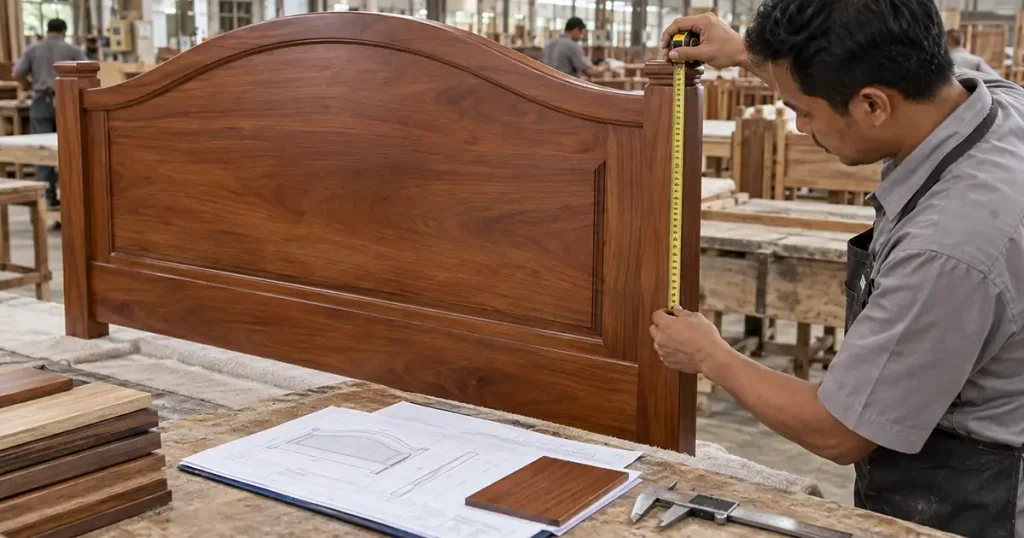
Once the sample is approved, the first check is simple: are the buyer, production team, and QC team working from the same final version?
At MPP Furniture, the approved product is supported by both physical and recorded references. This gives the production and quality teams a clear basis for checking dimensions, product appearance, and the agreed finish direction during manufacturing.
For retailers, the important question is not how the factory stores every record. It is whether the manufacturer is working from one agreed production version that reflects the approved sample, final dimensions, latest revisions, finish direction, mounting details, and other agreed requirements.
This matters because an approved sample can still be followed by confusion if an earlier drawing, specification, or finish reference remains in circulation. Before production moves forward, retailers should confirm that the version being manufactured is the version they actually approved.
If your headboard is still going through product development, sampling, or approval, see the guide to developing and approving a solid mahogany headboard.
2. Separate Fixed Specifications From Natural Mahogany Variation
Solid mahogany is a natural material, so consistency does not mean every headboard should look identical.
Some details should stay within the agreed specification. These include overall dimensions, proportions, construction details, mounting positions, alignment, hardware, workmanship standard, and the approved finish direction.
Other details can vary naturally. Grain pattern, wood figure, and undertone can change from board to board because no two pieces of wood are exactly the same.
In practice, MPP Furniture applies around a 10% color or tone tolerance for solid-finish products. Rustic products may allow a wider range because more natural variation is intentionally part of the approved look. This is MPP’s production practice, not a universal industry rule, so the acceptable range should still be agreed between the buyer and manufacturer for each product.
For a closer look at this topic, see the guide to mahogany color consistency across bulk orders.
3. Match Each Requirement With the Right Verification Method
A production standard is more useful when the buyer also knows how each requirement will be checked. Not every requirement should be judged in the same way.
Measure Objective Specifications
Dimensions, mounting positions, attachment points, alignment, and relevant construction dimensions can usually be checked against a drawing or product specification.
This is where simple measurements remove guesswork. If an agreed mounting point is in the wrong position, visual opinion should not decide whether it passes.
Use Visual References for Appearance and Workmanship
Finish direction, surface appearance, symmetry, profiling, and visible workmanship are different. They often need comparison with an approved physical sample, finish reference, or approved visual reference.
At MPP, profiling, meaning the overall look and form of the headboard, is also reviewed. A product can contain correct individual measurements yet still look wrong as a whole if the proportion or visual balance shifts.
MPP also checks glue strength as a separate construction concern. That matters because a glued area can look clean from the outside while its strength cannot be judged from appearance alone.
Use Product Testing When the Buyer Program Requires It
Some retail programs, contracts, or destination requirements may call for structural, performance, flammability, or other furniture testing. Intertek’s furniture guidance covers structural performance and product-quality evaluation, showing why testing should follow the product and buyer program rather than one generic rule.
The practical point is simple: measure what can be measured, compare what must be judged visually, and use formal testing when the program calls for it.
4. Check Whether the Standard Is Holding Across Actual Production
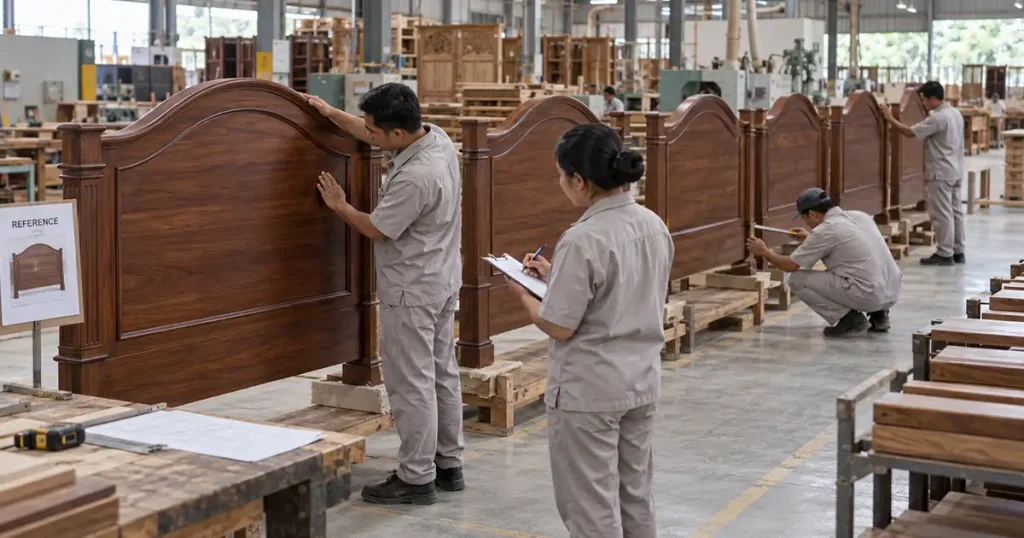
An approved sample proves that one headboard can meet the agreed direction. Actual production shows whether that direction is being repeated.
Retailers should review more than one unit from the production run. MPP’s own trial-order guidance recommends checking several pieces from the same SKU rather than only the best-looking piece because consistency becomes clearer when multiple units are compared.
Compare Multiple Production Units
Use the same approved references across the units you review. Look at dimensions, alignment, visible construction, finish direction, profiling, and workmanship.
The goal is not to hunt for a perfect unit. It is to see whether the controlled parts of the product remain stable as quantity increases.
Watch for Repeated Deviation
A single local defect and a repeated production problem are not the same thing.
For example, one unit with a small workmanship issue may need correction on that unit. But if the same mounting-position difference, alignment problem, finish shift, or workmanship issue appears across several units, the buyer should treat it as a pattern and ask for correction before more units follow the same direction.
This is where looking at several pieces matters more than approving one attractive finished unit.
5. Confirm the Headboard Packing System Before Finished Goods Accumulate
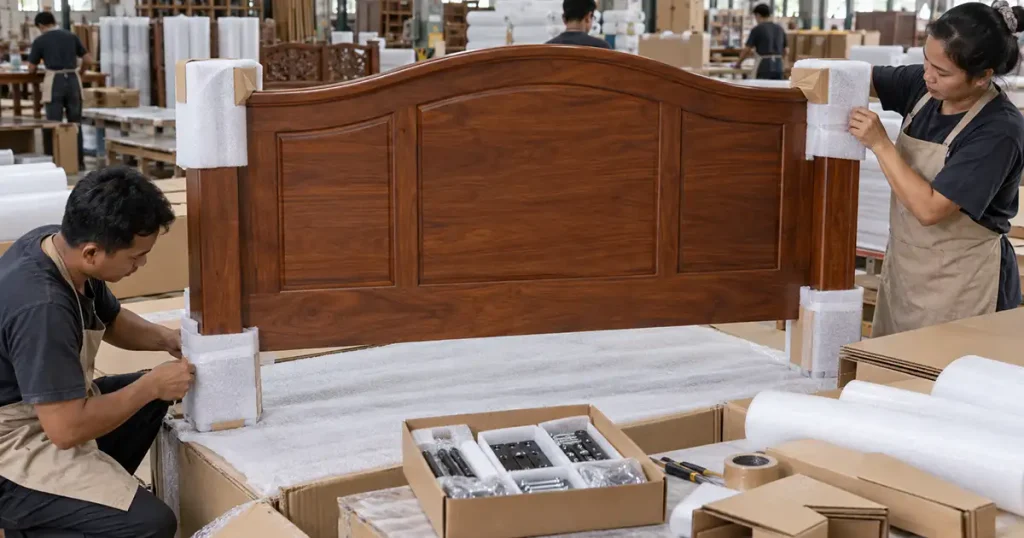
A headboard can leave production in good condition and still arrive damaged if the packing does not match its shape and vulnerable points.
In MPP’s packing experience, the legs of a headboard are one area that needs extra attention because they are more exposed than the broad flat surface. Extra protection is added around vulnerable points rather than treating every part of the headboard the same way.
Retailers should review surface protection, edges and corners, hardware placement, mounting components, detachable parts where applicable, product orientation, carton requirements, and any handling marks required by their distribution program.
Retailers may also have their own packaging rules. Crate & Barrel, for example, publishes separate furniture packaging guidance for vendors, which shows why a supplier should confirm retailer-specific requirements instead of assuming one packing method fits every customer.
When transit validation is required, the test should match the product and distribution plan. ISTA lists Procedure 2C as a partial simulation test for individual packaged furniture products transported in a container.
Final Thoughts: Release Bulk Production When the Standard Can Be Controlled
A good approved sample is the starting point, not the finish line. Before releasing a solid mahogany headboard into bulk production, the retailer should know which final version is being produced, what must remain fixed, what natural variation is acceptable, how each requirement will be checked, whether actual production is holding the standard, and how the product will be packed.
MPP Furniture supports this transition through in-house production, handcrafted work supported by machinery, and production-stage quality checks. MPP also offers free consultation, free product development, custom/OEM support, and exclusive custom design services; the company reports 99% client satisfaction and a 0.56% complaint ratio.
If your Indonesian mahogany headboard is already approved, the next useful discussion is not another design review. It is how that approved direction will be controlled as the order moves into bulk production.
Ready to Move Your Approved Mahogany Headboard Into Bulk Production?
If your solid mahogany headboard sample has already been approved, the next step is to make sure the same product direction can be maintained across the full order. Talk with MPP Furniture about your production requirements, quality expectations, and packing needs before bulk production moves forward.
FAQs About Indonesian Mahogany Headboard Bulk Production
1. What is the difference between sample approval and bulk production release?
Sample approval confirms that the buyer accepts the product design, dimensions, finish, and other agreed details. Bulk production release means the buyer and manufacturer are ready to reproduce that approved direction across the full order using the same production references and checking methods.
2. What should remain consistent across bulk mahogany headboards?
Dimensions, proportions, construction details, mounting positions, alignment, hardware, workmanship standard, and the approved finish direction should remain within the agreed specification. Natural characteristics such as grain, wood figure, and tone can still vary within the accepted range.
3. Does every solid mahogany headboard need to look identical?
No. Solid mahogany naturally varies in grain, figure, and undertone, so identical appearance is not a realistic target. The goal is to keep controlled product details consistent while allowing natural wood variation within the range agreed by the buyer and manufacturer.
4. How many production units should a retailer review?
There is no single number that applies to every order. Retailers should review enough units from actual production to see whether the approved dimensions, appearance, workmanship, and other agreed requirements are being reproduced consistently across the order.
5. When should headboard packing requirements be confirmed?
Packing requirements should be confirmed before a large quantity of finished goods accumulates. This gives the manufacturer time to prepare the right protection for vulnerable areas, hardware, mounting components, and any buyer-specific distribution requirements.

Hi, I’m Salman, founder of MPP Furniture, an Indonesian furniture manufacturer serving global retailers and project-based clients.
I began my career in my family’s export-oriented furniture company, gaining hands-on experience in production, construction, finishing, material performance, and product development. With a clear understanding of how international buyers evaluate furniture quality and reliability, I founded MPP Furniture to deliver export-ready products with consistent standards.
Here, I share insights from the perspective of a furniture manufacturer working directly with production teams on the factory floor, focusing on manufacturing and supplier evaluation.
Connect on LinkedIn


0 Comments