If you have already decided to develop teak indoor dining chairs with leather, choosing the wood and leather is only part of the job. How the leather is applied can change how customers see the chair, how it fits the wider collection, and what your production team needs to control.
This article will help you compare woven and upholstered leather without treating one as automatically better. You will see where each direction fits, what customers may notice, and what should be checked before moving from sample development into bulk production.
We will look at visual identity, comfort perception, retail positioning, SKU role, and production consistency. If you are still deciding why teak and leather belong together in the first place, start with our guide to teak dining room chairs with leather.
Why Woven vs Upholstered Leather Is More Than a Design Choice
Woven and upholstered leather do more than change the surface of a chair. They affect how much teak remains visible, how the seat is perceived, and which part of the product attracts attention first.
They also create different production demands. Woven construction depends heavily on strap tension, spacing, and alignment, while upholstery depends more on padding profile, leather fit, seams, and repeated shape.
For retailers, the better question is not, “Which one looks nicer?” It is, “Which application supports the role this chair needs to play in our collection?”
Woven Leather Dining Chairs: When the Material Becomes Part of the Design
More Visible Teak, Texture, and Craft Character
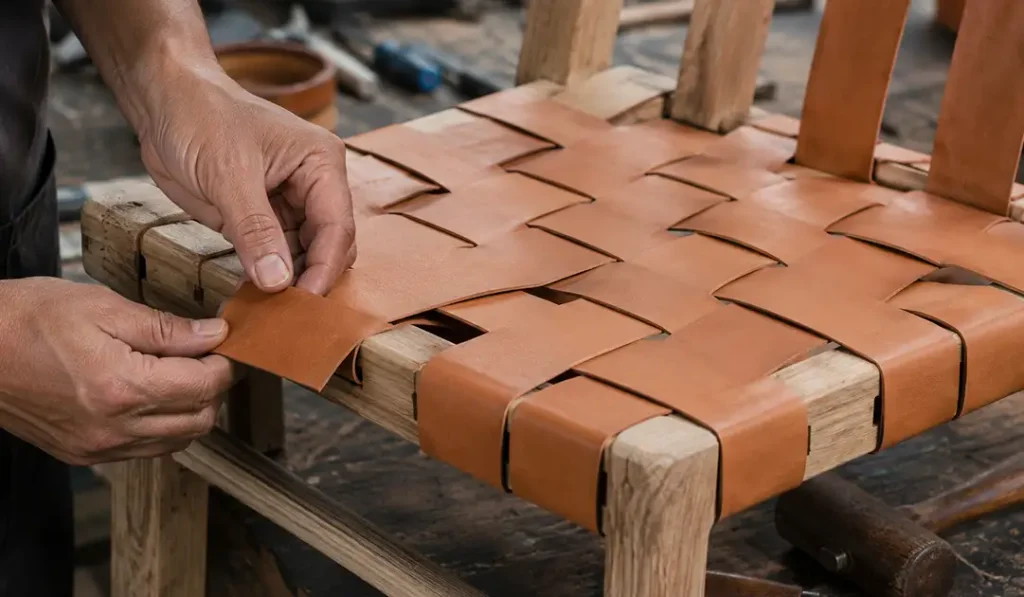
On woven leather dining chairs, the leather is easy to read as a separate material because gaps between the straps keep more of the teak frame exposed. The repeated pattern also adds texture without covering the wood that gives the chair its main material identity.
This makes the weaving itself part of the design. Design Milk's feature on the Smilow woven leather collection shows how leather strips are cut, woven onto finished wooden frames, and secured by hand, which shows how application and appearance are closely connected.
A Stronger Choice for Design-Led Collections
A woven leather chair can make sense when the collection relies on visible natural materials, open construction, or clear wood-and-leather contrast. It can also work well as a more distinctive SKU beside simpler dining tables, benches, or storage pieces.
That does not mean woven leather automatically creates a higher-end product. The detail needs to support the target customer and the wider assortment, rather than being added only because it looks different.
Upholstered Leather Dining Chairs: When Comfort Becomes More Visible
A Softer and More Refined Visual Direction
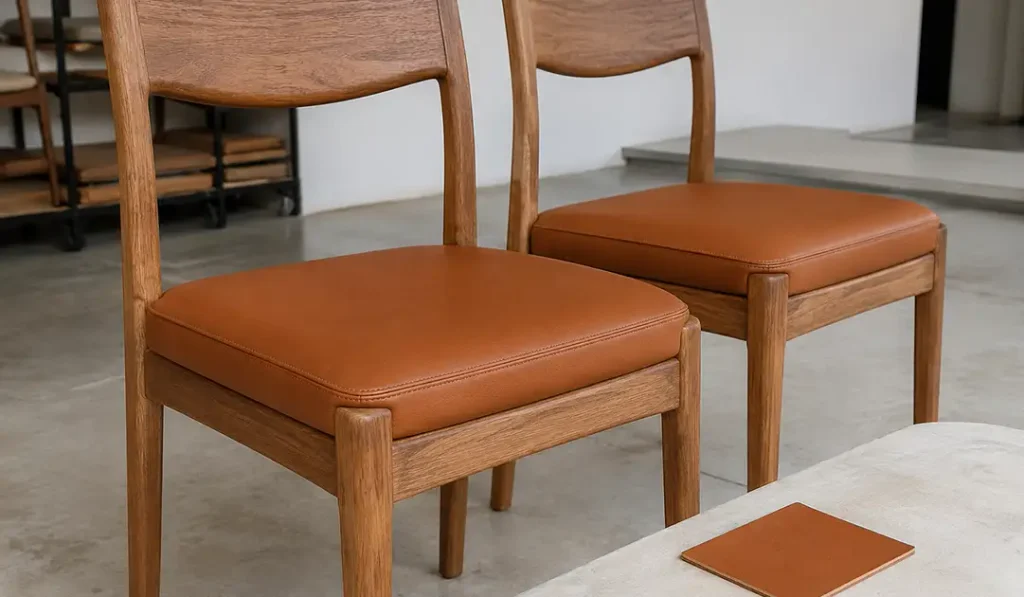
Upholstered leather dining chairs use a larger and more continuous leather surface, so the seat or backrest often carries more visual weight. Padding can also create a fuller profile, which can make the chair feel softer and more refined before the customer even sits down.
Teak still needs a clear visual role. If too much of the frame is hidden, a teak dining chair with leather seat may start to read more like an upholstered chair with wooden parts than a teak-led design.
Stronger Comfort Perception for the End Customer
Upholstery often creates a stronger expectation of softness because the padding is visible. This can fit collections aimed at customers who prefer a fuller seating expression or a more familiar indoor dining-chair look.
But visible padding does not mean universal comfort. Actual comfort also depends on seat depth, back angle, support, padding specification, and how the leather behaves on the finished chair.
How Woven and Upholstered Leather Require Different Production Controls
Choosing the leather application is only half the decision. Retailers also need to know whether the chosen Indonesian furniture supplier can repeat the approved result across bulk production.
Woven Leather Requires Consistent Tension, Spacing, and Alignment
Woven leather needs close control over strap width, spacing, alignment, and tension because small differences become more visible when several chairs are displayed together.
MPP is currently developing a leather dining chair where weaving tension became an important sampling point. If the leather is pulled too tightly, it may place too much stress on the wooden frame, so the weave and frame construction need to be reviewed together.
Upholstery Requires Consistent Padding Profile, Shape, and Finishing
Upholstered leather needs consistency in padding profile, seat shape, leather fit, seams, and finishing. The approved sample should become the production reference before buyers test an Indonesian furniture supplier with a trial order or move into larger bulk production.
Which Leather Application Fits Your Retail Positioning?
The best direction depends on what the chair needs to communicate inside the assortment. A woven application may fit better when exposed teak, texture, and material contrast should stay highly visible, while upholstery may fit better when the collection needs a softer and fuller seating expression.
| Collection Question | Woven Leather May Fit Better When... | Upholstered Leather May Fit Better When... |
| How visible should teak remain? | Exposed wood is central to the design | Leather should have more visual presence |
| What should customers notice? | Material contrast and texture | Softness and seating volume |
| What role does the SKU play? | More design-led or distinctive | More refined or supportive |
| What must production repeat? | Tension, spacing, pattern | Padding, shape, seams |
Retailers can also compare this decision with other approaches to custom wood and leather dining chair development when planning a broader indoor collection.
Woven or Upholstered: There Is No Universal Winner
Woven leather may suit a collection that wants visible teak, texture, and a stronger sense of material interaction. Upholstered leather may suit a range that needs visible softness, larger leather surfaces, and a fuller seating profile.
Both directions can work for teak leather dining chairs. The better option is the one that fits the target customer, SKU role, collection direction, and the factory's ability to reproduce the approved specification across bulk production.
Final Thoughts: Choose the Leather Application Around the Collection
Choosing between woven and upholstered leather should come after defining what the chair needs to do inside the collection. The decision affects visual identity, customer expectations, and the production controls behind the finished product.
For buyers sourcing Indonesian Indoor Furniture, it also helps to work with a manufacturer that can carry the approved sample into repeated production with consistent detailing.
Develop Teak and Leather Dining Chairs for Your Collection
MPP Furniture supports retailers, importers, wholesalers, and private-label brands developing custom teak dining chairs with woven or upholstered leather. From frame details and leather application to sample approval and bulk-production control, our team supports custom design, new product development, in-house production, and quality checks so buyers can move from an initial concept to a production-ready chair specification.
FAQ: About Teak and Leather Dining Chairs
1. Are woven leather dining chairs better than upholstered leather dining chairs?
No. Woven leather puts more attention on texture, exposed teak, and material interaction, while upholstery creates a fuller and softer visual direction.
2. Is woven leather suitable for teak indoor dining chairs?
Yes. Woven leather works well with teak when the design benefits from exposed wood, leather texture, and a lighter visual structure.
3. Are upholstered leather dining chairs more comfortable than woven leather chairs?
Not automatically. Upholstery creates a stronger visual expectation of softness, but comfort also depends on chair geometry, support, padding, and leather specification.
4. What should retailers consider when choosing woven or upholstered leather?
Retailers should compare collection direction, target customer, SKU role, teak visibility, comfort perception, and how consistently the selected application can be reproduced.
5. Can a teak dining chair with a leather seat be customized for retail collections?
Yes. Buyers can customize the frame, finish, leather color, woven pattern, upholstery profile, and private-label specification before approving the final sample for production.
A versatile content creator with a strong foundation in product photography and videography, and a comprehensive brand strategy. Capable of creating engaging content to connect consumers and producers, web analytics, and engaging visual content to drive interest and growth for a product or brand.
0 Comments